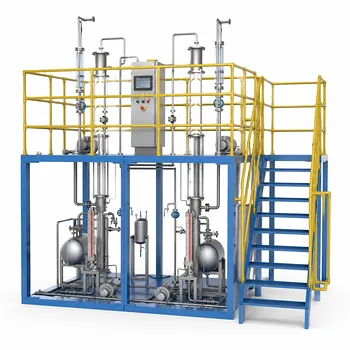
Because without it, you’d be trying to solve 14 or more highly nonlinear equations by hand—for a single data point. In a unit operations lab, you’re dealing with real multicomponent electrolyte mixtures, temperature-sensitive activity coefficients, and fugacity calculations that cannot be decoupled from each other. Computer-aided simulation isn’t a convenience; it’s the only practical way to reconcile your pilot plant measurements with rigorous thermodynamic theory, turning raw data into meaningful learning about phase behavior.
The core problem isn’t the math—it’s that the math is inseparable from the experiment. Multicomponent phase equilibria calculations require solving a dense, interdependent equation system whose parameters shift with temperature in ways that experimental data alone can’t untangle. Simulation bridges this gap by handling the computational load, letting you focus on what matters: comparing model predictions to physical reality and building engineering judgment.
Understanding the Computational Barrier
The surface need is clear: students in a unit operations lab must analyze phase equilibria for real fluid mixtures. But the deep need is to learn how to verify, interpret, and ultimately trust these calculations—without getting lost in arithmetic.
The Equation System Is Too Large for Manual Work
When you run a distillation or absorption column, you aren’t working with binary ideal mixtures. You’re handling multicomponent electrolytes where activity coefficients depend on ionic strength via parameters like Guggenheim or Pitzer models.
These models tie many variables together. A single equilibrium flash calculation can require solving 14 or more simultaneous equations, each containing temperature-dependent terms and non-ideal mixing rules.
Temperature Sensitivity Magnifies the Challenge
Henry’s constants and binary interaction parameters change dramatically with temperature. Semi-theoretical equations used for electrolyte systems are particularly sensitive to these shifts, making even small temperature errors propagate into large deviations in predicted phase splits.
Compounding the problem, experimental data at elevated temperatures is often scarce. Without a computational framework, you can’t reliably extrapolate the few measured points into a full vapor-liquid equilibrium (VLE) map.
Manual Iteration Would Destroy the Learning Objective
Even if you could solve the equations by hand, the sheer number of iterations would consume the entire lab period. You’d spend all your time on arithmetic instead of analyzing why the measured composition differs from the ideal case.
Simulation eliminates this roadblock, allowing you to rapidly run multiple cases, test sensitivity to parameters, and observe how non-idealities affect separation efficiency—the actual goal of the course.
Why Simulation Must Be Paired with the Pilot Plant
Simulation alone doesn’t teach you everything. The supplementary references remind us that model parameters must be validated through physical experimentation.
Dimensional Analysis Reveals Where Models Fail
Pilot plant experiments let you apply dimensional analysis and similarity theory to real processes. You measure actual flow rates, temperatures, and compositions, then compute dimensionless groups like Reynolds or Sherwood numbers.
Comparing these with simulation output highlights discrepancies between simplified mathematical models and complex real-world dynamics. That gap is where deep learning happens—it’s not a bug, it’s the feature.
The Laboratory Teaches You What No Textbook Can
When you operate a real column, you feel the lag in steady-state achievement, see flooding conditions evolve, and experience sensor noise. Engineering intuition grows from these observations.
A simulation may predict a perfect equilibrium stage, but the pilot plant shows you subcooled boiling, tray weeping, and mass transfer limitations. Without the physical experiment, the simulation becomes a black box that can mislead you into overconfidence.
Understanding the Trade-offs
Including a simulation in your lab work is powerful, but it comes with challenges you need to manage.
The Black Box Risk
If you treat the software as a magic oracle, you lose critical thinking. Students can fall into the trap of trusting simulation output without questioning the underlying assumptions—like the choice of activity coefficient model or the purity of input reagents.
The antidote is enforced reconciliation. Always overlay your experimental tie lines on the simulation’s phase envelope and analyze deviations. Ask: “Could this offset be due to an incorrect binary interaction parameter or an undetected azeotrope?”
Parameter Availability Can Limit Accuracy
Electrolyte models require extensive parameter sets. For uncommon ions or high-temperature conditions, the database may lack reliable values, forcing you to use default estimates that degrade simulation fidelity.
In such cases, the simulation becomes a hypothesis generator rather than a definitive answer. You’ll run it to see what the system would look like if the parameters were correct, then use the pilot plant to test that hypothesis.
Over-Reliance on Simulation Can Undermine Experiment Design
When simulation is too easy, there’s a temptation to let it dictate the experiment—adjusting sampling points or temperatures to match the model’s sweet spot. This reverses the proper scientific method, where the model must bow to reality.
Good lab pedagogy keeps the pilot plant as the primary source of truth, with simulation serving as an analysis and prediction tool.
Making the Right Choice for Your Lab Course
The question isn’t whether to use simulation, but how to integrate it so that it strengthens, rather than replaces, physical experimentation.
- If your primary focus is developing thermodynamic intuition: Use simulation to quickly generate phase diagrams under varying temperatures, then have students predict how the real column’s profile should look before they take a single measurement. This forces a hypothesis-first mindset.
- If your primary focus is teaching data reconciliation: Collect pilot plant data first, then use the simulation’s parameter estimation or regression tools to back-calculate the best-fit interaction parameters. Discuss why those values might differ from literature data—this directly addresses the discrepancy gap.
- If your primary focus is exposing students to industrial reality: Emphasize the simulation’s role as a digital twin. Show them how plant operators use such models for troubleshooting and optimization, but equally highlight the routine validation protocols that prevent blind reliance.
- If your primary focus is reinforcing mathematical foundations: Have students write a simplified version of the equilibrium solver (e.g., for a binary system) and compare it to the professional software’s results for a multicomponent case. This makes the scale and complexity leap tangible.
The simulation is not an enemy of lab experience—it’s the lens that brings the hidden complexity of phase equilibria into focus, provided you always keep one eye on the pilot plant and the other on the thermodynamic assumptions.
Summary Table:
| Aspect | Computer-Aided Simulation | Physical Pilot Plant |
|---|---|---|
| Mathematical Complexity | Solves 14+ non-linear equations instantly | Restricted to simplified binary calculations |
| Real-World Dynamics | Idealized models (e.g., NRTL, Pitzer) | Exposes weeping, flooding, and sensor noise |
| Learning Outcome | Fast parameter sensitivity & data regression | Develops engineering intuition & practical skills |
| Parameter Validation | Generates predictive VLE/LLE hypotheses | Provides ground-truth data to validate models |
Bridge Theory and Practice with LABPARK
Are you looking to enhance your chemical engineering, bioprocess, or environmental engineering curriculum? LABPARK provides state-of-the-art Educational and Vocational Unit Operations Pilot Plants designed for universities, research institutes, and enterprises.
- Engage Students: Allow students to validate complex thermodynamic simulations with real-world, high-fidelity physical data.
- Comprehensive Solutions: Covering chemical engineering, bioprocess & biotech, and environmental & water treatment.
- Built to Last: Durable, industrial-grade components adapted for safe educational use.
Ready to upgrade your laboratory's capabilities? Contact LABPARK today to discuss your pilot plant needs!
Related Products
- Binary System Vapor Liquid Equilibrium Data Determination Educational Unit Operations Pilot Plant
- Ternary Liquid-Liquid Equilibrium Educational Pilot Plant
- Multimodal Absorption and Desorption Pilot Plant for Unit Operations Training
- Multi-Reactor Educational Pilot Plant for Reaction Engineering Unit Operations
- Three-Tube Heat Transfer Educational Pilot Plant for Unit Operations Training
People Also Ask
- For VLE Experiments: Fugacity vs. Activity Coefficient Method Selection Criteria
- Why correlate VLE pilot plant data using Wilson, NRTL, and UNIQUAC? Achieve Accurate Column Scale-Up
- How do pilot plants assist in teaching & researching non-ideal VLE? Bridge Theory & Physical Validation
- How to Model VLE for Supercritical & Unstable Components? Pilot Plant Methods
- Why is accurate VLE data critical? Optimize Unit Operations & Process Scale-Up