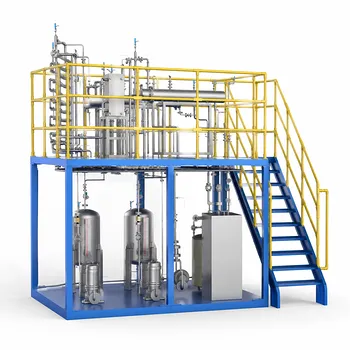
Calibration isn’t a formality—it’s the only way to transform a theoretical flow equation into a trustworthy measurement. In chemical engineering unit operations pilot plants, discharge coefficients (Cd) for devices like orifices, venturi meters, and weirs are not fixed constants. They shift with flow conditions, geometry, and even subtle wear. Without calibration, your flow data is, at best, an educated guess.
The surface need is knowing why calibration matters; the deep need is ensuring your pilot-plant experiments produce physically meaningful mass balances and teach the real-world gap between theory and practice. Calibration is essential because discharge coefficients are sensitive, non-linear functions of the specific system you’re running—they cannot be reliably plucked from a textbook. Only direct, in-situ calibration converts a flow meter’s raw signal into an accurate, defensible number.
The Discharge Coefficient Is Not a Static Property
A coefficient printed in a manual or a textbook is a nominal value, not a promise. In a real pilot plant, the effective Cd is a moving target shaped by multiple variables.
Standard Orifices: A Revealing Example
For a sharp-edged circular orifice, the textbook range is often cited as 0.59 to 0.68. That’s not a single number—it’s a 20% variation window. The actual coefficient inside your rig will decrease as the orifice diameter or the driving pressure head increases. The physical reason is tied to jet contraction and energy dissipation, which theory alone can’t pin down precisely without accounting for the local Reynolds number and edge sharpness.
Why the Venturi Meter Isn’t Immune
A venturi meter enjoys a much tighter range (Cd ≈ 0.97–0.99) because there is no jet contraction—the throat area is fixed, making the coefficient essentially a velocity coefficient. Yet it still drifts. The discharge coefficient is a function of the throat Reynolds number. Over months of operation, surface roughening or thin scale deposits inside the tube can lower Cd by 1–2%. An uncalibrated, fouled venturi can silently corrupt an entire experimental campaign.
The Real-World Vena Contracta Problem
In an orifice meter, the jet does not expand to fill the physical hole. The minimum flow area—the vena contracta—is smaller and variable. As a result, the coefficient of contraction (Cc) dominates Cd. This geometric complexity, combined with frictional head loss that dissipates rotational kinetic energy into heat, means the theoretical incompressible flow equation consistently overestimates the true flow unless calibration corrects for it.
Calibration Bridges the Theory–Reality Gap
Being a skilled engineer means knowing when an ideal equation is lying to you. Calibration is the instrument that uncovers the lie.
Teaching the Deviations No Textbook Predicts
Pilot plants serve as learning ecosystems. When students calibrate an orifice or a broad-crested weir, they see firsthand that flow near critical depth exhibits a wavy, unstable surface and that curvilinear entry flow prevents a true critical section from forming. Boundary friction alone can drop the actual discharge to 90–92.5% of the theoretical value. The calibration process forces them to measure, correct, and understand why—not just copy a coefficient from a handout.
Compressible Fluids Amplify the Error
If your pilot plant meters air or steam, an extra layer of uncertainty appears. The fluid’s specific weight drops between the inlet and the throat. Using the raw incompressible flow equation overestimates the true flow rate, because it assumes constant density. The correction requires an expansion factor (Y) that itself depends on the pressure ratio and the meter’s geometry. Calibrating for compressible flow means you must determine Y empirically for your specific system, or you risk mass balance closures that refuse to add up.
Manufacturing and Aging Create Unit-to-Unit Uniqueness
Even two “identical” pilot plant units with the same flow meter make and model will not behave identically. Minor manufacturing tolerances, slightly different inlet lengths, and component aging produce unique discharge coefficient signatures. Relying on a supplier’s generic calibration curve without verifying it on your own unit introduces a systematic error that propagates through every heat and mass balance you calculate.
Understanding the Trade-Offs and Pitfalls
Calibration is essential, but it’s not without its own demands. Ignoring these trade-offs can lead to as much trouble as skipping calibration entirely.
The Trap of Calibrating at a Single Point
A single-point calibration—say, at one flow rate—gives a false sense of security. Because Cd is a function of Reynolds number and head, a coefficient determined at 20% of full scale may be completely wrong at 80% of full scale. A calibration curve across the full operating range is mandatory for any experiment where flow rate will vary meaningfully.
The Cost of Neglecting Fluid Property Shifts
If your plant runs experiments with changing compositions or temperatures, fluid density and viscosity shift. A discharge coefficient derived for cold water won’t hold for a hot glycol solution. You must either recalibrate for the new conditions or compensate with real-time density and viscosity data—otherwise, your “calibrated” meter is still guessing.
When Over-Calibration Becomes a Distraction
In educational settings, there is a balance. Insisting on exhaustive, multi-variable calibration for every minor flow loop can eat into valuable lab time. The pedagogical goal is to understand the principle, not to chase the fifth decimal place unless the specific research objective demands it. Design your calibration scope around the required measurement uncertainty, not an abstract ideal of perfection.
Making the Right Choice for Your Pilot Plant
Your calibration strategy must align with your primary objective, whether it’s industrial-grade accuracy, student comprehension, or research rigor.
- If your primary focus is education and demonstrating first principles: Calibrate the key meters yourself, at multiple flow rates, in full view of the students. Let them see the raw data deviate from the theory, and have them derive the coefficient curve. The insight is the deliverable, not just the correct number.
- If your primary focus is closing precise mass balances for a research study: Calibrate every critical flow meter in situ using a gravimetric method (corrected for buoyancy and thermal expansion), across the entire expected Reynolds number range. For compressible streams, experimentally determine or validate the expansion factor.
- If your primary focus is scaling up and comparing data across multiple identical pilot units: Establish a careful master calibration on one unit, then verify the others against it. Accept that small between-unit offsets exist and decide whether a calibration transfer approach is justified to minimize systematic bias in your dataset.
Accurate flow measurement isn’t about picking the right textbook coefficient—it’s about having the discipline to verify, correct, and document the real relationship between your meter’s signal and the fluid passing through it.
Summary Table:
| Flow Device | Nominal Cd Range | Causes of Drift & Variance | Calibration Impact |
|---|---|---|---|
| Orifice Meter | 0.59 – 0.68 | Jet contraction, Reynolds number shifts, edge wear | Corrects up to 20% theoretical variance |
| Venturi Meter | 0.97 – 0.99 | Scaling, throat fouling, Reynolds number changes | Corrects 1–2% drift over long-term use |
| Open Weirs | Variable | Boundary friction, unstable surface waves | Adjusts for 8–10% flow reduction from theory |
Maximize Experimental Accuracy with LABPARK
Precise flow calibration starts with reliable, high-quality equipment. LABPARK provides premium Educational and Vocational Unit Operations Pilot Plants in chemical engineering, bioprocess & biotech, and environmental & water treatment designed specifically for universities, research institutes, and enterprises.
Help your students and researchers bridge the gap between theory and real-world practice. Contact us today to find the ideal pilot plant for your lab!
Related Products
- Carbon Dioxide Hydrogen Methanol Synthesis Educational Unit Operations Pilot Plant
- Multi Pump Fluid Transport Process Piping Unit Operations Training Pilot Plant
- Natural Product Extraction Unit Operations Training Pilot Plant
- Multi-Modal Distillation Unit Operations Training Pilot Plant
- Multi-Reactor Educational Pilot Plant for Reaction Engineering Unit Operations
People Also Ask
- How do temp & pressure affect methanol synthesis pilot plants? Optimize equilibrium and catalyst performance.
- Why is a purge system necessary when operating a gas recirculation loop in a methanol synthesis pilot plant? (Guide)
- Why do modern methanol pilot plants operate at lower pressures? Catalyst & Feed Requirements Explained
- What are the operational requirements for catalyst activation? Safe Methanol Pilot Plant Operation
- Why is the chemical plant startup schedule crucial? De-risk scale-up with pilot plants.