The short answer? A two‑dimensional heterogeneous model is preferred because it explicitly resolves the radial temperature and concentration gradients that dominate non‑isothermal pilot‑scale reactors and separately accounts for the mass and heat transfer resistances between the fluid and the solid catalyst. A pseudohomogeneous model assumes the fluid and catalyst are at identical temperatures and concentrations, and it often lumps radial effects into a single averaged coefficient. In a laboratory unit where exothermic or endothermic reactions create sharp radial profiles, that simplification can produce dangerously misleading predictions of conversion, hot‑spot formation, and thermal runaway.
Core Takeaway In non‑isothermal fixed‑bed reactor units, ignoring either the fluid‑solid transport differences or the radial gradients leads to unreliable data. A 2‑D heterogeneous model captures both dimensions of reality—phase‑wise heat/mass transfer and cross‑sectional temperature variation—making it the definitive tool for safe operation, accurate kinetic analysis, and scale‑up.
Why Pseudohomogeneous Models Fall Short in Non‑Isothermal Systems
The Flawed Assumption of Identical Phases
A pseudohomogeneous model begins with the premise that the temperature and concentration of the bulk fluid are exactly the same as those at the catalyst surface.
In symbols: $T = T_s$ and $C = C_s$.
When reactions are fast or heat effects are large, this assumption collapses.
Film resistances and intraparticle diffusion create measurable gaps between the fluid and the solid, and the model fails to capture the true driving forces.
When Transport Resistances Govern the Reaction Rate
In many pilot‑scale catalytic reactors, the observed reaction rate is limited by mass or heat transfer, not by the intrinsic chemical kinetics.
If you treat the reactor as pseudohomogeneous, you will misinterpret a transport‑limited rate as a kinetic constant—extracting apparent kinetics that cannot be scaled up.
Heterogeneous models distinguish the conditions inside the catalyst pellet from the surrounding fluid, preserving the intrinsic kinetic parameters that are essential for reliable reactor design.
The Danger of Unrealistic Hot Spot Predictions
One of the most dangerous flaws of a pseudohomogeneous approach in an exothermic reaction is that it lumps all thermal resistances into a single effective conductivity.
It cannot show how heat is truly distributed between the fluid and the solid phase, often predicting hot spots that are either vastly exaggerated or entirely missed.
For laboratory‑scale units where student and researcher safety is paramount, this inability to accurately locate or quantify temperature extremes is unacceptable.
The Critical Role of Radial Gradients — Why One Dimension Isn’t Enough
Heat Transfer Across the Bed Cross‑Section
In a non‑isothermal tubular reactor, heat is not removed or added only at the wall; radial temperature profiles develop throughout the entire catalyst bed.
A one‑dimensional model averages these profiles, masking the fact that the center of the bed can be hundreds of degrees hotter than the near‑wall region.
A two‑dimensional model uses effective radial thermal conductivity and wall heat transfer coefficients to faithfully map these gradients, giving a realistic picture of where hot spots or cold zones will form.
The Mears Criterion as a Decision Tool
Researchers can use the Mears criterion to decide when a 1‑D model is insufficient.
If the evaluated group value at the predicted hot spot exceeds 0.4, the radially averaged reaction rate deviates from the rate at the wall temperature by more than 5%—at that point, a 2‑D model becomes mandatory.
For many educational oxidation or dehydrogenation experiments run in pilot plants, this threshold is quickly crossed, making 2‑D simulation a requirement for both accuracy and safety.
Capturing Heat Flux Through the Solid Phase
A critical insight gained from heterogeneous, 2‑D simulations is that a significant portion of the radial heat flux—often around 25%—travels through the solid catalyst phase itself.
A pseudohomogeneous model cannot distinguish this solid‑phase conduction from fluid‑phase convection and radiation, leading to a fundamentally incorrect energy balance.
For students and operators, seeing this split is not just a theoretical nuance; it directly informs how they manage reactor temperature profiles and avoid thermal runaway.
The Combined Power of 2‑D and Phase Distinction
How a 2‑D Heterogeneous Model Solves the Puzzle
A two‑dimensional heterogeneous model integrates the best of both worlds:
- It solves separate energy and mass balances for the fluid phase and the solid catalyst phase, accounting for interfacial gradients.
- It tracks axial and radial variations within each phase, capturing the full spatial distribution of temperature and concentration.
This combination yields a simulation that mirrors the physical reality of a pilot‑scale fixed‑bed reactor—where both radial non‑uniformity and fluid‑solid transport limitations coexist.
Extracting Intrinsic Kinetics for Reliable Scale‑Up
The primary goal of many laboratory‑scale units is to generate kinetic data that can be trusted at industrial scale.
When you use a 2‑D heterogeneous model, you properly decouple the intrinsic reaction rate from transport phenomena.
The resulting kinetic parameters are not artifacts of the lab geometry; they become transport‑independent constants that can be confidently plugged into large‑scale reactor models.
Educational Value in Laboratory Units
Chemical engineering curricula use pilot plants to teach transport phenomena in a hands‑on way.
A pseudohomogeneous model erases the very gradients that students need to observe—temperature and concentration differences between fluid and solid, and across the bed’s radius.
Running both a simplified model and the full 2‑D heterogeneous simulation side‑by‑side allows students to diagnose when and why simplifications fail, cementing a deep understanding of reactor engineering.
Understanding the Trade‑offs and Limitations
Computational Intensity and Data Requirements
The fidelity of a 2‑D heterogeneous model comes at a cost.
It requires detailed knowledge of intraparticle and interphase transport properties, effective radial conductivity, and wall heat transfer coefficients that may not be readily available.
The computational effort is also considerably higher, demanding robust numerical methods and longer simulation times—a consideration in an instructional setting with limited resources.
When Simpler Models May Still Suffice
Not every experiment demands a full 2‑D heterogeneous treatment.
For mildly exothermic reactions, small tube diameters, or situations where the radial temperature difference ($\Delta T$) is truly negligible, a 1‑D pseudohomogeneous model can provide acceptable accuracy with far less complexity.
The key is to apply the Mears criterion and a prior assessment of mass transfer limitations before committing to the more elaborate model.
Making the Right Choice for Your Laboratory Reactor
Your decision should match the physical severity of your reaction and the purpose of your experimental run.
- If your primary focus is intrinsic kinetic parameter estimation: Use a 2‑D heterogeneous model to eliminate transport disguises and obtain true, scale‑up‑ready kinetics.
- If your primary focus is safety analysis and hot‑spot identification: A 2‑D heterogeneous model is non‑negotiable—it accurately locates temperature peaks and reveals solid‑phase heat conduction.
- If your primary focus is educational demonstration of transport phenomena: Run both a pseudohomogeneous model and the 2‑D heterogeneous model to let students witness the exact point where simplifications break down.
- If your reaction is mild and your tube diameter is very small: A 1‑D pseudohomogeneous approach may suffice, but always verify with the Mears criterion before finalizing the simulation strategy.
Choosing the right model is not about complexity for its own sake—it’s about ensuring that what you learn in the laboratory unit actually holds true on the plant floor.
Summary Table:
| Feature | Pseudohomogeneous Model | 2-D Heterogeneous Model |
|---|---|---|
| Phase Temperature & Conc. | Assumes fluid & catalyst are identical ($T=T_s, C=C_s$) | Separately accounts for fluid and solid phases |
| Radial Gradients | Lumps or averages radial profiles | Resolves radial temperature and concentration gradients |
| Transport Resistances | Ignores film & intraparticle resistances | Models heat & mass transfer limitations explicitly |
| Hot-Spot Prediction | Often misses or exaggerates hot spots | Accurately locates and quantifies peak temperatures |
| Kinetic Parameter Value | Yields apparent, geometry-dependent kinetics | Extracts intrinsic, transport-independent kinetics |
Bring Industrial-Scale Reality to Your Lab with LABPARK
To safely study complex reactor dynamics like radial temperature gradients and fluid-solid transport resistances, you need reliable physical systems.
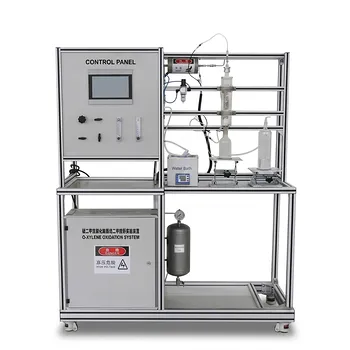
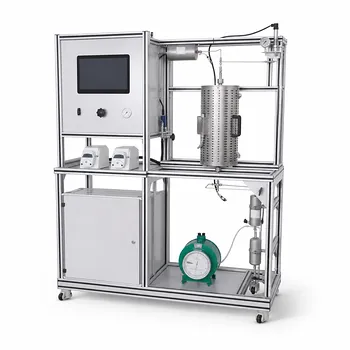
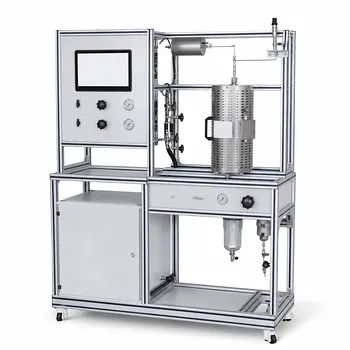
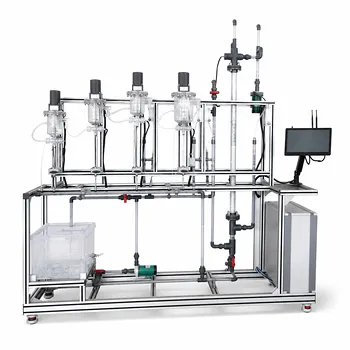
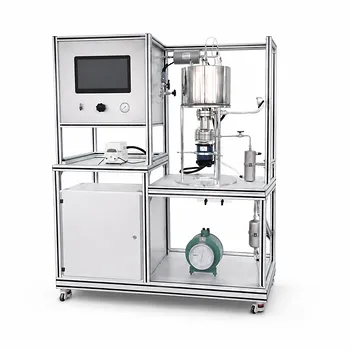
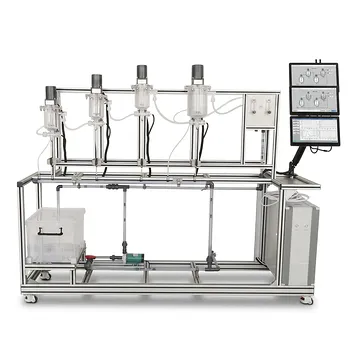
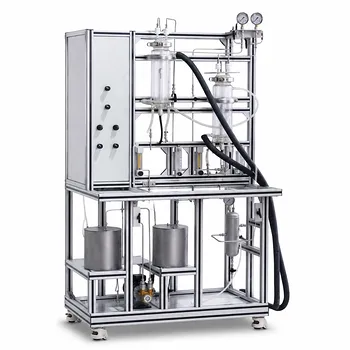
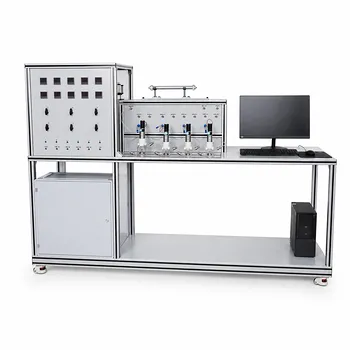
LABPARK provides premium Educational and Vocational Unit Operations Pilot Plants in chemical engineering, bioprocess & biotech, and environmental & water treatment. Designed specifically for universities, research institutes, and enterprises, our pilot plants allow students and researchers to bridge the gap between simulation theory and physical reality.
Ready to elevate your training and research capabilities? Contact LABPARK today to find the perfect pilot plant solution for your facility!
Related Products
- Fixed Bed Gas Solid Catalytic Reaction Educational Pilot Plant
- Multi-Reactor Educational Pilot Plant for Reaction Engineering Unit Operations
- Multi Functional Catalytic Reaction and Reactor Evaluation Educational Unit Operations Pilot Plant
- Fixed-Bed Chemical Reaction and Gas Dust Tar Removal Unit Operations Pilot Plant
- O-Xylene Oxidation to Phthalic Anhydride Educational Unit Operations Pilot Plant
People Also Ask
- How do reactor pilot plants safely study gas-solid reactions? Master kinetics with thermal & flow control.
- How does the Mears criterion evaluate transport resistance? Key Guide to Intrinsic Kinetics
- Fluidized vs. Fixed Bed Reactors: Comparing Heat & Complexity in Pilot Plants
- Why is a multibed configuration necessary for exothermic reactions? Optimize your pilot plant trajectory.
- What are the differences between pseudohomogeneous and heterogeneous models in pilot plants?