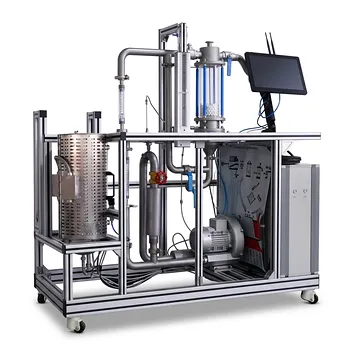
Here’s the fundamental truth: In a liquid level control loop, a proportional-only (P) controller ties its corrective output directly — and permanently — to the current error. When a load disturbance (like an increased discharge flow) hits the pilot plant, the control valve must open wider and stay open wider to maintain a new mass balance. This sustained non-zero output demands a sustained non-zero error, so the level can never return to the original setpoint; that permanent deviation is the steady-state offset.
Proportional-only control cannot drive the error to zero after a load change because it must “pay” for every sustained corrective action with a permanent error. The result is an inherent offset — a gap between the actual level and the setpoint that will not disappear until integral action is added.
The Mechanics of Proportional-Only Control
How a P Controller Responds to a Load Disturbance
Imagine a pilot plant surge tank under level control. The setpoint is 50%, the inlet valve is the manipulated variable, and the discharge is a process demand.
Suddenly, the discharge flow increases. The level begins to fall. The P controller detects the error and, according to the proportionality constant (K_c), opens the inlet valve. As the valve opens, inflow rises to match the higher outflow, and the level stops falling.
But here’s the catch: to keep the valve at its new, larger opening, the controller must keep receiving a non-zero error signal. If the error returned to zero, the valve would snap back to its original position, and the level would plummet. The only stable equilibrium is one where the error is permanently large enough to hold the valve at the new operating point — that is the offset.
Why the Error Can Never Return to Zero
A P controller’s output is (u(t) = K_c \cdot e(t) + u_{bias}).
Before the disturbance, the error was zero and the output was (u_{bias}). After the disturbance, the system needs a new output, say (u_{new} > u_{bias}), to hold the level. Plugging in: (u_{new} = K_c \cdot e_{ss} + u_{bias}). Unless (u_{new} = u_{bias}), the steady-state error (e_{ss}) cannot be zero.
Because a load change in a level loop permanently changes the required control effort (valve position), the P controller is structurally incapable of eliminating the error. It’s not a tuning issue; it’s a mathematical limitation.
Understanding the Trade-offs
Speed and Simplicity vs. Permanent Offset
Proportional-only control is exceptionally fast and intuitive. It reacts instantly to any deviation, which makes it valuable for surge tanks or processes where precise level is less critical than smooth flow. However, you trade off perfect setpoint tracking.
In a pilot plant, a small offset may be harmless if the level simply floats within a safe band. But if the level is tied to reaction stoichiometry, separation efficiency, or product quality, even a 2% offset can derail experiments. The key is to know your tolerance for steady-state error.
The Danger of Using High Gain to Hide the Problem
A common instinct is to crank up the proportional gain (K_c) to make the offset tiny. While a higher gain does reduce the offset (since (e_{ss} = \Delta u / K_c)), it can also destabilize the loop. Pushing (K_c) too high often leads to oscillations or actuator saturation, especially in noisy pilot-plant environments. The offset doesn’t disappear; it just gets harder to see until a bigger disturbance reveals the fragility.
Solving the Offset with Integral Action
A Proportional-Integral (PI) controller attacks the root cause. The integral term accumulates the error over time: (u_I = K_i \int e(t),dt).
Even when the error becomes extremely small, the integral keeps adding up until the cumulative correction exactly compensates for the load change. The integral term can sustain a changed valve position with zero steady-state error — because the integral of a past error does not go to zero when the error itself does.
In a pilot plant, switching from P-only to PI will eliminate the offset completely, bringing the level precisely back to the setpoint. However, adding integral action also adds slower reset dynamics and the risk of windup, which must be managed with anti-windup strategies.
Practical Implications for Your Pilot Plant Level Loop
Why Offset Matters More Than It Might Seem
In a unit operations pilot plant, level often cascades to flow controllers downstream. An offset in level can cause the cascade master to request a flow that’s slightly off, corrupting material balance calculations. Over a long campaign, that small error compounds, leading to misleading kinetic data or incorrect yield evaluations.
When Offset Can Be Tolerated
Some levels are simply buffer tanks. As long as the vessel doesn’t overflow or run dry, a few percent offset might be acceptable. Here, P-only control can keep things simple and extremely responsive, without the tuning complexity of an integral term.
Making the Right Choice for Your Control Goal
Use the following guide to decide whether proportional-only control fits your pilot plant’s level loop.
- If your primary focus is fast, robust response and you can tolerate a small, steady level offset: P-only control is often sufficient and easier to tune. It works well for non-critical surge tanks where exact setpoint holding is not required.
- If your primary focus is precise setpoint tracking and zero steady-state error must be guaranteed: Add integral action (PI control). This is mandatory for pilot-plant loops where level directly impacts reaction residence time, separation efficiency, or cascade setpoints.
- If your primary focus is avoiding loop instability while still needing minimal offset: Start with a conservative PI tuning using a low integral gain and anti-windup protection. Avoid over-reliance on extremely high proportional gain as a substitute for integral action.
By matching your control strategy to the true requirement — speed versus precision — you’ll keep your pilot plant operating reliably and your data trustworthy.
Summary Table:
| Control Type | Steady-State Error (Offset) | Response Speed | Ideal Application |
|---|---|---|---|
| Proportional (P-Only) | Yes (inherent offset remains) | Fast & immediate | Non-critical surge tanks & buffer vessels |
| Proportional-Integral (PI) | No (eliminated by integral action) | Slower reset dynamics | Critical levels (reactors, distillation columns) |
Optimize Your Process Control with LABPARK
Ensure precise process control and reliable data in your lab. LABPARK provides advanced Educational and Vocational Unit Operations Pilot Plants in chemical engineering, bioprocess & biotech, and environmental & water treatment for universities, research institutes, and enterprises.
Whether you need to demonstrate basic P-only offset or implement complex PI/PID control strategies, our pilot plants offer the perfect hands-on learning and research environment.
Contact LABPARK today to request a quote or customize your pilot plant setup!
Related Products
- Comprehensive Heat Transfer Coefficient Determination Educational Unit Operations Pilot Plant
- Fluid Friction Resistance Determination Educational Unit Operations Pilot Plant
- Quantitative Dosing and Liquid Flow Control Educational Unit Operations Pilot Plant
- Orifice and Venturi Flowmeter Calibration Educational Pilot Plant for Fluid Mechanics Laboratory
- Constant Pressure Filtration Educational Unit Operations Pilot Plant
People Also Ask
- When is ε-NTU preferred over LMTD in pilot plants? Predict heat exchanger performance without iteration.
- Why is the prevention of scale formation on heat exchanger surfaces a critical learning objective? Key Lessons
- How do unit conversions affect pilot plant calibration? Avoid errors in heat transfer data analysis
- How does transitioning to a multi-shell heat exchanger affect required area? Optimize pilot plant design.
- How can a heat transfer pilot plant demonstrate waste heat recovery? Learn to optimize industrial thermal systems.