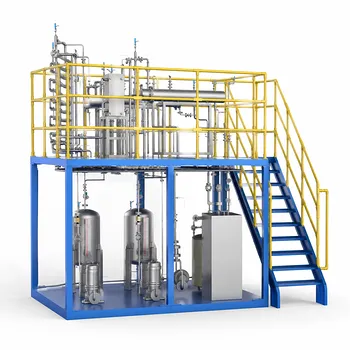
Scaling a microstructured reactor from a laboratory curiosity to a commercial workhorse is one of the most perilous leaps in chemical engineering. Heavy-pilot scale test reactors are necessary because laboratory experiments cannot replicate the complex heat transfer, mass transfer, and hydrodynamic behaviors that emerge at production flow rates. They serve as the definitive, risk-mitigating link between milliliter-per-hour microfluidics and cubic-meter-per-hour commercial production, proving long-term reliability and securing commissioning success before major capital is committed.
The leap from lab to plant is not a simple multiplication of size. A heavy-pilot reactor creates a managed environment where financial risk is neutralized and the physical reality of scaled-up microstructured unit operations is validated through empirical data, protecting enterprises from the catastrophic cost of a failed full-scale startup.
The Scale-Up Chasm: From Micro to Mega
A laboratory microreactor operates in a pristine, controlled universe. When that same chemistry needs to flow at industrial throughputs, the physics of the process changes fundamentally, and no amount of kinetic modeling alone can predict the outcome.
Why Lab Success Doesn’t Guarantee Plant Performance
Standard laboratory setups cannot simulate the fluid distribution, mixing gradients, or thermal stress cycles of field conditions. The heat exchange efficiency that keeps a microchannel isothermal at 10 mL/min can collapse when the flow becomes turbulent at several cubic meters per hour. A heavy-pilot reactor introduces industrial-style feed systems, heat transfer media, and control loops, revealing where lab-scale perfection breaks down under real operational stress.
The Inherent Limits of Theoretical Models
Reaction kinetics from a bench-top reactor provide a starting point, but they cannot substitute for physical reality. Commercial-scale unit operations involve complex gas redistribution, multi-phase interactions, and residence time distributions that theoretical fluid dynamics models only approximate. A pilot plant generates the semi-empirical data needed to tune those models, converting academic promise into an engineering design that can be commissioned with confidence.
The Pilot Plant as a Financial and Technical Risk Shield
Moving directly from laboratory microfluidics to a full commercial installation is a high-stakes gamble. The heavy-pilot reactor exists to remove that gamble from the equation, transforming unknown risks into controlled, measured proof.
De-Risking the Unknown: Validating Heat and Mass Transfer at Scale
A heavy-pilot reactor proves whether the intensified heat and mass transfer you measured in the lab can be sustained at production scale. Large-capacity microstructured mixers and heat exchangers, featuring split-and-recombine or interdigital geometries, are tested here. The pilot run reveals if pressure drop remains below critical limits, if hotspots form in unexpected places, and if the overall heat transfer coefficient holds up when throughput reaches several cubic meters per hour—all under the watch of economic decision-makers.
Corrosion, Catalyst Life, and Real-World Impurities
Laboratory chemicals are often reagent-grade; commercial feedstocks are not. A pilot plant exposes the microstructured unit to the gradual, corrosive wear of process impurities and allows for long-term monitoring of catalyst deactivation. It is the only place to evaluate mechanical catalyst stability under true fluid dynamic forces and to test catalyst separation protocols, especially for homogeneously catalyzed systems, before a multimillion-dollar plant is built.
Securing Economic Viability Through Empirical Data
A pilot plant validates more than chemistry—it validates the project’s return on investment. By operating continuously, it provides real numbers on raw material utilization, energy consumption, by-product handling, and maintenance frequency. This physical economic data protects B2B enterprises from the fatal error of underestimating production costs, giving stakeholders the certainty they need to release capital for a full-scale build.
Engineering Fidelity: Bridging the Hydrodynamic Gap
The core of the problem is fluid dynamics. Fluids do not scale linearly, and a microstructured unit operation is only as good as its ability to manage flow distribution at the targeted commercial rate.
Capturing Complex Fluid Dynamics
In fixed-bed or multibed configurations with interstage heat exchange, gas and liquid redistribution becomes a dominant performance driver. These behaviors simply do not exist in a small lab unit. A heavy-pilot reactor, with its industrial dimensions, allows researchers and engineers to map how fluids redistribute after each process step, providing the essential data to design internals that prevent channeling or flow maldistribution in the final plant.
Validating Pressure Drop and Energy Efficiency
A successful commercial microstructured unit must balance process intensification with an acceptable pressure drop, ideally below 10 bar. The pilot-scale setup, incorporating large microstructured components with capacities reaching cubic meters per hour, is where that balance is tested. It demonstrates that the advanced mixing geometries can deliver the required residence time and mass transfer without creating an energy penalty that destroys the process’s economic advantage.
Understanding the Trade-offs
The necessity of a heavy-pilot test reactor does not mean it is a financial triviality. A realistic assessment of its costs and limitations is essential for building trust in the scale-up pathway.
The Upfront Investment of Time and Capital
Constructing and operating a pilot plant delays the final time-to-market and carries a non-trivial capital cost. For organizations under intense pressure to be first-to-market, this deliberate deceleration can feel counter-productive. However, the cost of a pilot-scale failure is orders of magnitude smaller than a commercial-scale disaster, making the expense a strategic insurance premium rather than a burden.
The Non-Linear Extrapolation Challenge
A pilot reactor is a scaled-down representation, not a perfect miniature of the commercial unit. Certain wall effects, surface-to-volume ratios, or thermal gradients may still not scale identically. The art lies in designing the pilot to be “representative” enough in the specific dimensions that matter—mixing, heat transfer, and hydrodynamics—which requires deep technical expertise. A poorly designed pilot provides false confidence.
Making the Right Choice for Your Scale-Up Journey
The decision to invest in a heavy-pilot test reactor must align with your organization’s ultimate risk tolerance and strategic objectives. The following guidepost helps you navigate that choice.
- If your primary focus is minimizing financial risk: A heavy-pilot reactor is non-negotiable. It converts catastrophic blind-scale-up risk into a controlled, empirical validation phase, protecting your balance sheet from a failed commercial launch.
- If your primary focus is ensuring long-term operational reliability: The pilot provides the only platform to test catalyst degradation, corrosion under real impurities, and mechanical stability over hundreds of hours, securing a robust maintenance schedule before the full plant is built.
- If your primary focus is attracting investment or internal approvals: The data set from a successfully operated pilot—heat transfer coefficients, pressure drop curves, and verified production costs—is the single most powerful tool to de-risk the project in the eyes of a capital committee.
- If your primary focus is speed and you are replicating a proven, identical process: A heavy-pilot may be compressed, but for any novel microstructured chemistry, skipping this step invites a commissioning nightmare that will ultimately destroy any perceived schedule advantage.
The heavy-pilot test reactor is not an obstacle to commercialization; it is the most efficient bridge across the scale-up valley of death, turning an uncertain experiment into an engineered, bankable process.
Summary Table:
| Scale Phase | Flow Rate Range | Primary Focus | Key Risks Mitigated |
|---|---|---|---|
| Laboratory | Milliliters per hour | Reaction kinetics & chemical feasibility | Chemical pathway invalidity |
| Heavy-Pilot | Cubic meters per hour (test) | Heat/mass transfer, fluid dynamics & impurities | Scale-up and capital investment risks |
| Commercial | Cubic meters per hour (full) | Continuous production, ROI & throughput | Operational failure & downtime losses |
Bridge the Gap from Lab to Production with LABPARK
Successfully scaling up chemical processes requires precision-engineered equipment. LABPARK provides premium Educational and Vocational Unit Operations Pilot Plants in chemical engineering, bioprocess & biotech, and environmental & water treatment. We help universities, research institutes, and enterprises validate their processes and transition smoothly from research to commercial scale.
Ready to de-risk your next project? Contact our expert team at LABPARK today to find the ideal pilot plant solution for your needs!
Related Products
- Micro-Scale Gas-Solid Catalytic Reaction Educational Pilot Plant
- Methanol Synthesis and Catalyst Performance Evaluation Educational Unit Operations Pilot Plant
- Multi-Reactor Educational Pilot Plant for Reaction Engineering Unit Operations
- Fixed-Bed Chemical Reaction and Gas Dust Tar Removal Unit Operations Pilot Plant
- Multi Functional Catalytic Reaction and Reactor Evaluation Educational Unit Operations Pilot Plant
People Also Ask
- Fluidized vs. Fixed Bed Reactors: Comparing Heat & Complexity in Pilot Plants
- Why is a multibed configuration necessary for exothermic reactions? Optimize your pilot plant trajectory.
- Why is thermal management a major challenge in methane oxidative coupling? Reactor Solutions for Pilot Plants
- How does the Mears criterion evaluate transport resistance? Key Guide to Intrinsic Kinetics
- How do reactor pilot plants safely study gas-solid reactions? Master kinetics with thermal & flow control.