For recommending a vapor pressure equation in a pilot plant experiment, the clear, practical workhorse is the Antoine equation. Its simple form and widely available constants make it the ideal balance of accuracy and ease for correlating experimental data over the limited temperature ranges typical of a pilot-scale distillation column. While foundational principles come from the Clausius-Clapeyron relation, the Antoine equation is the definitive starting point for fitting your VLE data.
Choosing a vapor pressure equation is less about theoretical purity and more about the purpose of your experiment. The Antoine equation is the standard because it reliably connects your measured temperatures and pressures. But its true value emerges when it serves as the foundational input for a broader thermodynamic model, allowing you to rigorously test the consistency of all your experimental measurements.
The Foundational Role of Vapor Pressure in Your Pilot Plant
Before selecting a specific equation, it's crucial to understand why this choice matters so much. Your VLE data is a matrix of temperature, pressure, and phase composition. The vapor pressure equation is the fundamental link between the first two variables.
The Stakes of Getting It Wrong
An inaccurate vapor pressure model doesn't just create a curve-fit error. It cascades through your entire analysis.
It directly impacts your calculated activity coefficients, making a mixture appear more or less non-ideal than it truly is. This error then propagates into column design calculations, leading to an incorrect number of stages and an improperly sized reboiler or condenser.
Why Pilot Plant Data Needs Special Care
Pilot plants are designed for exploration, often with new mixtures or under unusual conditions. Your experimental data will inherently contain error.
Therefore, your chosen vapor pressure equation is the baseline of physical reality. A simple, robust equation like Antoine's provides a stable, trusted anchor. You can then use thermodynamic consistency tests, derived from the Gibbs-Duhem equation, to identify and reject bad experimental points. This process only works if your foundational pure-component model is sound.
Choosing Your Primary Tool: The Antoine Equation
For the overwhelming majority of distillation and VLE experiments in a pilot plant, the Antoine equation is the recommended starting point. It’s not just a step in a textbook; it’s the pragmatic choice for research.
The Definitive Working Equation
The equation takes the form:
ln P^sat = A - B / (T + C)
Here, P^sat is the saturated vapor pressure, T is the temperature, and A, B, and C are empirical, component-specific constants. The power of this equation lies not in theoretical derivation, but in its empirical accuracy. The constants are regressed from high-quality experimental data and are readily available for hundreds of compounds in standard reference texts.
Connecting Theory to Your Measurements
While the Antoine equation is empirical, you must understand its relationship to the Clausius-Clapeyron equation. Clausius-Clapeyron tells you the fundamental exponential relationship: the log of vapor pressure is inversely proportional to absolute temperature.
This is a critical insight for your pilot plant operation. It quantifies why a small temperature increase in your reboiler leads to a large vapor pressure surge. This principle governs the vacuum requirements for distilling heat-sensitive materials and is the basis for calculating the energy inputs needed for your heat exchangers.
Beyond Antoine: Equations for Extreme Conditions
The Antoine equation has a limited temperature range. If your pilot plant research pushes into high-pressure regions or spans from the triple point to the critical point, you need a more robust model.
Handling Wide Temperature Ranges
For advanced operations requiring high fidelity across a vast temperature spectrum, more complex equations like Wagner, Riedel, or Harlecher-Braun are necessary. These models account for the temperature dependence of the latent heat, which the simpler Clausius-Clapeyron and Antoine equations treat as constant or weakly dependent. They are not general-purpose tools but specialized instruments for high-stakes accuracy.
The Danger of Simplistic Extrapolation
A critical mistake is using an Antoine equation or a simple two-parameter equation of state to predict vapor pressure near the critical point. The physical assumptions break down in this region.
For example, the Peng-Robinson (PR) equation of state assumes a fixed critical compressibility factor (Zc) of 0.307. In reality, this value varies. This can lead to significant inconsistencies in density predictions near the critical region. If your pilot plant operates close to this zone, you should compare a cubic equation like PR against a three-parameter model, such as the Lee-Kesler correlation, to understand the extent of the error in your liquid density calculations.
Understanding the Trade-offs
Every model choice involves a compromise between simplicity, accuracy, and the specific calculation's purpose. Blindly trusting a model without understanding its limits is the most common source of error in pilot plant research.
Vapor Pressure Accuracy vs. Enthalpy Prediction
An equation of state may be excellent for VLE but poor for energy balances. For instance, in cryogenic or high-pressure systems, the Peng-Robinson equation generally offers about a 40% improvement in RMS error for vapor pressure predictions compared to Soave-Redlich-Kwong (SRK).
However, this hierarchy doesn't hold for all properties. For predicting enthalpies in these same systems, both SRK and PR can be less accurate than a correlation like Lee-Kesler. This means you might need different models for designing your column stages (VLE-focused) and sizing your condenser and reboiler (enthalpy-focused).
Simple vs. Complex Models for Associating Mixtures
If your mixture involves associating compounds like organic acids or alcohols, a standard vapor pressure equation fed into an activity coefficient model may still fail. The non-ideality in the liquid phase is too complex.
Simpler models assume a constant association factor, which often fails. More accurate methods introduce concentration-dependent corrections to better represent the reality of hydrogen bonding. In a research pilot plant, selecting the more sophisticated model is essential to reconcile your measured temperature, pressure, and mole fractions, ensuring your data isn't just precise, but thermodynamically consistent.
Making the Right Choice for Your Goal
Your selection is a strategic decision aligned with your experiment's primary objective. Start simple and only add complexity where the physics and your goals demand it.
- If your primary focus is data reconciliation and standard VLE measurement: Start with the Antoine equation for pure-component vapor pressures. Its simplicity and reliability make it the perfect anchor for applying Gibbs-Duhem consistency tests to identify and reject flawed experimental measurements.
- If your primary focus is designing column internals and calculating pressure drops: Prioritize an equation of state with superior liquid density predictions, such as Peng-Robinson (PR) over Soave-Redlich-Kwong (SRK). The lower compressibility factor in PR improves molal volume estimates by a factor of 2 to 4, which is critical for accurate hydraulic calculations.
- If your primary focus is modeling high-pressure or wide-boiling mixtures: Move beyond the Antoine equation and simple cubics. Evaluate a multi-parameter model like the Lee-Kesler correlation for both phase equilibria and enthalpy. Critically compare the predicted critical pressures from different methods, as the variation between them can be dramatic, leading to a completely different column operating strategy.
Your pilot plant is a verification tool. The equation you choose is the lens through which you view your experiment's physical reality, so select the lens that brings your most critical data into the sharpest focus.
Summary Table:
| Equation/Model | Recommended Use Case | Key Strengths | Limitations |
|---|---|---|---|
| Antoine | Standard VLE & data reconciliation | Simple, empirical, widely available constants | Limited temperature range |
| Clausius-Clapeyron | Basic theoretical relationship | Defines baseline T-P relationship | Assumes constant latent heat |
| Wagner / Riedel | Wide temperature & pressure ranges | Highly accurate up to critical point | Complex parameter fitting |
| Peng-Robinson (PR) | Column design & density calculations | Superior liquid volume estimates | Poor enthalpy prediction |
| Lee-Kesler | High-pressure & wide-boiling mixtures | Accurate phase equilibria & enthalpy | Complex multi-parameter model |
Optimize Your Pilot Plant Experiments with LABPARK
Choosing the right thermodynamic model is only half the battle—accurate verification requires reliable, high-performance equipment.
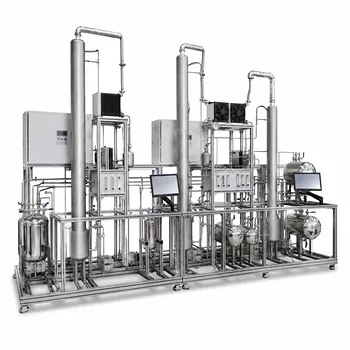
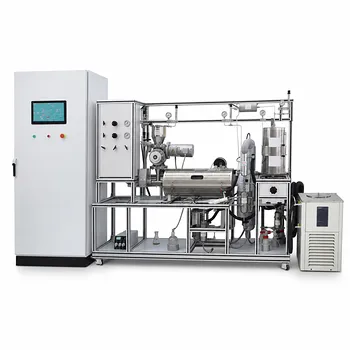
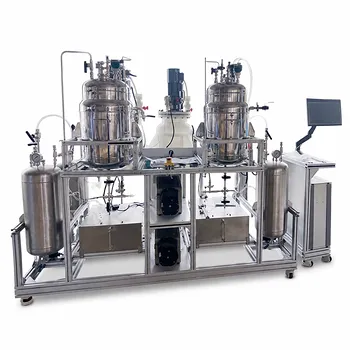
LABPARK provides premium Educational and Vocational Unit Operations Pilot Plants in chemical engineering, bioprocess & biotech, and environmental & water treatment. Specifically designed for universities, research institutes, and enterprises, our pilot plants deliver the precise process control and data reliability needed to validate your VLE models.
Contact our technical experts today to find the perfect pilot plant system for your lab!
Related Products
- Continuous Sieve-Plate Distillation Pilot Plant for Unit Operations Laboratory Education
- Multi-Functional Special Distillation Educational Pilot Plant
- Continuous Batch Extractive Distillation Educational Pilot Plant
- Multi-Modal Distillation Unit Operations Training Pilot Plant
- Electrolyte Distillation Purification and Formulation Educational Pilot Plant
People Also Ask
- How can real-time carbon number prediction improve distillation pilot plants? Optimize control.
- How to select the right activity coefficient model (Wilson, NRTL, UNIQUAC) for distillation pilot plants?
- What are the primary reflux ratio control strategies? Master Distillation Unit Operations
- How does catalyst water concentration affect distillation pilot plant design? Key separation train choices.
- Why is vacuum operation capability an essential feature for a distillation unit operations pilot plant? Unlock Efficiency