The core of a chemical engineer's distillation education isn't just learning to run a column—it's learning when not to trust the simplified math. By applying shortcut methods (Fenske-Underwood-Gilliland) before rigorous modeling (MESH equations), students quickly establish a theoretical baseline. The practical significance emerges when that baseline inevitably fails against the pilot plant's real-time sensor data, forcing a diagnosis of why the real column acts differently. This two-step process transforms an abstract design exercise into a tangible lesson on thermodynamic non-ideality and physical efficiency.
Distillation is governed by physics, not just algebra. The deliberate jump from a shortcut estimate to a rigorous plate-by-plate simulation—and then to physical operation—bridges the gap between idealized assumptions and chaotic reality. The mismatch between the shortcut prediction and the physical sensor readings is not an error; it is the primary learning objective, teaching the hidden cost of neglecting heat loss, pressure drop, and non-constant molar overflow.
From Classroom Theory to Physical Reality
The journey from a desktop simulation to a physical pilot plant is where chemical engineering intuition is forged. The transition between calculation methods mirrors the intellectual path a student must take to move from a "perfect" model to a functional operation.
The Role of Shortcut Methods as a Baseline
Before touching a valve or heating a reboiler, students must define the problem’s theoretical limits. Shortcut methods, specifically the Fenske-Underwood-Gilliland (FUG) approach, serve as this critical zero-order estimate.
These simplified equations quickly yield the minimum number of theoretical stages and the minimum reflux ratio by assuming constant relative volatility and constant molar overflow. This creates a "best-case scenario" in the student's mind, establishing the absolute physical limit of what the separation process can achieve. Students designate Light Key (LK) and Heavy Key (HK) components to project the optimal feed stage location, giving them a starting point before a single drop is distilled.
Using Rigorous Models to Confront Non-Ideality
Moving to a rigorous simulation shatters the assumptions of the shortcut world. This step is not about getting a "better number" but about seeing why the first number was wrong.
Students apply global iteration methods like Naphtali-Sandholm to simultaneously solve the MESH equations—Material, Equilibrium, Summation, and Enthalpy—for every tray. This immediately reveals how liquid-phase non-idealities break the constant volatility assumption, forcing the model away from classroom simplicity. Unlike the static Fenske output, the rigorous model struggles with convergence, teaching students about the sensitivity of complex distillation systems to initialization parameters.
Validating the Model with Tangible Sensor Data
The ultimate significance is tying both computational methods to physical reality. The pilot plant transforms abstract numbers into audible pumps and thermal gradients.
When students compare the rigorous model’s temperature profile against the physical column’s thermocouple readings, the deviation points become the most valuable teaching moments. A mismatch in intermediate tray temperatures doesn't mean the simulation is "broken"; it often reveals unaccounted heat loss through the column walls or an inaccurate tray efficiency estimate. By adjusting the Murphree efficiency in the rigorous model to match real-time sensor data, students directly experience the difference between a theoretical stage and a physical sieve tray.
Why the Transition Matters: The Hidden Curriculum
The technical steps are only half the story. The deeper significance in training lies in developing the diagnostic mindset needed to prevent operational disasters before they happen.
Correcting the Idealized Mindset
Running a shortcut model sets a trap that the rigorous calculation must disarm. If left uncorrected, the idealized input leads students to dangerously undersize the column’s heat duty in the physical plant.
Shortcut calculations ignore temperature gradients and enthalpy balances, hiding the fact that the top of the column is cooling while the bottom is heating. The rigorous model explicitly calculates these energy flows, predicting the true heat load required to prevent the reboiler from being thermally overloaded. This physical feedback loop shows that energy consumption is regulated by thermodynamic equilibrium, not just a simple input knob, correcting the false sense of linear control.
Understanding Process Instabilities via MESH
A physical column doesn’t just sit at steady state; it fluctuates. The structure of the rigorous method is essential for teaching dynamic operational control.
The global variable method links liquid flow rates and vapor traffic across the entire column, replicating the cascade effect observed during physical disturbances. If a student changes the feed temperature on the pilot plant, the rigorous model predicts the resulting propagation of weeping or flooding. Shortcut methods cannot resolve individual stage concentrations, leaving students blind to how a localized composition pinch chokes the entire separation.
Understanding the Pitfalls and Limitations
Even a perfectly tuned rigorous model has inherent limitations when applied to a teaching pilot plant. Students must learn to identify which errors belong to the software and which belong to the physical world.
The Reboiler Heat Loss Blind Spot
No simulation is immune to the "garbage in, garbage out" problem of thermal dynamics. The largest disconnect between the rigorous simulation and the pilot plant typically manifests in the reboiler heat duty.
Students often forget to factor in significant radiant heat loss from the uninsulated metal surfaces of a pilot-scale reboiler. A rigorous simulation will calculate a specific steam flow rate to achieve vapor boil-up, but the physical pilot plant may require 15-20% more utility input to compensate for environmental losses. The lesson here is critical: the simulation is thermodynamically closed, but the laboratory is not.
The Danger of Uncritical Process Simulation
In a research or training context, the rigorous model can become a black box that hides mass transfer realities. Just because the MESH equations "converge" mathematically does not mean the column will physically function.
A simulation might accept a tray with 95% efficiency without flagging a hydrodynamic issue, while the physical glass column clearly demonstrates that the downcomer is backing up and causing entrainment. Students learn that the numerical convergence of the matrix solution means nothing if the physical flow regime has shifted from stable froth to destructive jet flooding. This teaches that operation is a hydraulic problem as much as a thermodynamic one.
Developing an Effective Training Methodology
To maximize the practical significance of these dual methods, a structured, sequential approach to the pilot plant experiment is required.
Step 1: The Theoretical Sandbox
Begin by isolating the mathematics from the hardware. Students execute the Fenske-Underwood-Gilliland (FUG) shortcut method using only the specified light and heavy key recoveries and an average relative volatility.
This calculates the "impossible" column—one with infinite capital but zero operating cost at minimum reflux. It defines the physical ceiling of separation. The Erbar-Maddox correlation then brings them down to earth, providing the first economic trade-off between the number of trays and the reflux ratio for a finite column.
Step 2: The Digital Twin
Next, students import the shortcut results as the initialization guess for the rigorous Naphtali-Sandholm algorithm. The instructor should force a scenario that shortcut models handle poorly, such as a wide-boiling multicomponent mixture or a non-ideal azeotrope.
The simulation’s struggle to converge teaches the value of a good initial guess. Once converged, the output provides the detailed temperature and composition profiles that act as a "prediction map" for the physical run, eliminating arbitrary guesswork when setting the column's reboiler duty and reflux drum level.
Step 3: The Field Trial
Finally, the student energizes the pilot plant. However, the object of this run is not to "copy" the simulation but to document the deviation.
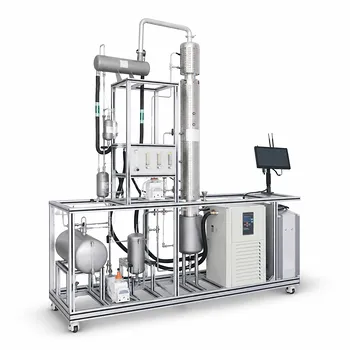
The student compares the physical column's differential pressure and tray temperatures against the rigorous model's predictions. When flooding is visually observed at a vapor load far lower than the rigorous model suggested, it forces a root-cause analysis. The student must actively consider mechanical factors—foaming in the packing, improper distributor installation—that fall outside the scope of MESH equations.
Making the Right Choice for Your Training Goal
The specific learning outcome determines which method should be used as the "source of truth" versus the "tool of approximation" during the laboratory session.
- If your primary focus is teaching economic optimization: Emphasize the Fenske-Underwood-Gilliland shortcut and Erbar-Maddox correlation. This reframes the lesson around the capital vs. operating expenditure curve, allowing students to instantly visualize the cost of energy at high reflux ratios.
- If your primary focus is teaching thermodynamic diagnostics: Force the transition from shortcut to rigorous. Have students identify the specific physical VLE interaction—often a non-ideality like a tangent pinch—that the shortcut method missed but the rigorous MESH energy balance exposed.
- If your primary focus is operational safety and hydraulics: Use the rigorous model as a base map but prioritize the physical sensor array. The lesson pivots to the column hydraulics, demonstrating that a converged energy balance is useless if the physical tray has transitioned into flooding due to excessive weir loading.
By learning to navigate the gap between a simplified shortcut, a rigorous digital twin, and a living, breathing piece of steel and glass, students stop merely operating equipment and start diagnosing it.
Summary Table:
| Method / Phase | Core Focus | Key Value in Training |
|---|---|---|
| Shortcut (FUG) | Constant relative volatility & molar overflow | Establishes absolute theoretical limits (minimum stages & reflux). |
| Rigorous (MESH) | Non-ideal VLE, enthalpy balances & tray dynamics | Predicts convergence issues and thermal loads accurately. |
| Pilot Plant Run | Real-world hydraulics, heat loss & sensor validation | Bridges the gap by exposing real thermodynamic and operational deviations. |
Bring textbook theory to life in your laboratory. LABPARK provides state-of-the-art Educational and Vocational Unit Operations Pilot Plants in chemical engineering, bioprocess & biotech, and environmental & water treatment for universities, research institutes, and enterprises. Equip your students with the tools to master both theoretical simulations and physical operations.
Contact LABPARK today to upgrade your training facilities!
Related Products
- Continuous Sieve-Plate Distillation Pilot Plant for Unit Operations Laboratory Education
- Multi-Functional Special Distillation Educational Pilot Plant
- Continuous Batch Extractive Distillation Educational Pilot Plant
- Multi-Modal Distillation Unit Operations Training Pilot Plant
- Electrolyte Distillation Purification and Formulation Educational Pilot Plant
People Also Ask
- What are the primary reflux ratio control strategies? Master Distillation Unit Operations
- How to select the right activity coefficient model (Wilson, NRTL, UNIQUAC) for distillation pilot plants?
- Why is vacuum operation capability an essential feature for a distillation unit operations pilot plant? Unlock Efficiency
- How can real-time carbon number prediction improve distillation pilot plants? Optimize control.
- How does catalyst water concentration affect distillation pilot plant design? Key separation train choices.