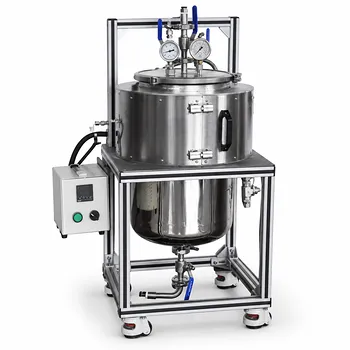
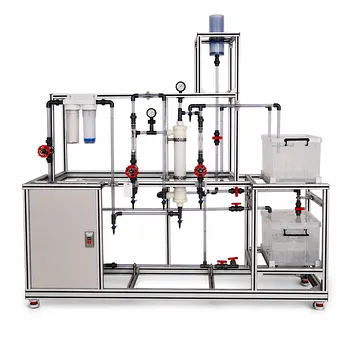
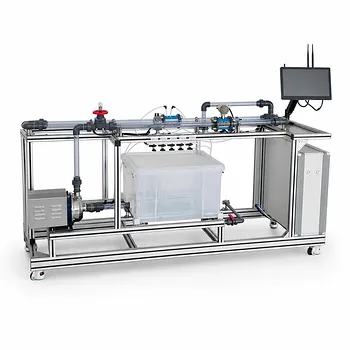
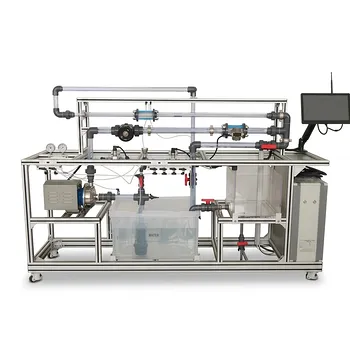
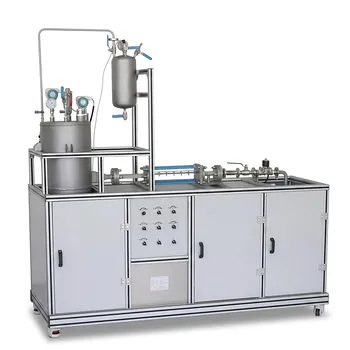
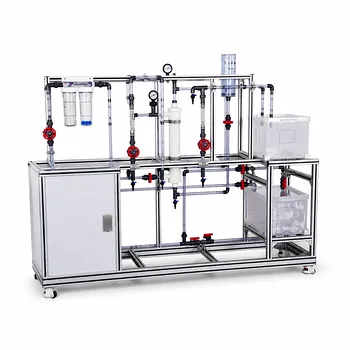
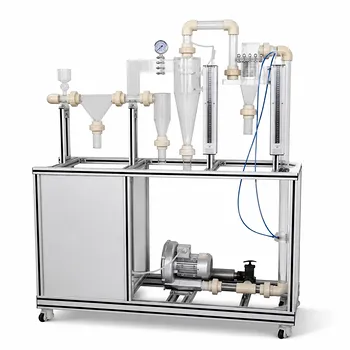
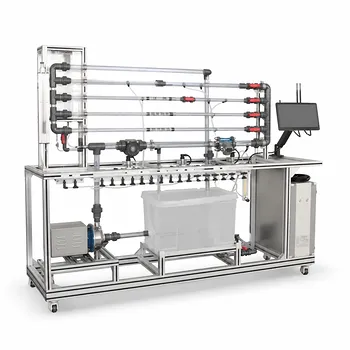
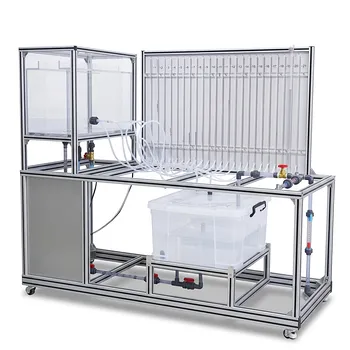
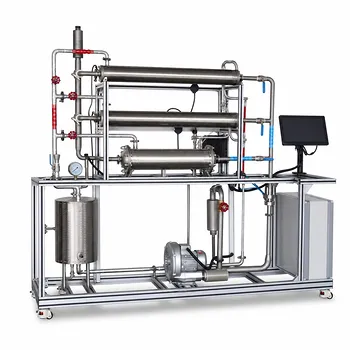
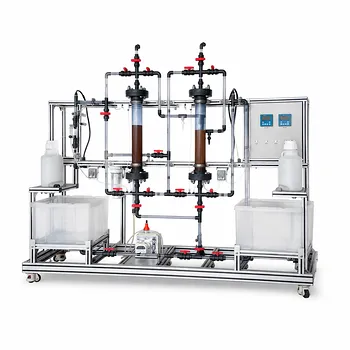
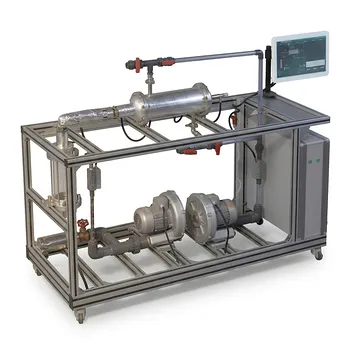
The difference between a teaching tool and an engineering instrument is capability and intent. A Buchner funnel quickly separates a solid from a liquid under vacuum, but it provides only a crude first approximation of filtration behavior. In contrast, a leaf filter is purpose-built to characterize a slurry’s filtration properties, capturing high-resolution filtrate volume–time data at multiple pressures to deliver the quantitative parameters essential for process scale-up.
For a chemical engineering laboratory, the choice between a Buchner funnel and a leaf filter defines what students learn. The Buchner funnel teaches basic separation; the leaf filter teaches filtration science. Only the leaf filter generates the time-resolved, pressure-variable measurements needed to calculate specific cake resistance and the compressibility index—the twin pillars of industrial filter design.
The Fundamental Difference in Purpose
The two devices address different stages of learning and investigation. Recognizing their distinct roles prevents educators from mistaking a quick lab demonstration for a rigorous characterization experiment.
Buchner Funnel: Simple Separation, Limited Data
The Buchner funnel is a straightforward vacuum filtration apparatus. Students pour slurry onto filter paper, apply vacuum, and watch clear liquid collect in a flask.
Its output is binary: the cake is formed, and the liquid is separated. While you can estimate an average flow rate, the funnel does not track how the filtrate rate decays over time with any precision. It yields only a rough, first-order approximation of cake properties, which is rarely sufficient for reliable scale-up.
Leaf Filter: A Tool for Engineering Analysis
A leaf filter is a larger, enclosed device designed specifically for diagnostic filtration tests. It holds a small filter medium (a “leaf”) in a pressure-tight vessel and records the cumulative filtrate volume as a function of time.
This time-resolved profile is the heartbeat of filtration characterization. By operating at multiple, precisely controlled pressures, the leaf filter reveals the slurry’s key engineering personality: its resistance to flow and how that resistance changes with applied pressure.
From Lab Data to Plant Design: The Parameter Gap
Scaling filtration from a benchtop to a plant requires two critical numbers. Without them, design remains guesswork.
Why Cake Resistance and Compressibility Matter
Specific cake resistance (α) quantifies how strongly the solid cake impedes filtrate flow. Compressibility index (n) describes how cake resistance increases when the driving pressure rises—whether the cake squashes down easily or holds its porous structure under stress.
These parameters dictate the size, pressure rating, and cycle time of industrial filters. An error in either can lead to oversized, costly equipment or a system that fails to meet throughput targets.
How a Leaf Filter Bridges the Gap
A leaf filter measures the filtrate accumulation curve under a fixed, tightly controlled pressure. Plotting time/volume versus volume yields a straight line whose slope contains the specific cake resistance.
Repeating the test at several different pressures—say 2, 4, and 6 bar—reveals how resistance scales with pressure. The slope of a log–log plot of α against pressure gives the compressibility index. A Buchner funnel cannot perform these stepped-pressure runs reliably, as it relies on a single vacuum-level motive force with minimal regulation.
The Hidden Factor of Pressure Control
Pressure is not just an operating condition; it is a diagnostic variable. How you manage it determines what you can learn.
Buchner’s Single-Pressure Limitation
A Buchner funnel operates at a coarse, near-constant vacuum, typically limited to the atmospheric pressure minus water vapor pressure. Small variations in house vacuum or seal quality introduce noise. You get one data point in the pressure–resistance curve, which is insufficient to deduce compressibility.
Leaf Filter’s Multi-Pressure Capability
Leaf filters use compressed nitrogen or air to pressurize the slurry vessel. This allows exact set points, stable operation, and easy switching between pressures during a single experiment or across successive runs.
The ability to collect filtration profiles at 3–5 distinct pressures is what transforms a simple observation into a full engineering model. Students learn how a slurry’s nature—hard, compressible, or incompressible—emerges only when pressure is systematically varied.
Understanding the Trade-offs
No tool is universally ideal. Recognizing the leaf filter’s higher demands and the Buchner funnel’s limitations ensures you match the instrument to the educational objective.
Complexity and Time
A leaf filter requires careful setup: sealing, pressure regulator adjustment, and data logging. A complete characterization run may take hours, compared to minutes for a Buchner filtration. This demands a more structured lab period and greater student readiness.
Cost and Maintenance
Buchner funnels are inexpensive, durable glass or porcelain. Leaf filters are specialized pilot-plant instruments with pressure vessels, regulators, and electronic balances for continuous weight recording. They cost more and need periodic maintenance, but they deliver a return on investment through the quality of data and depth of learning.
Educational Depth
A first-year student can grasp solid–liquid separation with a Buchner funnel. An advanced unit operations student needs to generate and interpret α and n values to internalize scale-up methodology. Choosing a Buchner funnel for a senior lab limits learning; attempting leaf-filter experiments with freshmen overwhelms them. The right tool aligns with the curriculum stage.
Making the Right Choice for Your Laboratory
Your goal dictates the appropriate equipment. Match the tool to the learning outcome you want to achieve in your unit operations course.
- If your primary focus is introducing basic separation principles: Use a Buchner funnel. It is fast, simple, and sufficient to show how a vacuum drives liquid through a cake.
- If your primary focus is teaching rigorous filtration characterization and scale-up: Invest in a leaf filter. It is the only way to obtain specific cake resistance and compressibility index data that students will rely on in industrial process design.
- If your program spans both introductory and advanced lab sequences: Start with the Buchner funnel for early demonstrations of solid–liquid separation, then transition to the leaf filter for in-depth unit operations experiments that mirror real engineering practice.
Choosing the instrument that fits your educational purpose ensures students leave the lab not just having observed a filtration, but having measured and understood the properties that will let them scale it from the bench to the plant floor.
Summary Table:
| Feature / Parameter | Buchner Funnel | Leaf Filter |
|---|---|---|
| Primary Purpose | Basic solid-liquid separation | Quantitative filtration characterization |
| Data Output | Binary (separated/not), crude flow rate | Time-resolved filtrate volume & mass curves |
| Pressure Control | Single, unregulated vacuum | Precise, multi-pressure control (e.g., via compressed air) |
| Key Metrics Derived | None (or highly unreliable) | Specific cake resistance ($\alpha$) & compressibility index ($n$) |
| Setup & Complexity | Fast, simple, low-cost | Structured setup, data logging, higher investment |
| Ideal Curriculum Level | Introductory/general chemistry labs | Advanced chemical engineering unit operations |
Elevate Your Chemical Engineering Lab with LABPARK
Bridge the gap between basic classroom demonstrations and real-world industrial practice. LABPARK provides high-quality Educational and Vocational Unit Operations Pilot Plants in chemical engineering, bioprocess & biotech, and environmental & water treatment for universities, research institutes, and enterprises.
Equip your students with the tools they need to master scale-up parameters like cake resistance and compressibility. Contact us today to find the perfect pilot-scale filtration systems and unit operations equipment for your laboratory!
Related Products
- Constant Pressure Filtration Educational Unit Operations Pilot Plant
- Hot Filtration Educational Unit Operations Pilot Plant Laboratory System
- Multifunctional Membrane Separation Educational Pilot Plant with Ultrafiltration, Nanofiltration, Reverse Osmosis
- Ultrafiltration Membrane Separation Educational Pilot Plant
- Multi-Functional Membrane Separation Educational Pilot Plant for Unit Operations Lab
People Also Ask
- How do educational unit operations pilot plants bridge theory and design? Bridge the Engineering Gap
- How do educational unit operations pilot plants address safety and waste management when scaling up?
- Why splitting a filtration batch doesn't always reduce cycle time? Pilot Plant Insights
- Why Demo Constant-Rate to Constant-Pressure Filtration on a Pilot Plant? Key Practical Insights
- How can researchers identify and resolve filter medium blinding? Optimize Your Pilot Plant Runs