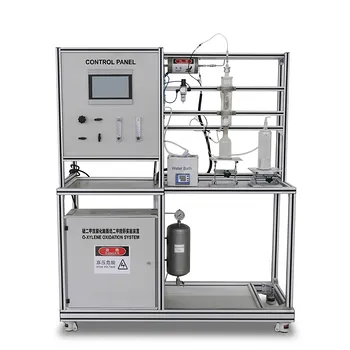
Resonance isn’t just a molecular detail—it’s a reactor design lever. When running a catalytic sulfur dioxide oxidation pilot plant, instructors can use the resonance structures of SO₂ to show students exactly why real-world enthalpy deviates from simple Lewis bond predictions. By linking that electronic stabilization directly to the measured heat of reaction and the resulting cooling duty, the entire logic behind heat-exchanger sizing, temperature control, and material selection becomes tangible.
The identical intermediate bond lengths in SO₂ and SO₃ prove electron delocalization. This resonance stabilization directly lowers the net energy released during oxidation—meaning the reactor’s heat management system must be sized for a very different heat load than textbook single-bond calculations would suggest.
From Lewis Structures to Resonance: The Molecular Reality
Why Lewis Structures Fall Short
A naïve Lewis picture for SO₂ shows alternating single and double sulfur–oxygen bonds.
Experimental data tells a different story: all S–O bond lengths are identical and lie between the expected values for single and double bonds.
This identity is the fingerprint of electron delocalization—the molecule is a resonance hybrid, not a flip-flop between two static forms.
Electron Delocalization and Stability in SO₂ and SO₃
Delocalization spreads electron density across multiple atoms, stabilizing the molecule below the energy any single Lewis structure would predict.
The same holds for the oxidation product SO₃, where all three S–O bonds are equivalent.
That extra stability means the energy difference between SO₂ and SO₃ is smaller than a bond-energy sum based on discrete single/double bonds would indicate.
Connecting Molecular Stability to Reactor Thermodynamics
Resonance and the Heat of Reaction
The catalytic oxidation ( \text{SO}_2 + \frac{1}{2}\text{O}_2 \rightarrow \text{SO}_3 ) is exothermic—but how exothermic?
Using only localized bond energies overestimates the heat released because the reactants (and products) are actually resonance-stabilized.
A correct enthalpy calculation must reflect that stabilization, and the difference is often tens of kJ/mol—enough to change an adiabatic temperature rise by a hundred degrees or more.
The Pilot Plant as a Thermodynamic Testing Ground
In a teaching pilot plant, students can measure the actual temperature profile along the catalyst bed and the overall heat removed by the cooling circuit.
They then perform two parallel theoretical calculations: one using naive Lewis bond energies and another incorporating resonance-corrected data.
The discrepancy between the naive prediction and the plant data is the “aha” moment—it makes the need for rigorous molecular insight concrete.
Translating Heat of Reaction into Reactor Design
Sizing Heat Exchangers for Exothermic Control
The corrected enthalpy of reaction defines the total heat removal duty required to keep the catalyst at its optimal temperature window.
Students can then design a shell-and-tube exchanger or a jacketed reactor that matches that duty, calculating log-mean temperature differences and required surface area.
Because the resonance-corrected heat load is lower, the exchanger becomes smaller—a direct consequence of electron delocalization.
Mass Transfer and Kinetic Considerations
Resonance also influences the molecular orbital interactions with the catalyst surface, subtly affecting adsorption energies and reaction rates.
In the pilot plant, instructors couple heat measurements with mass transfer analysis (e.g., measuring conversion at different flow rates) to show how molecular stability alters the operating point of the reactor.
This holistic view prevents the common mistake of treating thermodynamics and kinetics as isolated subjects.
Understanding the Trade-offs
The Gap Between Theory and Real Reactor Dynamics
Resonance-based bond corrections give a static energy picture, but a real catalytic reactor involves transient hot spots, pressure drops, and imperfect mixing.
Relying solely on that corrected enthalpy, without accounting for dynamic heat dispersion, can lead to undersized cooling in zones of high activity.
When Bond Energy Calculations Aren’t Enough
Resonance stabilization is only one piece of the energy balance.
Catalyst deactivation, side reactions (e.g., SO₂ to elemental sulfur), and non‑ideal gas behavior at high pressures can shift the observed heat release.
The pilot plant becomes the only ground truth—teaching students that molecular insight sets the direction, but engineering validation closes the loop.
Making the Right Choice for Your Teaching Lab
A pilot plant exercise can be tuned to different learning outcomes. Match your emphasis to your students’ primary goal.
- If your primary focus is deepening thermodynamic intuition: Confront students with the raw temperature data and the naive bond-energy prediction, then force them to derive the resonance correction from molecular data. The shock of the mismatch cements the concept.
- If your primary focus is reactor design workflow: Have students calculate the heat exchanger surface area first using Lewis bond energies, then with resonance-corrected values, and finally against the plant’s actual cooling load. This turns resonance into a practical sizing driver.
- If your primary focus is bridging chemistry and engineering: Pair the oxidation pilot plant with a complementary experiment (like a fuel cell pilot unit) where ion transport and overpotentials mirror the need for accurate molecular energy accounting, reinforcing the universal lesson.
With the right framing, the resonance hybrid in SO₂ becomes far more than a drawing on a page—it becomes the very reason a heat exchanger dimensions itself as it does.
Summary Table:
| Metric / Concept | Naive Lewis Model | Resonance Hybrid Model | Reactor Design Impact |
|---|---|---|---|
| Bond Energy | Overestimated (discrete bonds) | Accurate (stabilized delocalization) | Prevents over-sizing cooling systems |
| Heat of Reaction | Higher predicted enthalpy release | Lower actual enthalpy release | Enables compact heat exchanger design |
| Catalyst Interaction | Simplistic adsorption model | Realistic orbital interaction | Accurate kinetic and mass transfer analysis |
Bring Molecular Theory to Life with LABPARK
Bridging the gap between abstract molecular theory and real-world chemical engineering requires hands-on, high-fidelity equipment. LABPARK provides premium Educational and Vocational Unit Operations Pilot Plants in chemical engineering, bioprocess & biotech, and environmental & water treatment for universities, research institutes, and enterprises.
Our advanced pilot plants empower students to validate thermodynamic models, measure heat transfer dynamics, and master reactor sizing in real time. Ready to elevate your laboratory's learning experience? Contact us today to explore our tailored pilot plant solutions!
Related Products
- O-Xylene Oxidation to Phthalic Anhydride Educational Unit Operations Pilot Plant
- Carbon Dioxide Hydrogen Methanol Synthesis Educational Unit Operations Pilot Plant
- Carbon Dioxide Hydrogenation Methanol Synthesis Educational Unit Operations Pilot Plant
- Fixed-Bed Chemical Reaction and Gas Dust Tar Removal Unit Operations Pilot Plant
- Natural Product Extraction Unit Operations Training Pilot Plant
People Also Ask
- Why Is the Peclet Number (Pe) Key in Tubular Reactors? Avoid Critical Modeling Errors
- Why determine reaction order & activation energy in pilot plants? Key to safe scale-up.
- What materials fit high-temp oxidation pilot plants? Key Hastelloy & Titanium Requirements
- Why is the reactor tube-to-catalyst particle diameter ratio (dt/dp) critical? Key to Accurate Kinetic Scale-Up
- Under what conditions can axial diffusion be neglected? Reactor Simulation Guide