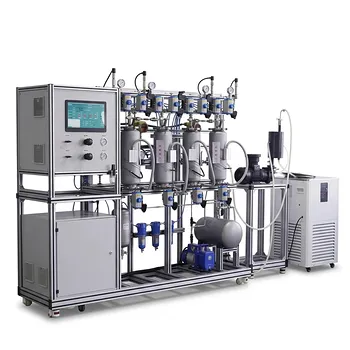
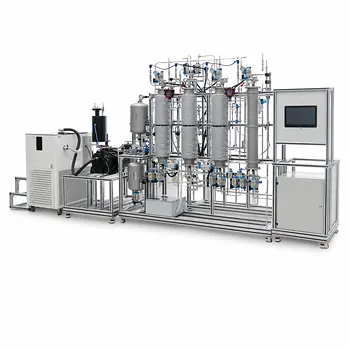
Bag filters capture particles by physically blocking them with a fibrous medium and accumulated dust cake, while electrostatic precipitators use high-voltage electrical fields to charge particles and pull them onto collection plates. This fundamental difference in mechanism dictates their applications, cost, and the engineering principles they teach. For a pilot plant, bag filters excel at demonstrating mechanical cleaning systems and cake filtration physics. An ESP, though more complex and expensive, is the definitive tool for exploring advanced emission control, high-temperature gases, and submicron particle capture.
The core difference is not just about how particles are removed, but about the engineering concepts each unit embodies. A bag filter is a lesson in mechanical separation, pressure drop, and surface filtration. An ESP is a lecture in electrostatics, ionization, and dry/wet cleaning of charged particles—making it irreplaceable for modern environmental curricula.
How Each Separator Actually Removes Particles
The underlying physics of particle capture determines what students see, measure, and internalize. Understanding these sharply different mechanisms is your first design criterion.
Bag Filters: Filtration Through a Built-Up Dust Cake
A bag filter relies on physical interception and impaction. Dirty gas passes through a fabric or felt tube, and particles larger than the weave’s pores are trapped on the surface.
The real workhorse is the dust cake that accumulates. Once a thin layer forms, it becomes the primary filtration medium, dramatically increasing efficiency for particles around 1 μm. Students can observe how pressure drop rises as the cake thickens, then drops after cleaning.
This mechanism makes bag filters iconic for teaching pulse-jet or mechanical shaking cleaning cycles. The interplay between filtration efficiency, energy consumption, and bag wear is a highly educational, hands-on experience.
Electrostatic Precipitators: Charging and Collecting Particles in an Electric Field
An ESP separates particles without any physical barrier touching the gas stream. First, high-voltage electrodes ionize the gas, creating a corona discharge.
Particles become electrically charged as they pass through this field. Charged particles then migrate toward grounded collection plates, where they adhere and lose their charge.
The collected dust is removed by rapping (dry ESP) or washing (wet ESP). This mechanism enables the ESP to capture extremely fine particles, well into the sub-2 μm range, with very low pressure drop. In a pilot plant, students directly measure voltage-current curves and correlate them with collection efficiency—a powerful lesson in electrostatics and particle physics.
Designing the Pilot Plant for Educational Impact
Your choice between these two units shapes the experiments and engineering principles you can cover. Consider the specific learning objectives each unit delivers.
Bag Filters: Ideal for Mechanical and Process Control Curricula
A pilot-scale baghouse is compact and affordable. It directly demonstrates real-time pressure drop evolution, dust cake formation, and the dynamics of cake detachment during cleaning.
Students can experiment with different filter media, pulse frequencies, and dust loadings. The system naturally ties into lessons on fan sizing, energy consumption in filtration, and maintenance cycles. Its robust, visual operation builds intuition about fundamental chemical engineering separations.
Electrostatic Precipitators: The Gold Standard for Advanced Emission Control
An ESP pilot plant is the tool for teaching technologies required for the strictest environmental regulations. It handles hot, corrosive, sticky fumes that would blind a bag filter.
Students manipulate voltage levels, plate spacing, and rapping intensity to see the direct effect on submicron particle capture. Because the pressure drop is negligible compared to a bag filter, they can analyze energy trade-offs: you pay for electricity upfront at the power supply rather than throughout the system. This makes the unit essential for environmental engineering courses focused on flue gas treatment and compliance.
The Multi-Stage Advantage
In many pilot plants, a cyclone pre-cleaner is placed upstream—especially before an ESP—to remove coarse dust. This demonstrates industrial practice and protects the downstream unit. If you opt for an ESP, integrating a small cyclone first enriches the curriculum with lessons on staged separation.
Understanding the Trade-offs
No technology is perfect. An objective educational design must also highlight limitations, preparing students for real-world decision-making.
Bag Filter Limitations
Bag filters are temperature-sensitive. Fabric materials degrade above certain limits (often 200–280°C, though high-performance synthetics extend this). Condensation or sticky dust can blind bags permanently. Deep cleaning performance may also vary, and there’s a significant pressure drop that multiplies fan power costs. In a pilot plant, these failure modes become teachable moments.
Electrostatic Precipitator Challenges
ESPs come with higher capital cost and operational complexity. High-voltage equipment demands strict safety interlocks and trained supervision, which can be daunting in a teaching lab. Efficiency is sensitive to dust resistivity; particles with very high resistivity can cause back corona, dramatically lowering performance. Wet ESPs add water treatment complexity. A pilot ESP is not a plug-and-play device, but it excels at demonstrating “problematic” dust behaviors.
Making the Right Choice for Your Educational Goal
Whether you lean toward a bag filter or an ESP depends entirely on the story you want your pilot plant to tell. Start with your curriculum’s core mission.
- If your primary focus is teaching fundamental particle separation physics and process control: Choose a bag filter. Its tangible pressure drop curves, visible cake formation, and mechanical cleaning cycles are unmatched for building foundational knowledge.
- If your primary focus is advanced environmental engineering and compliance technologies: Invest in an ESP. It’s the only unit that teaches electrostatic precipitation, submicron capture, and high-temperature gas cleaning—the backbone of modern industrial emission control.
- If your budget or safety constraints are tight, but you still need fine-particle demonstration: A bag filter with a transparent housing and simple pulse-cleaning can deliver much of the necessary insight at a fraction of the cost, while still pairing well with a pre-cyclone for multi-stage lessons.
A well-designed pilot plant doesn’t just demonstrate a unit operation—it tells the story of the trade-offs, energy balances, and physical phenomena that shape real engineering. Match the mechanism to your students’ journey, and the learning follows naturally.
Summary Table:
| Feature | Bag Filter | Electrostatic Precipitator (ESP) |
|---|---|---|
| Mechanism | Physical blocking & dust cake filtration | Electrostatic charging & collection plates |
| Particle Size | Effective for standard/coarse particles | Excellent for submicron (< 2 μm) particles |
| Pressure Drop | High (increases as dust cake builds) | Negligible (extremely low) |
| Teaching Focus | Mechanical cleaning, cake filtration physics | Electrostatics, ionization, emission control |
| Cost & Safety | Lower cost, standard lab safety | Higher cost, high-voltage safety protocols |
Build the Perfect Unit Operations Lab with LABPARK
Are you looking to upgrade your chemical or environmental engineering curriculum? LABPARK designs and manufactures premium Educational and Vocational Unit Operations Pilot Plants specializing in chemical engineering, bioprocess & biotech, and environmental & water treatment.
We help universities, research institutes, and enterprises select and customize the ideal pilot plants—from transparent bag filters demonstrating pressure drop curves to advanced ESP systems for high-temperature gas cleaning.
Contact LABPARK today to collaborate with our engineers and get a customized proposal for your laboratory!
Related Products
- Fixed-Bed Chemical Reaction and Gas Dust Tar Removal Unit Operations Pilot Plant
- Bench Scale Carbon Dioxide Capture Educational Unit Operations Pilot Plant
- Green Anhydrous Ethanol Purification Extractive Distillation Unit Operations Training Pilot Plant
- Ion Exchange Water Purification Educational Pilot Plant for Engineering Unit Operations
- Gas-Solid Heterogeneous Separation Demonstration Educational Unit Operations Pilot Plant
People Also Ask
- When to transition from PID to adaptive control in pilot plants? Key process indicators.
- How do deviations in estimating latent heat impact pilot plant thermal systems? Avoid hardware mis-sizing.
- Why Compare Predicted and Experimental Excess Enthalpy? Key to Accurate Pilot Plant Scale-up
- How do steady-state and dynamic simulations complement pilot plants? Validate scale-up and controllability
- Why Use PTFE & Hastelloy in Chemical Pilot Plants? Prevent Corrosion & Ensure Safety