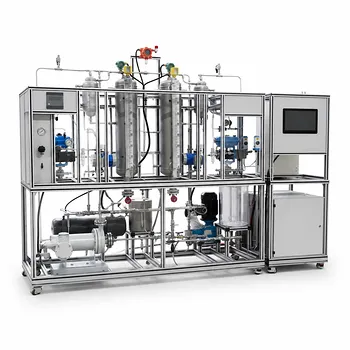
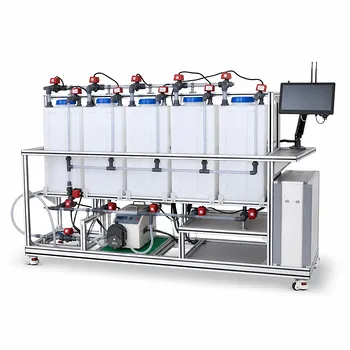
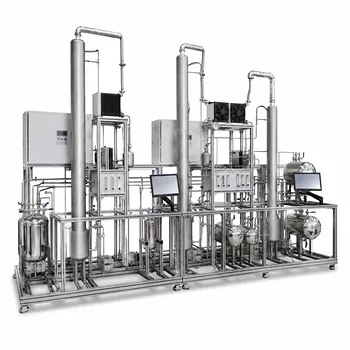
The core of a training-grade chlor-alkali pilot plant is defined by two technology decisions and a safety system that can never be compromised. For effective student instruction, your pilot plant must include modern membrane cell and diaphragm cell electrolysis modules so trainees can directly compare electrical efficiency, product purity, and operational trade-offs. Integral instrumentation for cell voltage, current density, pH, and temperature is non-negotiable, while safety demands chlorine gas scrubbing, dedicated hydrogen ventilation, automated shutdown protocols, and materials engineered to resist the process’s corrosive, explosive nature.
Selecting the right pilot plant isn't a features checklist—it’s a curriculum decision. The technology you choose directly defines which fundamental electrochemical principles students can observe, measure, and internalize. The safety architecture determines whether that learning happens in an environment that prepares them for industrial reality or shelters them from it. Every component, from the membrane material to the shutdown logic, either amplifies or dilutes the educational value.
The Technology Foundation: Cell Types and Instrumentation
Why Membrane and Diaphragm Modules Are Both Essential
A single cell type teaches students one narrow slice of chlor-alkali reality. A true training plant must pair a modern membrane cell with a classic diaphragm cell. Each forces students to confront different core principles:
- A membrane cell uses a perfluorinated cation-exchange membrane to separate the anode and cathode compartments completely. This yields high-purity caustic soda (approximately 30-35% NaOH) and extremely pure hydrogen and chlorine because the gases cannot mix. Trainees can directly observe how membrane selectivity (blocking chloride ions while allowing sodium ions to pass) maximizes current efficiency and product quality, while learning that this purity comes at a strict brine quality requirement to prevent membrane fouling.
- A diaphragm cell uses a porous asbestos or polymer diaphragm that separates the gases but allows liquid to flow from anode to cathode. The resulting caustic soda is diluted (~12% NaOH) and contains significant sodium chloride, demanding downstream evaporation. Students see firsthand how the trade-off for lower capital cost and tolerance for less-pure brine is a more complex purification train and lower overall thermal efficiency.
Side-by-side operation makes abstract concepts tangible. Instead of just memorizing decomposition voltages, students measure the actual cell voltage for each technology, calculate energy consumption (kWh/ton of NaOH), and attribute differences to overvoltage contributions and ohmic drops. This transforms the pilot plant from a demonstration rig into a problem-solving laboratory.
The Sensor Suite That Drives Deep Learning
The primary reference’s list—cell voltage, current density, pH, temperature—is the minimum required to teach the central metric of this process: current efficiency. Current efficiency (the ratio of actual product formed to that predicted by Faraday’s laws) is the heartbeat of any electrolytic operation, and it degrades due to side reactions. Without these sensors, students can’t quantify why.
- Cell voltage and current density allow calculation of power demand and allow students to plot polarization curves when electrode materials are swapped. They see how an increase in current density raises overvoltage and reduces energy efficiency—a real-world design constraint.
- pH monitoring at the cathode is critical because the formation of OH⁻ ions creates a strongly alkaline environment. pH data, combined with temperature readings, helps students model mass transfer, detect membrane or diaphragm degradation, and understand the risk of chlorate formation if anolyte pH drops unexpectedly.
- Temperature influences reaction kinetics and membrane life. A training plant must show how thermal management (often through internal cooling coils or external heat exchangers in the brine circuit) stabilizes operation and prevents thermal runaway in the case of power imbalance.
Integrate these sensors into a user-friendly data acquisition system (DAQ). A DAQ that logs data and displays trends in real time turns raw numbers into a narrative about the energy efficiency, mass balance, and side reaction dynamics that shape industrial decision-making.
Safety Features: The Non-Negotiable Architecture
Chlorine Gas Management: Scrubbing and Containment
Chlorine is toxic, and in a student lab, zero risk is the only standard. A packed-bed gas scrubber, typically using a caustic soda solution to neutralize Cl₂ via the reaction Cl₂ + 2NaOH → NaOCl + NaCl + H₂O, must be integral to the pilot plant. It should be sized to handle the full rated chlorine production rate plus a safety margin. Additionally, localized ventilation hoods directly over the anode compartment capture any fugitive emissions before they reach the breathing zone. The combination of a dedicated scrubber and a fail-safe ventilation system—interlocked with chlorine gas detectors that instantly sound alarms and initiate shutdown—creates a layered defense that protects students even during common operational mistakes like a brine flow interruption.
Hydrogen Gas: Explosion-Proof Design
Hydrogen’s wide flammability range (4-75% in air) demands special attention. Dedicated, constantly-operating ventilation in the cathode area and exhaust ducts that vent hydrogen safely outdoors are required. All electrical fittings in the hydrogen zone must be explosion-proof (suitable for Class I, Division 1 environments). The system must include hydrogen-specific gas detectors that trigger an automatic shutdown if concentrations approach the lower explosive limit. Students need to see these measures not as bureaucratic hurdles, but as the physical translation of industrial safety standards like NFPA 70 and ATEX directives—a lesson they will carry into their professional lives.
Automated Shutdown Logic: The Invisible Guardian
The primary reference’s call for “automated shutdown protocols in case of power or flow failures” is the tip of the iceberg. A robust training plant needs a safety instrumented system (SIS) that monitors:
- Brine and catholyte flow rates: Low flow can cause dry-chlorine reactions or localized overheating.
- Power supply stability: A sudden loss of rectifier current can reverse electrode potentials and damage membranes.
- High-high and low-low gas pressure: To prevent gas breakthrough across the membrane or backflow that could mix hydrogen and chlorine.
- Emergency stops: Easily accessible by instructors from multiple locations.
These interlocks should not be hidden black boxes. The pilot plant must visually indicate which safety trip has activated, teaching students the chain of causality that leads from a process upset to a safe state. This transparency embeds the logic of process hazard analysis into the training experience.
Material Selection: Standing Up to Brine and Caustic
The process fluids—saturated brine, chlorinated anolyte, and concentrated caustic—will destroy a plant made from the wrong materials. The specifications should mirror industrial practice:
- All wetted parts in the brine and caustic circuits must be 316L stainless steel, duplex stainless steel, or high-nickel alloys to resist chloride-induced pitting and caustic stress corrosion cracking.
- Anode compartments demand titanium structures with a coated mixed metal oxide (MMO) anode, while cathode compartments can use nickel or stainless steel.
- Gaskets and O-rings must be PTFE or chemically resistant elastomers.
For educational use, a limited number of transparent sections (thick-walled borosilicate glass sight glasses on the cell or on a side-stream) can show students gas evolution and two-phase flow patterns without compromising containment—provided they are protected by pressure-rated shields and are kept small enough to minimize risk.
How These Features Translate into Educational Value
Teaching Faraday’s Laws and Efficiency
Students need to measure actual chlorine and hydrogen production against the theoretical yield calculated from current. Integrated gas flow meters (mass flow or volumetric with temperature/pressure compensation) on the anode and cathode outlets let them calculate current efficiency directly. When they see that a diaphragm cell yields lower purity chlorine (due to oxygen from water oxidation side reactions), they connect I = zFn to real-world consequences: energy losses, electrode degradation, and the importance of anode coating selection.
Demonstrating Overvoltage and Electrode Kinetics
A training plant should allow easy electrode interchangeability. By swapping between graphite, titanium-MMO, and older-style DSA electrodes in a test cell, students generate Tafel plots. They observe how overvoltage changes with material and surface condition, linking fundamental electrochemistry to the massive energy bills that drive the industry toward dimensionally stable anodes and advanced coatings.
Exploring Mass Balance and Side Reactions
Integrated sample ports and on-line pH sensors in both anolyte and catholyte loops enable students to detect the formation of chlorate (ClO₃⁻) and active chlorine species. They can correlate a drop in anolyte pH with increased chlorate formation and a corresponding loss of current efficiency. This is the bridge from textbook side reactions to practical plant optimization—teasing out how subtle parameter shifts (temperature, brine concentration, membrane condition) cascade into yield losses.
Understanding the Trade-offs
Cost vs. Curriculum Depth
A membrane-only plant is cheaper to build and maintain, but it robs students of the chance to compare the two dominant industrial technologies. If budget is tight, a modular skid that can accommodate both a membrane module and a diaphragm module (swap-out) is a pragmatic compromise. The diaphragm module can be a simplified design, as students need only a few hours of hands-on time to understand the difference in caustic quality and energy consumption. The long-term educational return on investment from comparison vastly outweighs the incremental hardware cost.
Complexity vs. Operability
Too many automated safeguards can turn a pilot plant into a “press-and-watch” experience, stripping the operator-in-training of the burden of active monitoring. Design the shutdown logic to be tiered: alarms at high/low limits prompt student intervention, while only second-tier high-high/low-low limits trigger an automatic trip. This teaches alarm management and keeps students engaged. Conversely, a fully manual plant with no interlocks is unacceptable for a teaching environment where novices will make mistakes. Strike the balance with a “supervised manual” philosophy: basic control loops are manual or single-loop PID, but the SIS is always vigilant.
Transparency vs. Safety
The supplementary references highlight the value of transparent sections for observing hydrodynamics. In a chlor-alkali plant, however, clear pipes carrying chlorine and hydrogen introduce a formidable safety risk. The compromise is to use high-integrity sight glasses only on low-pressure brine and catholyte lines, and to verify that the material is chemically compatible with NaOH. Only gas-free liquid flows should be visible. This provides the visual payoff—seeing bubbles, liquid levels, and flow behavior—without dangerous exotic materials.
Maintenance Burden and Consumable Costs
Membrane cells require regular brine purification to prevent calcium and magnesium scaling. The pilot plant must include a small brine treatment skit (softening and precipitation) to teach this lesson. Diaphragms degrade over time and must be replaced; the cost and procedure should be transparent. When selecting a pilot plant, understand the annual consumable budget and ensure that the diaphragm or membrane replacement frequency aligns with your course cycle; a plant that sits unused for months may still consume consumables through corrosion or membrane dry-out.
Making the Right Choice for Your Training Goal
Your final selection must match your educational objectives, the experience level of your students, and the safety culture you intend to build.
- If your primary focus is introductory chemical engineering principles: Choose a pilot plant that emphasizes the fundamental cell modules, clear sensor readouts, and a highly automated safety system. Prioritize ease of operation so that students spend their mental energy on Faraday’s laws and mass balances rather than troubleshooting hardware.
- If your primary focus is training future plant operators and process engineers: Insist on both membrane and diaphragm cells, full manual-override capability on control loops, and a detailed alarm management interface. The students must experience the consequences of brine contamination, flow imbalances, and voltage adjustments firsthand—within the safety net of the SIS.
- If your primary focus is research on electrode materials and energy optimization: Demand modular cell designs that allow quick changes of anodes, cathodes, and (if possible) membrane types. The DAQ must support high-resolution logging of overvoltage components, and the plant should have ports for electrochemical impedance spectroscopy probes.
- If your primary focus is constrained by budget but you still need credible training: Invest in a single membrane cell pilot plant but ensure the supplier provides a detailed digital twin or simulation module that accurately models diaphragm cell behavior. Supplement the physical hardware with a curriculum that uses those models for side-by-side comparison—the learning still happens, but at a fraction of the capital cost.
Choose the pilot plant that forces your students to confront the core physical and chemical realities, not the one that hides them behind automation. The best training plant is the one that transforms a bright, engaged learner into an engineer who instinctively knows why an anode coating fails or why a pH sensor reading is an early warning—not just an answer on an exam.
Summary Table:
| System Category | Key Components | Educational & Safety Value |
|---|---|---|
| Electrolysis Cells | Membrane & diaphragm modules | Allows comparison of efficiency, yield, and purity. |
| Instrumentation | Voltage, current, pH, & temp sensors | Enables calculation of current efficiency & Tafel plots. |
| Safety Systems | Cl2 scrubber, H2 ventilation, SIS | Protects operators and demonstrates industrial safety. |
| Materials | Titanium, 316L SS, PTFE | Ensures corrosion resistance against harsh chemicals. |
Elevate Your Chemical Engineering Program with LABPARK
Equip your students and researchers with hands-on learning systems built for safety and academic rigor. LABPARK provides premium Educational and Vocational Unit Operations Pilot Plants in chemical engineering, bioprocess & biotech, and environmental & water treatment for universities, research institutes, and enterprises.
Ready to integrate safe, industrial-grade electrolysis training into your curriculum? Contact LABPARK today to request a quote or customize your pilot plant!
Related Products
- Alkaline Membrane Water Electrolysis Educational Pilot Plant Unit Operations Training System
- Electrochemical Water Treatment Educational Unit Operations Pilot Plant
- Methane Cracking Educational Unit Operations Pilot Plant
- Multi-Modal Distillation Unit Operations Training Pilot Plant
- Methanol Synthesis and Catalyst Performance Evaluation Educational Unit Operations Pilot Plant
People Also Ask
- How do chemical engineering pilot plants demonstrate electrolysis? Bridge Theory & Industrial Scale
- How do alkaline and PEM electrolysis technologies differ in pilot plant operations?
- Why is the selection of electrode materials critical when configuring or operating educational electrolysis pilot plants?
- Bipolar vs Monopolar Electrolysis: Key Configuration Details to Analyze in Pilot Plants
- Which Electrolysis Pilot Plant Parameters Ensure Safety & Efficiency? Key Controls Explained