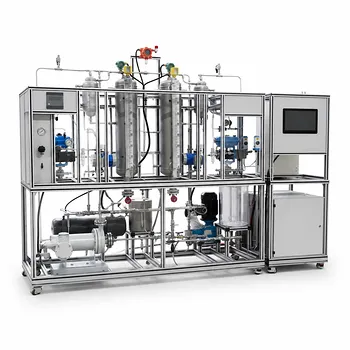
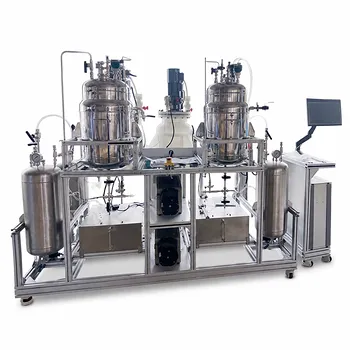
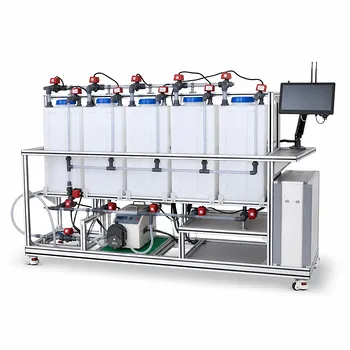
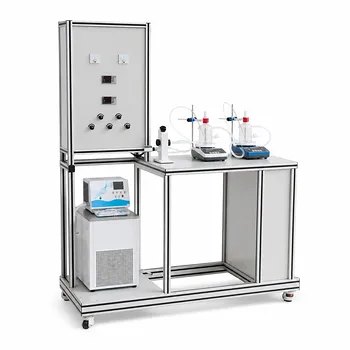
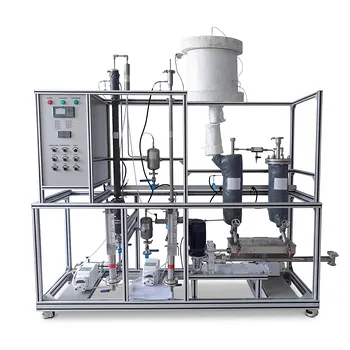
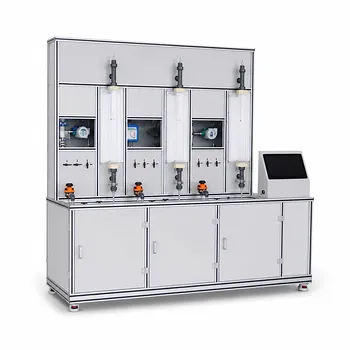
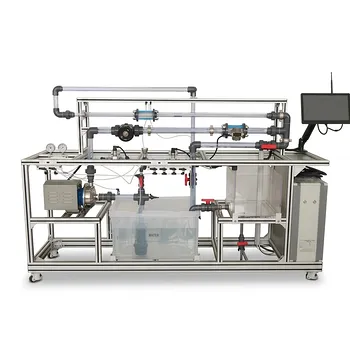
Electrolysis isn’t just a chemical equation—it’s a visible transfer of energy and matter. Educational pilot plants bring this abstract concept to life by letting students watch gas bubbles stream from one electrode while a metallic coating grows on another, all within a transparent, controlled, and industrially scaled cell. These plants not only show the oxidation-reduction half-reactions but also allow students to measure the exact electrical charge fed into the system, collect the products, and calculate electrochemical equivalence, turning theory into tangible, quantitative evidence.
At their heart, chemical engineering pilot plants for electrolysis transform invisible ion migration into objective proof—gas volume, metal mass, pH shifts—while teaching students to use electrical measurements to determine reaction rates, current efficiency, and the real-world constraints of industrial unit operations. They bridge benchtop chemistry with the demands of scale-up and process safety.
Visualizing Redox Reactions in a Controlled Cell
The Transparent Pilot Reactor: A Window into Electrode Processes
Using the classic electrolysis of aqueous zinc chloride, a pilot plant deploys clear, electrolyte-filled vessels with distinct electrodes. When a direct current is applied, students immediately observe chlorine gas bubbling from the anode and a deposit of solid zinc forming on the cathode. This direct visual feedback links the abstract concept of electron transfer to concrete physical changes at each electrode.
Separating Half-Reactions for Clear Understanding
The pilot plant physically or visually separates the two fundamental processes. At the positive electrode (anode), chloride anions release electrons ($2\text{Cl}^- - 2\text{e}^- \rightarrow \text{Cl}_2\uparrow$), and the evolved gas is captured in a graduated tube. At the negative electrode (cathode), zinc cations acquire those electrons to plate out pure metal ($\text{Zn}^{2+} + 2\text{e}^- \rightarrow \text{Zn}$). By isolating these events, the plant reinforces that oxidation and reduction are concurrent but spatially distinct, a core mechanism students often struggle to appreciate from paper equations alone.
Quantifying the Unseen: Faraday’s Laws in Action
From Charge to Mass: The Hands-On Calculation
The pilot plant becomes a precision measurement system. Students set a constant current and time, directly recording the total charge passed ($\text{Coulombs} = \text{Amperes} \times \text{Seconds}$). After the run, they weigh the cathode to determine the actual mass of metal deposited, then compare it to the theoretical mass predicted by Faraday’s law—one gram-equivalent weight deposited per 96,500 Coulombs. This hands-on exercise makes electrochemical equivalence a concrete, verifiable result instead of a memorized constant.
Measuring Efficiency: Where Theory Meets Reality
Real electrolysis never achieves 100% ideal conversion, and the pilot plant exposes these imperfections. Students calculate current efficiency by comparing the actual gas volume collected (via mass flow meters or graduated tubes) or metal gained against the theoretical yield. Side reactions, ohmic heating, or electrode passivation become visible as a shortfall, giving students a diagnostic lens to investigate process losses—a critical skill for any industrial engineer.
Scaling Up for Industrial Relevance
From Beakers to Plate-and-Frame Electrolyzers
While a basic lab uses a small beaker and manual power supply, educational pilot plants mimic industrial conditions with plate-and-frame or membrane electrolyzers, industrial-grade rectifiers, recirculating pumps, and heat exchangers. This scale introduces engineering realities: mass transfer limitations, electrolyte flow distribution, and the effect of hydrodynamics on coating uniformity. Students experience firsthand how the perfect stoichiometry of the bench top must be balanced against the engineering demands of continuous operation.
Teaching Process Control and Instrumentation
Integrated online sensors transform the pilot plant into a data-rich learning environment. Conductivity meters track electrolyte depletion; pressure transmitters and flowmeters measure gas generation rates; pH probes at the cathode reveal the formation of alkaline products. By monitoring these real-time signals, students can calculate reaction kinetics under varying conditions and learn to implement process control strategies—exactly as they would in a modern electrochemical plant.
Safety as a Taught Mechanism
When the pilot plant demonstrates the chlor-alkali process ($2\text{NaCl} + 2\text{H}_2\text{O} \rightarrow 2\text{NaOH} + \text{H}_2\uparrow + \text{Cl}_2\uparrow$), it also teaches the inseparable link between chemistry and hazard mitigation. Built-in gas absorption systems neutralize toxic chlorine, while explosion-proof fittings and ventilation manage hydrogen. Students grasp that safe handling of electrode products is not an afterthought but a core design principle of any electrolysis unit, reinforcing both the chemical mechanisms and the professional responsibility of a chemical engineer.
Understanding the Trade-offs
- Complexity can obscure fundamentals: Operating pumps, control valves, and SCADA interfaces may distract students from the underlying electron-transfer principles if not carefully scaffolded in the curriculum.
- Transparency vs. industrial realism: Clear vessels provide unmatched visual insight but rarely represent the opaque, high-temperature, high-pressure cells used in industry. Some real-world phenomena—like membrane fouling or advanced electrode kinetics—remain unseen.
- Resource intensity: Pilot plants demand significant space, maintenance, and consumables. Shared operations can limit each student’s hands-on time, potentially diluting the learning experience compared to a simple, fully independent lab box.
- Interpretation risks: The excitement of visible gas plumes and metal sheen can lead students to focus on the spectacle rather than the quantitative analysis. Without guided inquiry, the plant becomes a demonstration rather than an investigative tool.
Making the Right Choice for Your Teaching Goal
- If your primary focus is fundamental electrochemistry theory: Opt for a simplified, transparent cell running the zinc chloride experiment. It delivers the clearest visualization of half-reactions and Faraday’s laws with minimal procedural overhead.
- If your goal is to train future process engineers: Select a pilot plant with industrial-style plate-and-frame reactors, automated control loops, and comprehensive online instrumentation to emphasize current efficiency, mass transfer, and scale-up thinking.
- If you need to illustrate the complete energy conversion picture: Integrate galvanic (fuel cell) modules alongside electrolysis units so students can directly compare spontaneous chemical-to-electrical energy conversion with externally driven non-spontaneous redox.
- If safety and environmental awareness are paramount learning outcomes: Choose a plant that includes gas scrubbing, hydrogen management, and integrated leak sensors, forcing students to address real hazard mitigation as part of the experimental protocol.
Ultimately, educational electrolysis pilot plants transform a two-line redox equation into a multi-sensory, data-rich experience that grounds abstract theory in physical evidence and industrial context, preparing students to design, operate, and troubleshoot the electrochemical processes that power modern manufacturing.
Summary Table:
| Key Concept | Educational Demonstration Method | Student Learning Outcome |
|---|---|---|
| Redox Visualization | Transparent cells showing gas bubbling & metal plating | Spatial separation of half-reactions is physically proven |
| Faraday's Laws | Precision current timing and product mass measurements | Verification of electrochemical equivalence & current efficiency |
| Industrial Scale-up | Plate-and-frame reactors with recirculating pumps & sensors | Understanding mass transfer, hydrodynamics, & process control |
| Process Safety | Integrated gas scrubbers and ventilation systems | Hands-on training in hazard mitigation and chemical design |
Bring Industrial-Scale Chemical Engineering into Your Classroom
Are you looking to bridge the gap between textbook theory and practical engineering for your students? LABPARK designs and delivers premium Educational and Vocational Unit Operations Pilot Plants in chemical engineering, bioprocess & biotech, and environmental & water treatment.
We empower universities, research institutes, and enterprises worldwide with safe, transparent, and fully instrumented training systems that prepare the next generation of engineers.
Contact LABPARK today to find the perfect pilot plant solution for your lab!
Related Products
- Alkaline Membrane Water Electrolysis Educational Pilot Plant Unit Operations Training System
- Water Electrolysis Hydrogen Production and Storage Educational Pilot Plant
- Electrolytic Hydrogen Production Educational Unit Operations Pilot Plant
- Electrolyte Distillation Purification and Formulation Educational Pilot Plant
- Electrochemical Water Treatment Educational Unit Operations Pilot Plant
People Also Ask
- How do alkaline and PEM electrolysis technologies differ in pilot plant operations?
- Why is the selection of electrode materials critical when configuring or operating educational electrolysis pilot plants?
- Bipolar vs Monopolar Electrolysis: Key Configuration Details to Analyze in Pilot Plants
- Which Electrolysis Pilot Plant Parameters Ensure Safety & Efficiency? Key Controls Explained
- Diaphragm vs Membrane Electrolysis Pilot Plant: Which is Best for Chemical Engineering Education?