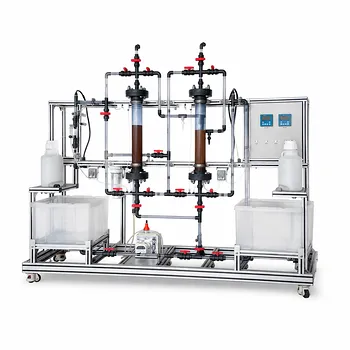
The process gap boils down to product purity and the energy required to achieve it.
The diaphragm method produces a weak, salt-contaminated caustic soda stream (10–12% NaOH, ~10,000 mg/L NaCl) that demands heavy downstream concentration. The ion-exchange membrane method delivers a near-salt-free, 32–35% NaOH solution directly from the cell while consuming only 75–80% of the diaphragm cell’s electrical energy. For a university pilot plant, this translates into a choice between illustrating classical mass-transfer steps on one hand, and demonstrating modern, high-efficiency, green-chemistry production on the other.
While the ion-exchange membrane method delivers superior energy efficiency, product concentration, and purity—making it the modern industry standard—the diaphragm method’s mechanical simplicity and obvious thermodynamic limitations can be an equally powerful teaching tool for foundational electrochemical principles. Your selection hinges on whether your curriculum needs to mirror current industrial practice or lay bare the fundamental unit operations of separation and purification.
Breaking Down the Process and Economic Differences
The surface-level comparison is defined by four tightly linked factors: energy consumption, product quality, down-stream load, and environmental footprint. Each factor shapes the economics and the lessons a student takes away from the pilot plant.
Energy Consumption and Operating Costs
A membrane cell draws only 75–80% of the electrical energy required by a diaphragm cell for the same caustic output.
That gap comes from the membrane’s ability to block convective mixing; the diaphragm cell must pump current through a more resistive, porous structure that allows bulk liquid movement.
Lower electrical demand directly lowers operating cost.
Total operating expenses for a membrane plant typically run about 85–95% of those for a diaphragm plant, once you account for the reduced thermal load discussed below.
For a university budget, this means the membrane pilot plant offers a leaner, more modern cost profile to study.
Product Concentration and Purity
A diaphragm cell’s liquor leaves the cathode compartment at only 10–12 wt% NaOH and carries roughly 10,000 mg/L of sodium chloride.
The ion-exchange membrane, by contrast, yields 32–35 wt% NaOH with a salt level around 30 mg/L—a 300-fold reduction in contamination.
That purity change is what redefines the entire downstream flowsheet.
Students can immediately grasp why modern chlor-alkali plants abandoned the diaphragm: the cost and complexity of concentrating and purifying a dilute brine product are enormous.
Downstream Processing Requirements
The diaphragm pilot plant demands extra unit operations.
The dilute caustic must be evaporated, which can consume up to 5 tons of steam per ton of 30% NaOH product, and the salt that crystallizes out must be removed and recycled.
This transforms a simple electrolysis demonstration into a full-blown evaporation and crystallization exercise.
A membrane pilot plant offloads that work to the front end.
The cell itself produces saleable-strength caustic, but it will not tolerate the same level of brine impurities.
Strict brine purification—often including ion-exchange softeners—becomes a prerequisite, shifting the teaching focus to upstream raw material preparation.
Environmental and Safety Considerations
Asbestos diaphragms pose well-documented health risks, and their use is heavily restricted in many jurisdictions.
Membrane cells eliminate that hazard entirely, making them a safer, regulation-proof choice for an educational laboratory.
The Educational Value: What Students Learn From Each Method
Beyond economics, the pilot plant is a curriculum delivery tool. The technology you select dictates the specific mass-transfer, thermodynamic, and process-integration concepts your students will master.
Diaphragm: A Window into Classical Unit Operations
The diaphragm cell’s low-purity, low-concentration product stream creates a natural need for evaporation, crystallization, and salt handling.
Students see firsthand how mass-transfer limitations inside the porous separator set the stage for an entire thermal separation train.
It is a vivid demonstration of why industry moved on—and a rigorous introduction to energy integration principles.
Membrane: Teaching Green Chemistry and High-Efficiency Processes
A membrane pilot plant puts modern cation-exchange technology at the center of the investigation.
Students measure the permselectivity of a fluorosulfonate film, optimize current efficiency, and see how eliminating convective flow unlocks 35% caustic at room temperature.
It aligns directly with industry trends, allowing laboratory exercises on energy benchmarking, high-purity chemical production, and the shift away from hazardous materials.
Understanding the Trade-offs: Complexity vs. Clarity
No single electrolysis technology is the “best” for every teaching goal.
Choosing a pilot plant means weighing the richness of the downstream challenge against the elegance of a compact, modern process.
Diaphragm cells teach mass transfer and separation from a place of obvious imperfection.
The dilute, salty effluent becomes a built-in case study for evaporation economics, steam optimization, and salt recovery—all core chemical engineering topics.
Membrane cells deliver a “clean” electrochemical lesson but demand a more sophisticated support system.
The brine must be polished to sub-ppm hardness before it enters the cell; otherwise, membrane fouling ruins performance.
This shifts the learning emphasis toward ion-exchange purification and membrane integrity rather than post-electrolysis separations.
Capital and maintenance considerations also differ.
A robust diaphragm cell may be less expensive to purchase and physically tougher, while a membrane cell’s higher upfront cost and membrane replacement requirements mimic real industrial constraints—valuable lessons in lifecycle costing.
Making the Right Choice for Your Curriculum Goals
Select the physical pilot plant based on the story you want your students to internalize.
- If your primary focus is modern industrial alignment and green chemistry: Choose the ion-exchange membrane pilot plant. It delivers high-purity, high-concentration output with lower energy consumption and zero asbestos risk, directly reflecting today’s best-practice chlor-alkali production.
- If your primary focus is foundational mass transfer and thermal separation processes: Opt for a diaphragm unit. Its dilute, contaminated product stream forces students to design, operate, and optimize the evaporation and crystallization steps that defined the industry for decades.
- If your goal is comparative learning and process synthesis: Deploy both technologies side-by-side. This empowers students to measure energy usage, product purity, and steam demand experimentally, deriving for themselves why membrane cells became the standard.
A well-chosen electrolysis pilot plant does more than demonstrate electrochemistry; it becomes the lens through which students see energy, separations, and sustainability as an interconnected whole.
Summary Table:
| Feature / Metric | Diaphragm Method | Ion-Exchange Membrane Method |
|---|---|---|
| NaOH Concentration | Dilute (10–12 wt%) | Concentrated (32–35 wt%) |
| Salt Contamination (NaCl) | High (~10,000 mg/L) | Very Low (~30 mg/L) |
| Relative Energy Consumption | 100% (Baseline) | 75–80% of diaphragm cell energy |
| Primary Downstream Need | Heavy evaporation & crystallization | None (requires strict upstream purification) |
| Environmental & Safety | Asbestos hazards (restricted) | Safe, green-chemistry aligned |
| Core Educational Value | Classical separation & mass-transfer | Modern high-efficiency electrochemistry |
Elevate Your Engineering Lab with LABPARK Pilot Plants
Choosing the right electrolysis system is critical to aligning your curriculum with modern industrial standards. LABPARK provides state-of-the-art Educational and Vocational Unit Operations Pilot Plants designed specifically for universities, research institutes, and enterprises.
Whether your focus is on chemical engineering, bioprocess & biotech, or environmental & water treatment, our custom-engineered pilot plants bridge the gap between academic theory and industrial reality.
Ready to enhance your department's practical training capabilities? Contact LABPARK today to discuss your laboratory specifications and get a tailored solution.
Related Products
- Alkaline Membrane Water Electrolysis Educational Pilot Plant Unit Operations Training System
- Electrolytic Hydrogen Production Educational Unit Operations Pilot Plant
- Electrochemical Water Treatment Educational Unit Operations Pilot Plant
- Water Electrolysis Hydrogen Production and Storage Educational Pilot Plant
- Electrolyte Distillation Purification and Formulation Educational Pilot Plant
People Also Ask
- How do chemical engineering pilot plants demonstrate electrolysis? Bridge Theory & Industrial Scale
- How do alkaline and PEM electrolysis technologies differ in pilot plant operations?
- Why is the selection of electrode materials critical when configuring or operating educational electrolysis pilot plants?
- Bipolar vs Monopolar Electrolysis: Key Configuration Details to Analyze in Pilot Plants
- Which Electrolysis Pilot Plant Parameters Ensure Safety & Efficiency? Key Controls Explained