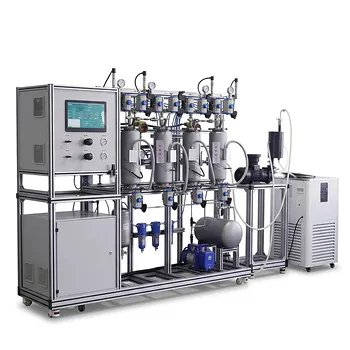
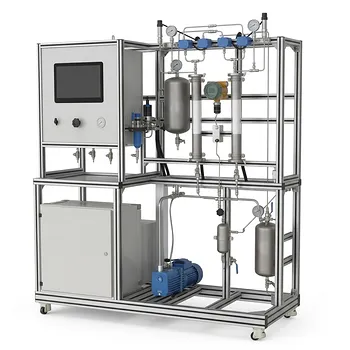
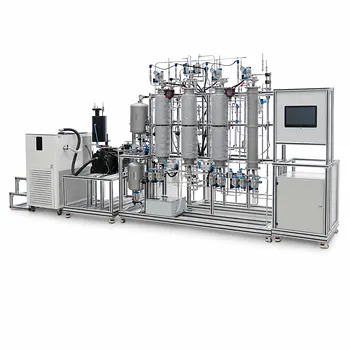
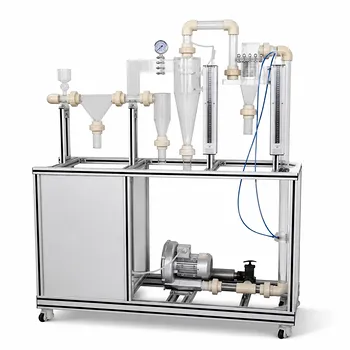
The core distinction between TSA and PSA in a gas separation pilot plant centers on the regeneration mechanism and the resulting cycle dynamics. Temperature Swing Adsorption (TSA) relies on temperature changes—adsorbing at low temperatures and desorbing with high-temperature purge gases. This process is inherently slow because solid adsorbents have poor thermal conductivity, leading to cycle times often measured in hours. In contrast, Pressure Swing Adsorption (PSA) regenerates the adsorbent by changing pressure under near-isothermal conditions, with adsorption at high pressure and desorption at low pressure or vacuum. Pressure changes propagate quickly, enabling rapid cycles that can be completed in minutes.
Your selection between TSA and PSA defines both the speed of experimentation and the type of separation phenomena you can investigate. TSA is the go‑to when you need to study thermal regeneration and trace impurity removal, while PSA unlocks high‑throughput, rapid‑cycle studies ideal for bulk gas purification and air drying.
The Fundamental Process Differences
Regeneration Mechanism: Heat vs. Pressure
TSA forces adsorbed components off the solid surface by raising the bed temperature. A hot purge gas (often steam or inert gas) provides the thermal energy to overcome the adsorbate‑surface interactions. This makes TSA particularly effective for strongly held species—like volatile organic compounds (VOCs) that would not desorb easily with pressure swings alone.
PSA achieves regeneration by reducing the partial pressure of the adsorbed component. A simple pressure drop—often down to atmospheric pressure or vacuum—shifts the adsorption equilibrium, releasing the gas molecules without requiring external heat. This purely physical pressure swing keeps the system close to isothermal and eliminates the energy penalty of heating and cooling.
Cycle Duration and Thermal Dynamics
TSA cycle times are dominated by heat transfer limitations. Heating a packed bed of adsorbent to desorption temperature (e.g., 363 K or higher) and then cooling it back down can stretch from 60 to over 200 minutes. These long, thermal‑inertia‑driven cycles limit how many experimental runs you can perform in a single lab session.
PSA cycles are orders of magnitude faster—typically 5 to 60 minutes. Because pressure changes travel through the bed at the speed of sound, the adsorbent can be swung between high‑pressure feed and low‑pressure regeneration in a matter of seconds. This rapid cycling is what makes PSA the workhorse for high‑capacity industrial separations like hydrogen purification or oxygen generation.
How These Differences Impact Pilot Plant Operation
Experimental Throughput and Learning Speed
In a teaching or research pilot plant, PSA’s fast cycles mean you can run multiple parameter studies in a single lab period. Students can quickly adjust cycle times, pressure ratios, or adsorbent types and immediately observe the effect on purity and recovery.
TSA pilot plants, by contrast, demand patience. A single full cycle can eat up an entire morning. This is not a drawback if your goal is to study thermal regeneration dynamics, bed temperature profiles, or energy integration strategies—but it drastically reduces the number of experiments you can complete in a given timeframe.
Energy Needs and Operational Complexity
PSA’s main energy input is compression of the feed gas. It requires no external heating, making it simpler and often more energy‑efficient for bulk separations. The plant itself can be relatively straightforward, with fewer high‑temperature safety hazards.
TSA involves heating and cooling systems—heat exchangers, steam generators, or electric heaters—plus the need to manage hot purge gases. This adds operational complexity and energy consumption, yet it opens the door to investigating real‑world challenges like heat integration, hot spot formation, and condensate recovery of desorbed VOCs. In VOC recovery pilot plants, operators must carefully monitor temperature and concentration limits (like lower explosive limits) to avoid unsafe conditions in the regeneration loop.
Understanding the Trade‑offs in Pilot Plant Selection
Every choice involves compromises that directly affect the scope and depth of your experiments.
- With TSA, you gain the ability to handle strongly adsorbed, high‑boiling components that PSA cannot easily remove. But you pay for it with slower cycles, higher utility costs, and more complex safety protocols. TSA is ill‑suited for rapid parameter screening or for situations where you need dozens of separation‑regeneration cycles per day.
- With PSA, you get speed, simplicity, and high‑throughput operation. Yet PSA struggles when the adsorbate holds on too tightly—regeneration by pressure alone may leave a heel of impurity that slowly poisons the bed. PSA cycles also require careful valve timing and may need vacuum pumps for deep desorption, which adds capital cost.
- Testing breadth: Incorporating a TSA pilot plant gives students and researchers hands‑on experience with thermal effects, while PSA teaches the importance of pressure‑swing dynamics, void volumes, and compression costs. The two are complementary, not interchangeable, and many academic programs eventually need both to fully cover unit operations.
Making the Right Choice for Your Pilot Plant Goals
The best pilot plant is the one that aligns with the problems you need to solve. Use these goal‑driven guidelines to decide.
- If your primary focus is studying thermal regeneration, heat transfer limitations, or VOC recovery: Choose a TSA system. It will let you map temperature gradients, optimize purge gas flow, and investigate real‑world safety constraints like solvent flammability.
- If your primary focus is rapid parametric testing, bulk gas purification, or air drying: Choose a PSA system. Its quick cycles will maximize experimental throughput and allow you to explore pressure ratios, cycle schedules, and adsorbent screening within a normal lab schedule.
- If your primary focus is demonstrating a complete spectrum of industrial adsorption processes: Invest in both TSA and PSA modules. Together they teach the contrasting thermodynamic levers—temperature vs. pressure—that dominate commercial gas separation design.
A pilot plant’s value lies not just in its hardware, but in the specific separation science it lets you explore. Align the regeneration principle with your research questions, and the plant will deliver insights that scale from the lab bench to full‑scale industry.
Summary Table:
| Feature | Temperature Swing Adsorption (TSA) | Pressure Swing Adsorption (PSA) |
|---|---|---|
| Regeneration Method | Thermal swing (heating & cooling) | Pressure swing (isothermal) |
| Cycle Duration | Slow (60 to 200+ minutes) | Fast (5 to 60 minutes) |
| Primary Energy Input | Thermal energy (steam, electric heaters) | Mechanical energy (feed gas compression) |
| Best Suited For | Trace impurity removal, VOC recovery | Bulk gas separation, air drying |
| Key Experimental Value | Studying heat transfer & thermal regeneration | Studying high-throughput & rapid cycle dynamics |
Ready to Upgrade Your Chemical Engineering Lab?
Choosing between TSA and PSA depends on your specific teaching and research objectives. LABPARK provides state-of-the-art Educational and Vocational Unit Operations Pilot Plants in chemical engineering, bioprocess & biotech, and environmental & water treatment.
We help universities, research institutes, and enterprises implement robust, industry-grade pilot systems designed for hands-on learning and advanced research.
Contact LABPARK today to discuss your pilot plant requirements and get a customized solution!
Related Products
- Bench Scale Dual Column Gas Separation and Capture Educational Pilot Plant
- Multi-Component Gas Pressure Swing Adsorption Pilot Plant for Unit Operations Education
- Pressure Swing Adsorption Educational Unit Operations Pilot Plant
- Educational Pressure Swing Adsorption Ethylene Capture Unit Operations Pilot Plant
- Gas-Solid Heterogeneous Separation Demonstration Educational Unit Operations Pilot Plant
People Also Ask
- What are the key thermodynamic considerations for gas mixture modeling? Expert Guide
- How does the separation mechanism of gas permeation differ from liquid membrane processes? Pilot Plant Guide
- Why Are Binary Interaction Parameters Critical for Gas Separation Pilot Plants? Avoid Costly Failures
- Which membrane materials are commonly used in gas separation pilot plants, and how is membrane fouling typically managed?
- Why is Graham's Law critical for gas separation in pilot plants? Master Unit Operations Design