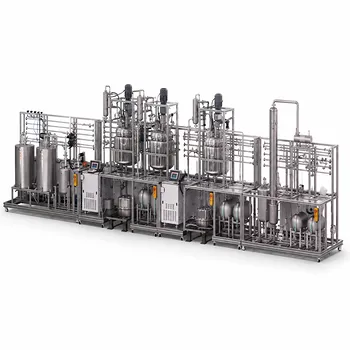
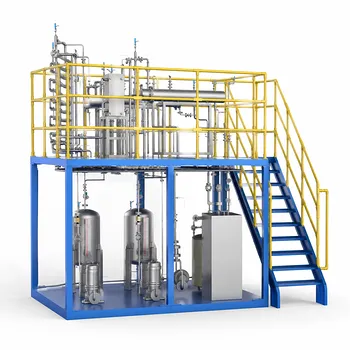
For a chemical engineering unit operations pilot plant, the salvage value is almost never a financial linchpin. It is typically estimated as an extremely modest figure—generally below 10% of the initial inside-battery-limits (ISBL) investment—and is often entirely excluded from formal profitability analysis because its value, when discounted back to the present, is negligible. However, a prudent lifecycle budget must still account for the complete end-of-project cash flows, which include the recovery of working capital and any decommissioning costs, to create a realistic institutional asset management plan.
Although a pilot plant’s end-of-life scrap or resale value rarely exceeds 10% of the original equipment cost, the true terminal cash flow also includes the recovery of working capital. For long-term institutional planning, it is essential to include a conservative (and often near-zero) salvage estimate to avoid unrealistic budget forecasts, even while recognizing that standard discounted cash flow analysis can safely ignore this component due to its minimal present value impact.
The Composition of Terminal Cash Flows
When a chemical engineering pilot plant reaches the end of its useful life, the terminal cash flow is not a single number. It is a combination of recovered assets and necessary expenditures that together determine the net cash movement.
The Two Inflows: Salvage and Working Capital
The salvage value is the amount the institution can realize by selling the unit operations equipment for scrap or resale.
Working capital—the cash tied up in raw materials, in-process inventory, and spare parts—is fully recovered when the pilot plant ceases operation. This recovery is often significantly larger than the salvage value itself and is the primary reason a project’s final cash flow can be positive.
The Potential Outflow: Decommissioning Costs
Decommissioning costs (dismantling, hazardous material disposal, site restoration) can partially or fully offset any salvage inflows. In some cases, especially with highly specialized or contaminated equipment, the net terminal cash flow can even be negative.
Estimating Salvage Value: The <10% Rule and its Nuances
Your primary budgeting anchor for pilot plant equipment is straightforward but grounded in industrial project economics.
The Core Estimate: Under 10%
For unit operations pilot plants, the scrap or resale value is consistently observed to fall below 10% of the initial ISBL investment. This figure reflects the highly specialized, often custom-built nature of the equipment and the limited secondary market.
Why Resale Value is So Low
Pilot plants are designed for flexibility and research, not for high-volume production. Their value to another organization is diminished by technology obsolescence, the cost of reconfiguration, and the absence of standardized, plug-and-play components.
Moving from a Class 5 to a Realistic Estimate
Early in project planning, a Class 5 “order of magnitude” estimate (accuracy ±30–50%) is sufficient to flag the salvage value as a minor line item. As the budget matures, simply refining this to a specific percentage (e.g., 5% of ISBL) without extensive engineering detail is pragmatically adequate, because end-of-life accuracy has almost no impact on the project’s overall economic merit.
The Discounting Effect: Why Profitability Analysis Ignores Salvage
Standard profitability metrics like Net Present Value (NPV) and Internal Rate of Return (IRR) rely on the principle of the time value of money.
Present Value Makes Future Dollars Disappear
Using the core formula PV = FV / (1 + i)^n, where “i” is the discount rate and “n” is the year, a salvage value occurring 15-20 years in the future is discounted so heavily that its present value contribution becomes inconsequential. For example, even a relatively large salvage inflow discounted over two decades at a 10% rate shrinks to less than 15% of its face value, often well within the margin of error of the overall project cost estimate.
The Exception: The After-Tax Context
When an analysis considers taxes, salvage value can interact with the depreciation tax shield. If the equipment is sold for more than its book value, a tax liability on the recaptured depreciation may be triggered, slightly reducing the net terminal inflow. Conversely, a sale below book value can generate a tax loss benefit. These effects, while academically correct, are almost never material for the small-scale pilot plant.
When and Why End-of-Life Estimates Still Matter
Despite their negligible impact on discounted profitability, terminal cash flow estimates are not useless. They serve a distinct institutional purpose.
Realistic Asset Management and Replacement Planning
During the procurement and institutional planning phase, understanding that the equipment will likely return less than 10% of its purchase price prevents over-optimistic depreciation schedules and ensures that future replacement budgets are based on securing new capital rather than relying on a trade-in.
Budgeting for the Complete Lifecycle
A lifecycle budget must look at all five project phases, including Phase 5: End-of-Life. Ignoring decommissioning costs or assuming a high resale value creates a hidden funding gap. Including a conservative, near-zero net salvage value build resilience into the laboratory or enterprise’s long-term financial model.
Understanding the Trade-offs and Common Pitfalls
A clear-eyed view of end-of-life estimation requires acknowledging what can go wrong.
The Trap of Overestimating Resale Value
Assuming that high-quality stainless-steel unit operations skids will hold their value is a mistake. Obsolescence, specialization, and relocation costs typically erode resale value to scrap metal levels.
Neglecting Decommissioning Costs
Budgets that only account for the salvage income often forget the cost of safely disconnecting gas, power, and utilities. Net salvage can become negative, turning a presumed small gain into an unplanned expense.
Mismatching the Estimation Accuracy
Applying a high-accuracy Class 2 estimate (±5–10%) to a salvage value component that is inherently uncertain and strategically insignificant wastes engineering resources. End-of-life estimates are best kept as simple, conservative percentages of the initial capital expenditure.
Making the Right Choice for Your Goal
How you handle end-of-life cash flows should align directly with the purpose of your estimation exercise.
- If your primary focus is a classic NPV/IRR profitability analysis: Exclude salvage value entirely from the discounted cash flow model. Its present value contribution is negligible, and exclusion simplifies the analysis without affecting the decision.
- If your primary focus is accurate lifecycle budgeting for grant proposals or institutional capital planning: Include a conservative terminal cash flow estimate. Use a scrap value of 0–5% of the initial ISBL investment, add the full recovery of any working capital, and deduct a reasonable allowance for decommissioning costs to arrive at a realistic net end-of-life position.
- If your primary focus is comparing upgrade options (e.g., Incremental ROI): Ignore terminal values for the old equipment. Focus the evaluation solely on incremental profit and incremental investment over the project’s operating life, as the end-of-life difference between scenarios will likely be immaterial.
- If your primary focus is an educational classroom exercise: Emphasize the conceptual distinction between recovering working capital (a real cash inflow) and a minimal salvage scrap value. Use a simple, predefined rate (e.g., 5% of ISBL) to reinforce the principle of terminal cash flows without distorting the learning objective of discounted cash flow analysis.
Ultimately, a sound lifecycle budget treats the pilot plant’s salvage value as a minor, conservative estimate—recognizing its existence for planning integrity but never relying on it to make the investment case financially viable.
Summary Table:
| Terminal Cash Flow Component | Typical Value / Estimate | Budget Impact & Planning Action |
|---|---|---|
| Salvage Value | < 10% of initial ISBL investment | Keep conservative; negligible in discounted NPV/IRR models due to long timeframes. |
| Working Capital Recovery | 100% of raw materials & spare parts | Represents the primary positive cash inflow at the end of the project life. |
| Decommissioning Costs | Varies (dismantling & disposal) | Essential to include; can offset salvage gains and lead to a net terminal outflow. |
| Net Terminal Cash Flow | Often near-zero or slightly negative | Critical for institutional asset management, replacement planning, and grants. |
Optimize Your Lab’s Lifecycle Budget with LABPARK
Planning a pilot plant project involves complex long-term financial and technical decisions. LABPARK provides premium Educational and Vocational Unit Operations Pilot Plants in chemical engineering, bioprocess & biotech, and environmental & water treatment tailored for universities, research institutes, and enterprises.
By partnering with us, you gain access to durable, modular, and highly adaptable equipment designed to simplify decommissioning, minimize lifecycle uncertainty, and maximize your educational and research ROI.
Contact LABPARK experts today to receive a customized technical consultation and budget estimation for your laboratory!
Related Products
- Carbon Dioxide Hydrogen Methanol Synthesis Educational Unit Operations Pilot Plant
- Multi Pump Fluid Transport Process Piping Unit Operations Training Pilot Plant
- Natural Product Extraction Unit Operations Training Pilot Plant
- Multi-Modal Distillation Unit Operations Training Pilot Plant
- Multi-Reactor Educational Pilot Plant for Reaction Engineering Unit Operations
People Also Ask
- How do temp & pressure affect methanol synthesis pilot plants? Optimize equilibrium and catalyst performance.
- Why is a purge system necessary when operating a gas recirculation loop in a methanol synthesis pilot plant? (Guide)
- Why do modern methanol pilot plants operate at lower pressures? Catalyst & Feed Requirements Explained
- What are the operational requirements for catalyst activation? Safe Methanol Pilot Plant Operation
- Why is the chemical plant startup schedule crucial? De-risk scale-up with pilot plants.