An azeotropic point is not a minor anomaly—it is a hard thermodynamic wall.
When you spot it on an x‑y vapor‑liquid equilibrium (VLE) diagram, the curve intersects the 45‑degree line at that composition. At that exact mixture, the vapor generated during boiling has the same composition as the liquid. As a result, no further separation can be achieved through standard fractional distillation; the relative volatility drops to 1 and the concentration stops changing no matter how many equilibrium stages you add.
The azeotropic point freezes separation because the driving force for enrichment vanishes. In a pilot plant, this forces you to abandon simple rectification and instead shift the VLE envelope—by changing system pressure or introducing a third component—to create a new, non‑azeotropic region where separation becomes feasible again.
Why the Azeotropic Point Stops Separation Cold
The Intersection on the x‑y Diagram
The x‑y diagram plots the mole fraction of a component in the vapor (y) against its mole fraction in the liquid (x).
Under normal conditions, the curve lies above the 45° line, indicating that the vapor is richer in the more volatile component.
At the azeotropic composition, the curve crosses the 45° line—x equals y. The liquid and vapor are identical, so no composition change occurs during boiling.
Positive vs. Negative Azeotropes: Two Faces of the Same Barrier
Azeotropes come in two forms, but both halt conventional distillation.
Positive azeotropes, like ethanol‑water, boil at a temperature lower than either pure component and form a minimum‑boiling mixture.
Negative azeotropes, such as hydrochloric acid‑water, boil at a temperature higher than the pure components and form a maximum‑boiling mixture.
Regardless of the type, at the azeotropic point the relative volatility α = 1, making fractional distillation powerless.
What This Means for Your Pilot Plant Run
When you approach the azeotrope, column temperatures plateau and no further enrichment occurs beyond the azeotropic composition.
For example, in an ethanol‑water system at atmospheric pressure, you can only reach about 89.4 mol% ethanol by simple rectification; the vapor leaving the top stage stays pinned at that composition.
This is not a malfunction—it is the thermodynamic limit of the system at that pressure.
Turning the Barrier into a Learning Opportunity
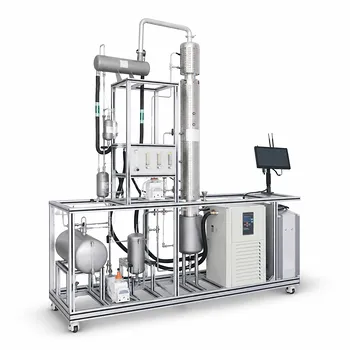
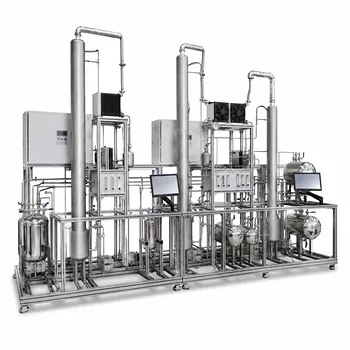
A pilot plant is the ideal environment to investigate how to overcome this hard stop and to validate the separation strategies before scaling up.
Pressure Swing Distillation: Shifting the Goalposts
The azeotropic composition is not fixed; it moves when you change the operating pressure.
Lowering the pressure can shift the azeotropic composition significantly. For the ethanol‑water system, dropping the pressure from 101.33 kPa to 13.33 kPa shifts the azeotropic mole fraction of ethanol from 0.894 to 0.992.
By equipping your pilot column with vacuum capability and precise pressure control, you can demonstrate this shift in real time.
Run the column at two different pressures: the intermediate product from the first column (near the first azeotrope) becomes a feed that can be fully separated in the second, lower‑pressure column.
Azeotropic and Extractive Distillation: Introducing an Entrainer
When pressure swing isn’t practical, you can alter the VLE by adding a third component—an entrainer.
In azeotropic distillation, the entrainer forms a new, low‑boiling azeotrope that carries off one component, allowing the other to be recovered pure.
To run such experiments, your pilot plant needs:
- Multiple feeding ports to optimize the entrainer introduction point
- Precise temperature sensors at multiple stages to track the temperature profile
- Reflux ratio adjustment to control product purity and determine the minimum reflux ratio
These features turn the pilot plant into a hands‑on tutorial for calculating optimal entrainer‑to‑feed ratios and validating ternary VLE models.
Decoding Heterogeneous Azeotropes
When the liquid phase splits into two immiscible layers (due to strong positive deviations from ideality), a heterogeneous azeotrope appears.
The mixture boils at a constant temperature as long as two liquid phases coexist. Once the more volatile liquid phase has evaporated, the remaining homogeneous liquid begins to change composition, and the boiling temperature climbs.
In a pilot plant, you can observe this transition—the pot temperature holds steady, then rises—directly confirming phase splitting in real time.
Common Pitfalls and Trade‑offs When Tackling Azeotropes
Model vs. Reality: VLE Data is a Starting Point
Most VLE diagrams and simulations are built on pure‑solvent systems and ignore the presence of reaction by‑products, intermediates, or trace impurities.
In a real mixture, these components can shift the azeotropic composition or even create an unexpected azeotrope.
Pilot plant runs with actual process fluids are essential to confirm that the assumed thermodynamic behavior holds under real‑world conditions.
The Energy Penalty of Over‑Design
Historical shortcut methods often over‑designed columns to compensate for imprecise VLE data—leading to extra stages, oversized reboilers, and excessive reflux ratios.
While safe, this approach bloats energy consumption. Operating the pilot plant lets you pinpoint the true minimum reflux and optimum number of stages, avoiding the over‑design penalty.
Trade‑off: Pressure‑swing systems require vacuum pumps and tighter seals, adding capital and maintenance costs. Entrainer processes introduce an additional separation step to recover the entrainer.
Ternary Distillation Boundaries: Invisible Cages
In ternary systems, distillation boundaries divide the phase diagram into separate regions.
Mass balance lines cannot cross these boundaries with simple rectification—if your feed lies in one region, you cannot obtain a pure product located in another.
To break through, your pilot plant can test extractive, salt‑effect, or reactive distillation. These methods add a solvent, salt, or reactant to alter the relative volatility and shift or bypass the boundaries. However, the added complexity demands careful control and a thorough understanding of the ternary phase diagram.
Making the Right Moves in Your Pilot Plant
- If your primary focus is teaching thermodynamic fundamentals: Map the x‑y diagram by sampling liquid and vapor at total reflux, and let students physically trace the azeotropic pinch point where compositions become equal.
- If your primary focus is validating a pressure‑swing process: Run the same feed at multiple pressures and record the shift in azeotropic composition, confirming that the required pressure differential is achievable and economic.
- If your primary focus is scaling up an entrainer‑based separation: Use the pilot plant to optimize the entrainer‑to‑feed ratio, determine the best feed‑plate location, and calculate the minimum reflux ratio at targeted product purities.
- If you encounter an unexpected azeotrope during a run: First check for liquid‑phase splitting that indicates a heterogeneous azeotrope, then explore moderate pressure changes to see if the azeotrope shifts enough to complete the separation.
Ultimately, the azeotropic point does not spell failure—it transforms your distillation pilot plant from a simple fractionation device into a powerful investigative tool for non‑ideal thermodynamics.
Summary Table:
| Strategy | Separation Mechanism | Pilot Plant Requirements |
|---|---|---|
| Pressure Swing | Shifts azeotropic composition by changing system pressure | Vacuum capability & precise pressure control |
| Azeotropic/Extractive | Adds a third component (entrainer) to alter relative volatility | Multiple feed ports & precise stage temperature sensors |
| Heterogeneous Azeotrope | Exploits liquid-phase splitting into two immiscible layers | Phase separation monitoring & decanter integration |
Bring Advanced Thermodynamics to Life with LABPARK Pilot Plants
Are you looking to teach complex separation processes or validate scale-up models for non-ideal mixtures? LABPARK designs and manufactures high-performance Educational and Vocational Unit Operations Pilot Plants tailored for universities, research institutes, and enterprises.
Whether your focus is chemical engineering, bioprocess & biotech, or environmental & water treatment, our systems feature:
- Flexible Configurations: Easily test pressure-swing, extractive, and multi-stage distillation.
- Industrial-Grade Controls: Precise pressure, temperature, and reflux ratio adjustments to accurately map VLE behavior.
- Robust Scale-Up Validation: Safely run real-world mixtures to optimize your commercial designs.
Don't let thermodynamic barriers slow down your research or training. Contact LABPARK today to customize a pilot plant solution that meets your exact educational and research goals!
Related Products
- Continuous Sieve-Plate Distillation Pilot Plant for Unit Operations Laboratory Education
- Multi-Modal Distillation Unit Operations Training Pilot Plant
- Green Anhydrous Ethanol Purification Extractive Distillation Unit Operations Training Pilot Plant
- Dual-Mode Rectification Pilot Plant for Practical Training Unit Operations
- Ethyl Acetate Synthesis Unit Operations Pilot Plant for Practical Training
People Also Ask
- Why is vacuum operation capability an essential feature for a distillation unit operations pilot plant? Unlock Efficiency
- What are the primary reflux ratio control strategies? Master Distillation Unit Operations
- How does catalyst water concentration affect distillation pilot plant design? Key separation train choices.
- How to select the right activity coefficient model (Wilson, NRTL, UNIQUAC) for distillation pilot plants?
- How can real-time carbon number prediction improve distillation pilot plants? Optimize control.