Because the theoretical map you are using stops being accurate precisely when the material enters the most operationally dangerous territory. The extended corresponding states method is a powerful shortcut for predicting a fluid's viscosity and thermal conductivity from basic thermodynamic data. However, it fundamentally breaks down when the fluid's density approaches or exceeds its critical density—a condition exactly like the one found inside high-pressure pilot plants for separations and supercritical reactions. If students don’t grasp this limitation, they will unknowingly build their heat exchanger and column designs on "predicted" values that can be dramatically wrong.
The core takeaway is that theoretical models have a defined job scope, and that scope is often violated in real pilot plant operations. For dense gases and non-ideal mixtures, the standard corresponding states method fails as a predictive tool. Therefore, the real lesson for students isn't just about viscosity; it’s that engineering safety and accuracy demand they always cross-validate any theoretical prediction with direct physical measurement from the pilot plant’s own instrumentation.
The Danger of "Black Box" Predictive Models
Chemical engineering students are trained to seek elegant, generalized solutions. But pilot plants are designed to teach the messy gap between theory and reality.
Where the Equations Lose Their Grip
The extended corresponding states method works by scaling the properties of a target fluid against a well-known reference fluid using critical temperature, critical pressure, and the acentric factor. This is elegant, but strictly empirical.
The critical flaw emerges when the ratio of a fluid's density to its critical density ($\rho/\rho^c$) is greater than or equal to 1. In this dense-phase or supercritical region, the simple scaling relationships break down. The model can no longer accurately map the complex, multi-body molecular interactions that govern viscosity and thermal conductivity.
A 10% Input Error, a Catastrophic Sizing Failure
In an educational setting, a miscalculation can lead to a confusing result. In practice, it's dangerous. A seemingly minor 10% deviation in a predicted gas viscosity value profoundly alters the calculated vessel diameter for a fractionator or an absorber.
Getting the viscosity wrong cascades into incorrect Reynolds numbers, false pressure drop calculations, and ultimately, a pilot plant that cannot achieve its design separation efficiency or heat transfer rate. Teaching this limitation forces students to confront the direct, causal link between an abstract transport property and a tangible, expensive piece of stainless steel.
Moving Beyond a Broken Model
Once the limitation is understood, the educational objective shifts from pure prediction to a sophisticated cycle of correction and validation.
Theory with a Correction Factor
Recognizing a model's failure is the first step; applying a physics-based fix is the next. When the standard corresponding states method fails, it can be rescued by incorporating density-dependent correction factors, often derived from the Modified Enskog Theory. These corrections explicitly account for the transfer of momentum and energy during molecular collisions at high densities that the simpler method ignores. This teaches students that a model’s accuracy can be extended, but only by adding back the physics you previously simplified away.
The Primacy of Physical Measurement
The pilot plant instrument is the ultimate source of truth. A rotameter's reading, a differential pressure cell across a reactor bed, and a thermocouple’s temperature profile on a heat exchanger surface all contain direct, empirical evidence of the real transport properties at play.
The lesson is to close the loop. Students must learn to use the theoretical model to form an initial hypothesis, but then use the pilot plant data to calculate the actual, operationally-true transport properties. Discrepancies between the model and the measurement aren’t a failed experiment; they are the most valuable data point, revealing non-idealities in the fluid mixture.
Understanding the Trade-offs
Objective instruction requires outlining where this method is appropriate and where common mistakes are made.
When Corresponding States is Sufficient
This is not an argument to discard a valuable tool. For simple, non-polar fluids like nitrogen or light hydrocarbons far from their critical point, kinetic theory and the corresponding states principle provide excellent estimates. In these gentle, dilute-gas conditions, the method’s speed and generality make it the right tool for preliminary design. The skill is in identifying the boundary.
The Pitfall of Nonconformal Mixtures
The most insidious errors occur with complex mixtures, where the method’s foundational assumptions collapse entirely. A common student mistake is to blindly apply a model calibrated for simple, spherical molecules to a nonconformal mixture containing polar compounds or long-chain hydrocarbons. The single acentric factor cannot capture this molecular complexity. The result isn't just an error; it's a prediction that is structurally incapable of describing the fluid's true behavior, making experimental validation not just helpful, but mandatory.
Making the Right Choice for Educational Objectives
Integrating these limitations into pilot plant instruction shapes better engineers. Here is how to apply these concepts based on your teaching goals.
- If your primary focus is teaching fundamental process control: Force students to compare the theoretical heat transfer duty of a heat exchanger with the duty calculated directly from the experimental flow rates and inlet/outlet temperatures. The gap they find will naturally illustrate the limitation.
- If your primary focus is on safe equipment design: Assign a problem where students must size a high-pressure separator for a supercritical fluid using both an uncorrected corresponding states model and one with a density correction. The difference in calculated vessel diameter, and the associated cost and safety implications, will make the lesson concrete.
- If your primary focus is on research methodology: Require that every process simulation be paired with a direct experimental measurement plan from the pilot plant for at least one critical transport property, framing the theoretical model as a sanity check, not the design basis.
The overriding lesson is that a model is only a temporary substitute for direct observation, and in the dense, high-pressure reality of a chemical pilot plant, direct observation through instrumentation is the only path to true understanding.
Summary Table:
| Fluid State / Region | Model Accuracy | Limitation & Impact | Recommended Action |
|---|---|---|---|
| Low-Density / Simple Fluids | High | Accurate for non-polar fluids far from critical point | Use standard corresponding states for quick estimation |
| Dense & Supercritical Phases ($\rho/\rho^c \ge 1$) | Low (Fails) | Fails to map multi-body interactions; causes sizing errors | Apply density corrections (e.g., Modified Enskog Theory) |
| Nonconformal Mixtures | Extremely Low | Cannot capture polar or long-chain molecular complexity | Validate theoretical predictions with direct instrument data |
Bridge the Gap Between Chemical Engineering Theory and Practice
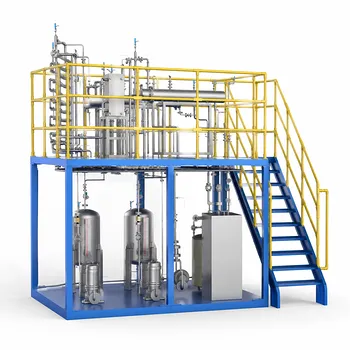
Equip your students and researchers with the hands-on tools they need to validate theoretical models. LABPARK provides high-quality Educational and Vocational Unit Operations Pilot Plants in chemical engineering, bioprocess & biotech, and environmental & water treatment for universities, research institutes, and enterprises.
By integrating our pilot plants into your curriculum, you can help students transition from abstract transport phenomena equations to real-world physical verification, ensuring safety and precision in process design.
Contact LABPARK today to find the perfect pilot plant solution for your lab!
Related Products
- Carbon Dioxide Hydrogen Methanol Synthesis Educational Unit Operations Pilot Plant
- Multi Pump Fluid Transport Process Piping Unit Operations Training Pilot Plant
- Natural Product Extraction Unit Operations Training Pilot Plant
- Multi-Modal Distillation Unit Operations Training Pilot Plant
- Multi-Reactor Educational Pilot Plant for Reaction Engineering Unit Operations
People Also Ask
- How do temp & pressure affect methanol synthesis pilot plants? Optimize equilibrium and catalyst performance.
- Why is a purge system necessary when operating a gas recirculation loop in a methanol synthesis pilot plant? (Guide)
- Why do modern methanol pilot plants operate at lower pressures? Catalyst & Feed Requirements Explained
- What are the operational requirements for catalyst activation? Safe Methanol Pilot Plant Operation
- Why is the chemical plant startup schedule crucial? De-risk scale-up with pilot plants.