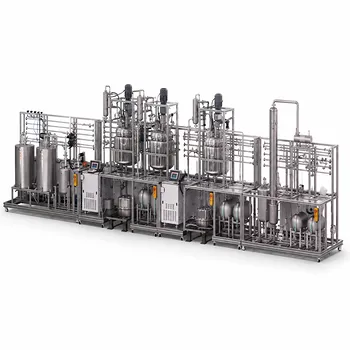
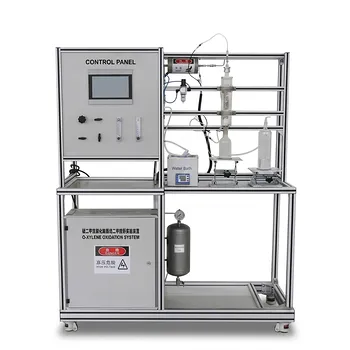
Effective heat management in a Fischer-Tropsch (FT) pilot plant hinges on integrating reactor features that maximize heat removal area and maintain intimate contact between the reaction zone and a coolant. The most proven configurations for handling the intense exothermicity (roughly 145 kJ per mole of –CH2– formed) are multitubular fixed beds with boiling water, slurry-phase reactors with internal cooling coils, fluidized beds with immersed coolant tubes, and emerging monolithic loop reactors with liquid recycle. These designs turn the fundamental challenge of removing heat safely into a teachable platform for studying transport phenomena and reactor control.
The unifying principle is to provide a short path for heat transfer and a large heat sink. In practice, this means choosing a reactor that either surrounds the catalyst with coolant, submerges the reaction in a liquid bath, or uses vigorous solids mixing to erase temperature gradients—all while making the heat removal process visible and measurable for an educational environment.
Why Heat Management Defines FT Pilot Plant Design
The Exothermic Reality of Carbon Chain Growth
Every carbon-carbon bond formed in Fischer-Tropsch synthesis liberates a substantial quantity of heat. Without immediate, effective removal, the catalyst bed can overheat, causing thermal runaway, rapid deactivation, and a dangerous loss of selectivity toward desired hydrocarbons. In a pilot plant, demonstrating how to tame this energy release is as important as the synthesis itself.
Safety and Educational Goals
A pilot plant is a sandbox for understanding industrial-scale risks. The design must prevent hot spots, maintain isothermal operation, and allow students to directly observe how coolant flow, agitation, or gas recycle influences temperature. The reactor design thus becomes a living lab for the “three transfers and one reaction”—mass, heat, momentum transfer coupled with kinetics.
Essential Reactor Configurations for Heat Removal
Multitubular Fixed Bed Reactors
This design packs the catalyst inside hundreds of narrow tubes (often ~0.05 m diameter), closely resembling a shell-and-tube heat exchanger. Boiling water circulates on the shell side. As the reaction proceeds, heat is absorbed by the water, generating steam at a controlled pressure and temperature. This boiling mechanism provides an exceptionally high heat transfer coefficient and effectively clamps the tube wall temperature. High linear gas velocities and syngas recycle further boost convective heat removal from the catalyst bed.
Slurry-Phase Reactors
Here, fine catalyst particles are suspended in a liquid wax medium. The liquid’s high thermal mass and the continuous flow pattern create superior heat distribution compared to a gas-solid system. Submerged cooling coils carry boiler feed water or thermal fluid through the slurry, removing the heat of reaction directly at the source. This configuration virtually eliminates radial temperature gradients and provides outstanding thermal stability, making it ideal for studying FT kinetics in a near-isothermal environment.
Fluidized Bed Reactors
Turbulent mixing of gas and catalyst solids in a fluidized state leads to rapid temperature equalization. Immersed cooling coils fed with water or thermal oil extract the majority of the heat generated. The remaining energy is swept out with the product and recycle gases. Because the entire bed behaves as a single thermal zone, fluidized bed pilots excel at demonstrating large-scale temperature control and steady-state operation, even at high-temperature FT conditions.
Monolithic Loop Reactors (Emerging Educational Tool)
A modern alternative uses a monolithic catalyst support with a high surface-to-volume ratio and very low pressure drop. The reaction heat is managed by recycling a cold liquid or gas effluent through an external heat exchanger before returning it to the reactor. This loop limits the temperature rise across the catalyst bed to a few degrees, creating a safe, controllable platform. It is particularly valuable for educational settings, as it physically separates the cooling duty from the reaction zone, simplifying instrumentation and spotlighting the link between recycle ratio and temperature control.
Understanding the Trade-offs
Multitubular: Hotspots and Pressure Drop
Despite their industrial relevance, fixed bed tubes can develop radial temperature profiles if gas velocity is too low, and the high velocities needed for heat removal cause significant pressure drop. The presence of boiling water on the shell side also demands strict pressure vessel safety trains.
Slurry-Phase: Sedimentation and Attrition
The liquid medium offers superb heat transfer but introduces challenges of catalyst settling and separation from the wax product. Fine particles can agglomerate, reducing the effective active area, while mechanical stirring can erode catalyst particles over long runs.
Fluidized Beds: Attrition and Erosion
Vigorous particle motion guarantees thermal uniformity, yet it accelerates catalyst attrition—the formation of fines—and causes erosion of internal cooling coils and reactor walls. Maintaining proper fluidization quality requires careful control of gas distributor design and particle size distribution.
Monolithic Loops: Channeling and Scale-Up
While trivial from a heat-removal perspective, monoliths can suffer from maldistribution of flow, leading to underutilized channels. The design is relatively new for FT, so robust scale-up correlations are less mature than for traditional reactors.
Making the Right Choice for Your Pilot Plant
Base your selection on what you most need the plant to demonstrate.
- If your primary focus is industrial relevance and steam generation: Choose a multitubular fixed bed with boiling water. It parallels commercial FT reactors and lets students observe the direct link between heat removal and steam production.
- If your primary focus is uniform temperature and intrinsic kinetics study: A slurry-phase reactor with submerged coils provides near-perfect isothermal conditions. Catalyst evaluation and kinetic modeling become far simpler.
- If your primary focus is dynamic solids handling and high-temperature operation: A fluidized bed with internal cooling coils delivers excellent heat transfer coefficients and demonstrates the complexities of fluidization—attrition, elutriation, and distributor design.
- If your primary focus is safety, simplicity, and teaching heat transfer fundamentals: A monolithic loop reactor with external heat exchange offers a transparent system where the temperature rise is directly controlled by the recycle ratio, minimizing risk while maximizing pedagogical clarity.
Every effective FT pilot plant design turns the immense heat release from a hazard into a teachable moment, letting you safely explore the boundary between reaction kinetics and transport phenomena.
Summary Table:
| Reactor Type | Heat Transfer Method | Primary Advantage | Key Challenge |
|---|---|---|---|
| Multitubular Fixed Bed | Boiling water on shell side | Industrial relevance & steam generation | Radial hotspots & pressure drop |
| Slurry-Phase | Submerged cooling coils | Excellent thermal stability; near-isothermal | Catalyst settling & separation |
| Fluidized Bed | Immersed cooling tubes | Rapid temperature equalization | Catalyst attrition & erosion |
| Monolithic Loop | Effluent recycle via external HEX | High safety; simple instrumentation | Flow maldistribution (channeling) |
Scale Up Safely with LABPARK Pilot Plants
Mastering highly exothermic processes like Fischer-Tropsch synthesis requires precision engineering. LABPARK provides premium Educational and Vocational Unit Operations Pilot Plants in chemical engineering, bioprocess & biotech, and environmental & water treatment.
Tailored for universities, research institutes, and enterprises, our advanced systems help you safely demonstrate complex transport phenomena, heat transfer, and reactor control while maximizing hands-on learning and research efficiency.
Ready to upgrade your laboratory? Contact LABPARK today to find the perfect pilot plant configuration for your training and research needs.
Related Products
- Methanol Synthesis and Catalyst Performance Evaluation Educational Unit Operations Pilot Plant
- Ethyl Acetate Synthesis Unit Operations Pilot Plant for Practical Training
- Carbon Dioxide Hydrogenation Methanol Synthesis Educational Unit Operations Pilot Plant
- Crude Benzene Hydrogenation Educational Unit Operations Pilot Plant
- Micro-Scale Gas-Solid Catalytic Reaction Educational Pilot Plant
People Also Ask
- Why is a purge system necessary when operating a gas recirculation loop in a methanol synthesis pilot plant? (Guide)
- How do temp & pressure affect methanol synthesis pilot plants? Optimize equilibrium and catalyst performance.
- Why do modern methanol pilot plants operate at lower pressures? Catalyst & Feed Requirements Explained
- What are the operational requirements for catalyst activation? Safe Methanol Pilot Plant Operation
- Why Compare Predicted and Experimental Excess Enthalpy? Key to Accurate Pilot Plant Scale-up