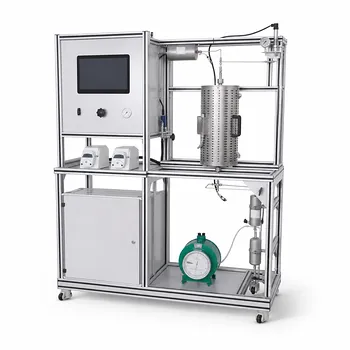
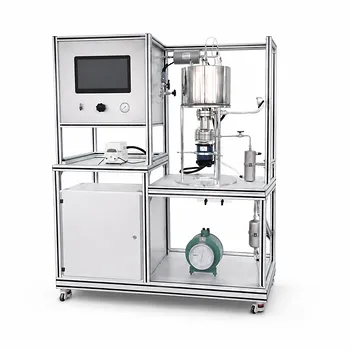
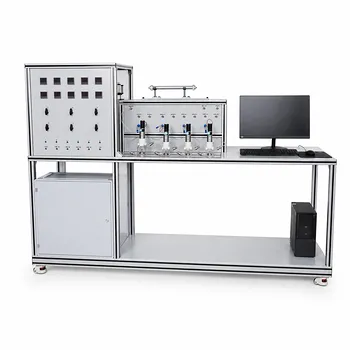
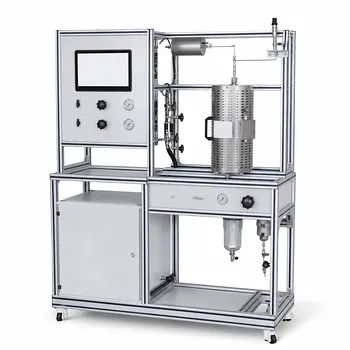
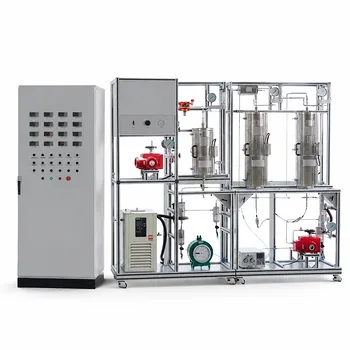
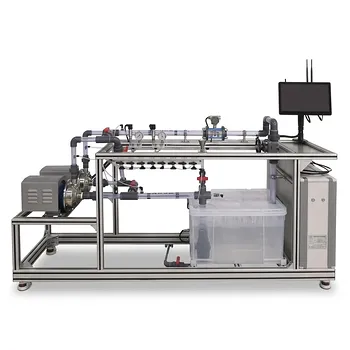
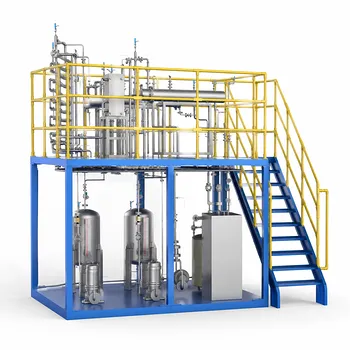
A reactor trainer is more than just a miniature chemical plant—it’s a controlled environment for discovery. The transition from platinum to vanadium-based catalysts in SO₂ oxidation is a laboratory proxy for one of the most consequential industrial shifts in chemical engineering. In a trainer, this transition becomes a hands-on case study that forces students to confront the real-world trade-offs between catalytic activity, poison resistance, and long-term cost. It moves the conversation from abstract theory to measurable, economic decision-making.
The true significance of studying this transition lies in demonstrating that catalyst selection is a multi-objective optimization problem. A laboratory trainer transforms a historical footnote into a reproducible experiment, allowing students to quantify how durability against poisons like arsenic can outweigh raw kinetic performance over an asset’s 10–20 year lifetime.
The Educational Power of a Catalyst Switch
Moving from Theory to Tangible Trade-offs
Platinum’s superior activity is easy to read in a textbook. A reactor trainer lets students experience why that activity was abandoned when exposed to realistic feed impurities.
By doping the SO₂ stream with trace arsenic compounds, the trainer makes catalyst deactivation visible. Students can track conversion decay curves side-by-side and immediately see that platinum’s steep drop makes it economically unviable, while vanadium maintains a stable, albeit lower, baseline.
The Historical Necessity of the Transition
The contact process originally relied on platinum, but raw materials like pyrite often contained arsenic. This poison aggressively deactivated the catalyst, causing frequent shutdowns and costly metal losses.
Vanadium pentoxide on a porous silica carrier solved that crisis. It offers exceptional poison resistance and an active lifetime of 10–20 years, a reality that students can only fully appreciate when they replicate the failure mode of platinum in the lab.
Unpacking the Catalyst Properties in the Lab
Activity vs. Poisoning Resistance
A reactor trainer exposes the core tension. Platinum delivers a higher initial reaction rate, but the surface area is swiftly blocked by arsenic chemisorption. Vanadium catalysts operate with a lower turnover frequency but maintain their active sites for months or years.
Students can run accelerated life tests, measuring the specific poisoning rate constant for each material. This teaches them to evaluate a catalyst not at time zero, but across its entire service life.
The Economics of Catalyst Lifetime
Catalyst cost is more than the price per gram. A trainer that simulates a multi-year industrial campaign can show how vanadium’s longevity translates into fewer shutdowns, lower replacement expenses, and a higher net present value—even with a lower space-time yield.
By attaching cost models to conversion data, students learn that a cheap, poison-tolerant catalyst can be far more profitable than a high-activity, short-lived alternative. This link between chemical kinetics and balance-sheet thinking is the ultimate lesson.
Understanding the Trade-offs in Reactor Trainer Design
The Risk of Oversimplification
A trainer that compares platinum and vanadium only under clean conditions will mislead. Without poison injection, students will wrongly conclude platinum is universally better. The entire educational value hinges on realistically mimicking industrial feeds.
Likewise, the trainer must not ignore temperature and mass transfer effects. Vanadium’s activity is sensitive to the molten salt layer that forms at typical operating temperatures (400–600°C), a nuance that demands careful reactor design to avoid masking the true catalyst behavior.
Ensuring Meaningful Data
Accelerated poisoning tests are powerful but can exaggerate deactivation pathways. A well-designed trainer must balance poison concentration and exposure time to remain kinetically relevant.
Additionally, the porous support structure of vanadium catalysts can introduce internal diffusion limitations that a simple packed-bed trainer may not resolve. Students should be prompted to calculate effectiveness factors and assess whether the observed performance reflects intrinsic kinetics or transport artifacts.
Making the Right Choice for Your Educational Goal
Match the complexity of your catalytic reactor trainer to your curriculum’s primary objective.
- If your primary focus is teaching catalyst deactivation mechanisms: Design the trainer with an online gas analyzer and controllable poison injection. Have students directly measure how arsenic concentration reduces platinum’s active surface area versus vanadium’s steady-state activity.
- If your primary focus is economic analysis and process optimization: Extend the run length to hours or days, and integrate a raw data export for life-cycle costing. Assign tasks that force students to calculate the break-even point where vanadium’s lower initial activity is outweighed by its poison tolerance.
- If your primary focus is hands-on reactor operation and safety: Include a multi-bed adiabatic setup. Let students experience how inter-stage cooling and catalyst loading are adjusted for different catalyst systems, reinforcing the practical knowledge that a catalyst change reshapes the entire reactor design.
Ultimately, the platinum-to-vanadium transition is not just a historical footnote—it is a supremely effective teaching vehicle that transforms abstract selection criteria into concrete, measurable outcomes. A well-designed reactor trainer turns that transition into an unforgettable lesson in the economic DNA of chemical processes.
Summary Table:
| Feature / Catalyst | Platinum (Pt) | Vanadium-based ($V_2O_5$) | Educational / Design Significance |
|---|---|---|---|
| Initial Activity | Exceptionally high | Moderate to low | Demonstrates trade-off between kinetics and durability |
| Poison Resistance | Poor (deactivates via Arsenic) | Excellent long-term resistance | Teaches catalyst life cycle & feed impurities impact |
| Lifespan & Cost | Short lifetime (high cost) | 10–20 years (cost-effective) | Introduces NPV and reactor economics to students |
| Design Complexity | Simple packed bed | Temperature sensitive (400–600°C) | Emphasizes heat control & transport limitations |
Elevate Your Chemical Engineering Lab with LABPARK
Bridging the gap between thermodynamic theory and industrial reality requires precision-engineered lab equipment. LABPARK provides state-of-the-art Educational and Vocational Unit Operations Pilot Plants in chemical engineering, bioprocess & biotech, and environmental & water treatment for universities, research institutes, and enterprises.
Our catalytic reactor trainers allow students to simulate real-world catalyst poisoning, calculate kinetics, and master process economics in a controlled environment.
Ready to upgrade your engineering curriculum? Contact LABPARK today to discover our customizable pilot plant solutions!
Related Products
- Fixed Bed Gas Solid Catalytic Reaction Educational Pilot Plant
- Ethylbenzene Dehydrogenation Educational Unit Operations Pilot Plant
- Fixed-Bed Chemical Reaction and Gas Dust Tar Removal Unit Operations Pilot Plant
- Multi Functional Catalytic Reaction and Reactor Evaluation Educational Unit Operations Pilot Plant
- Micro-Scale Gas-Solid Catalytic Reaction Educational Pilot Plant
People Also Ask
- How do reactor pilot plants safely study gas-solid reactions? Master kinetics with thermal & flow control.
- How does the Mears criterion evaluate transport resistance? Key Guide to Intrinsic Kinetics
- Why is a multibed configuration necessary for exothermic reactions? Optimize your pilot plant trajectory.
- Fluidized vs. Fixed Bed Reactors: Comparing Heat & Complexity in Pilot Plants
- How is the friction factor determined for fixed-bed pilot plants? Select the best pressure drop correlation.