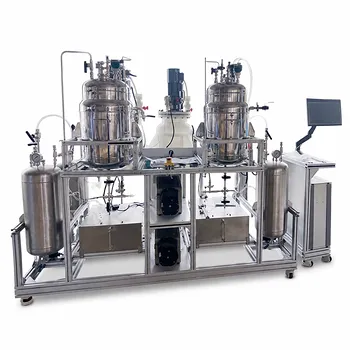
While direct composition measurement is the ideal quality indicator, in a pilot-scale distillation column, the immediate and practical answer is to select an indirect variable—specifically a key temperature in the column. For chemical engineering education, using either the column top temperature ($T_D$) or the temperature of a sensitive tray as the controlled variable is the standard, cost-effective approach that faithfully teaches industrial process control.
The essence of distillation purity control lies in exploiting the fixed physical relationship between temperature and composition at constant pressure. By stabilizing a critical temperature in the column, you indirectly hold the product composition constant, avoiding the high cost, lag, and maintenance headaches of direct online analyzers. This transforms an abstract concept into a hands-on control problem on the pilot plant floor.
Why Direct Composition Control Is Impractical
A student’s first instinct is to measure the thing you care about: the actual mole fraction of the product. However, pilot plants built for education must balance pedagogical value with operational simplicity, and direct measurement creates multiple barriers.
The Cost and Maintenance Burden of Online Analyzers
Online gas chromatographs or spectroscopic probes deliver precise composition data but come with a high capital cost that rarely fits an academic lab budget. Their upkeep requires calibration gases, skilled personnel, and frequent maintenance cycles—all of which detract from student learning time and operational continuity.
The Crippling Impact of Measurement Delay
Even if a direct analyzer were funded, it introduces a significant dead time into the control loop. The analyzer takes a sample, processes it, and reports a value often minutes later. In a dynamic separation process, attempting to control with this delayed signal leads to oscillations and poor stability, turning a lesson on purity control into a lesson on troubleshooting a sluggish loop—before the fundamental principle is understood.
The Temperature-Proxy Principle
With pressure held constant, the boiling point of a binary or multi-component mixture directly corresponds to a unique liquid composition. This transforms a composition control problem into an easier, faster temperature control problem.
How Constant Pressure Locks in the Relationship
According to the vapor-liquid equilibrium (VLE) relationships, at a single operating pressure, every tray temperature maps to a specific liquid composition. If you hold the column pressure dead-still, then stabilizing, say, the vapor space temperature at the top of the column ($T_D$) essentially locks the distillate composition ($x_D$) at its desired value. This link is the foundation of the entire control strategy.
Sensitive Tray vs. Top Temperature
Which temperature should you control? The answer depends on what you intend to demonstrate.
- Column top temperature ($T_D$): This directly correlates with the overhead product quality. When the distillate is the primary product with a tight purity spec, controlling $T_D$ is the most intuitive choice. It’s simple to instrument and directly connected to the purity students measure in the lab.
- Sensitive tray temperature: A sensitive tray is the location in the column where the temperature profile changes most drastically per unit change in composition. Controlling this tray’s temperature is often far more responsive to upsets than the top temperature, making it the preferred variable in industrial practice. It can detect a composition shift long before the disturbance reaches the condenser, enabling proactive correction and letting students observe the column’s dynamic gain.
Designing the Control Channel for Effective Learning
Selecting the point of measurement is only half the story. The manipulated variable you pair with that temperature must form a fast, high-gain control channel. This is where the educational pilot plant truly shines, allowing students to feel the consequences of poor loop pairing.
Manipulated Variables and Their Dynamics
The two classic manipulated variables to control a temperature are reflux flow rate and the reboiler heating medium flow rate. Their dynamic responses are starkly different, and this contrast is a vital teaching moment.
- Reflux flow rate: Manipulating the reflux acts directly on the internal liquid traffic in the top of the column. The time constant is small because a change at the reflux valve quickly alters the liquid on the top tray and thus the vapor composition. This yields a responsive loop that students can tune with simple P/PID methods.
- Heating medium (steam) flow rate: Changing the reboiler duty first boils more liquid, which must propagate as increased vapor flow up the column. The process dead time and time constant are much larger, making the loop sluggish and prone to instability if tuned aggressively. Demonstrating this on a physical column teaches the criticality of dead-time compensation more powerfully than any simulation.
Inventory Loops as a Foundation
A pilot plant is unstable unless its material balance is stabilized first. The top and bottom liquid levels (reflux accumulator and reboiler sump) must be controlled autonomously. If these inventory loops are not tightly tuned, the temperature control loop will fight an unsteady flow regime, generating confusion rather than insight. Students must learn that liquid inventory control is not the same as purity control; they are separate degrees of freedom.
Understanding the Trade-offs
No control strategy is without compromise. Presenting these limitations honestly builds the objectivity expected from a technical advisor.
The Pressure Stability Assumption Is Brittle
The entire temperature-as-composition proxy collapses the moment the column pressure drifts. A pressure control loop (often manipulating condenser duty) is an absolute prerequisite. If pressure varies, the same temperature can correspond to very different compositions. The lesson: pressure control is not an afterthought; it’s the enabler of the entire purity control scheme.
Energy Costs and the Reflux Gamble
The simplest way to increase purity deviation correction is to increase reflux ratio. However, this directly hikes the reboiler energy demand. In an educational setting, there’s a temptation to over-reflux for “safe” operation. Students must quantify this trade-off: a 10% purity over-spec may double the energy consumption, a brutal reality of industrial distillation economics.
No Proxy Is Perfect Without Equilibrium
The assumption that temperature equals composition works perfectly only at thermodynamic equilibrium. Tray efficiencies, entrainment, or flooding conditions during student-led experiments can break this relationship. The measured temperature may lag or misrepresent the average tray composition, teaching the limits of equilibrium-based models.
Making the Right Choice for Your Educational Goal
The final selection of the controlled variable should map directly to the learning outcomes you want to reinforce in the pilot plant.
- If your primary focus is teaching fundamental steady-state separation principles: Select the column top temperature ($T_D$) with constant reflux ratio operation. This makes the separation principle transparent and directly linkable to the McCabe-Thiele diagram they’ve drawn in class.
- If your primary focus is teaching industrial process dynamics and loop tuning: Choose the sensitive tray temperature controlled by reflux flow rate. This setup offers fast dynamics, requiring students to tune PID parameters and observe cascading effects, mimicking how plants actually optimize column performance.
- If your primary focus is comparing control channel quality and dead-time compensation: Install both a reflux-to-sensitive-tray loop and a steam-to-sensitive-tray loop, and let students switch between them. The drastic difference in controllability will anchor the importance of process gain and dead time in their minds permanently.
- If your primary focus is demonstrating operational troubleshooting: Deliberately include a pressure disturbance experiment. Have students try to control purity with temperature while the pressure loop is malfunctioning. The resulting product swings will underscore why a single controlled variable is never enough in an integrated unit operation.
By selecting a temperature proxy that aligns with your core teaching goal, you transform the pilot plant from a mere piece of hardware into a definitive, experience-based lesson in the art and science of process control.
Summary Table:
| Controlled Variable Option | Key Advantage | Best Educational Use Case |
|---|---|---|
| Column Top Temperature ($T_D$) | Directly correlates with distillate quality; easy to conceptualize. | Teaching fundamental steady-state separation and McCabe-Thiele verification. |
| Sensitive Tray Temperature | Fast response to dynamic changes; detects upsets before they reach the top. | Teaching industrial process dynamics, PID loop tuning, and disturbance rejection. |
Bring Industry-Grade Process Control to Your Laboratory
Ready to elevate your engineering curriculum? LABPARK provides premier Educational and Vocational Unit Operations Pilot Plants in chemical engineering, bioprocess & biotech, and environmental & water treatment for universities, research institutes, and enterprises.
Help your students bridge the gap between theory and industrial reality with hands-on distillation control systems. Contact us today to build your custom pilot plant solution!
Related Products
- Continuous Sieve-Plate Distillation Pilot Plant for Unit Operations Laboratory Education
- Multi-Functional Special Distillation Educational Pilot Plant
- Continuous Batch Extractive Distillation Educational Pilot Plant
- Multi-Modal Distillation Unit Operations Training Pilot Plant
- Electrolyte Distillation Purification and Formulation Educational Pilot Plant
People Also Ask
- Why is vacuum operation capability an essential feature for a distillation unit operations pilot plant? Unlock Efficiency
- How to select the right activity coefficient model (Wilson, NRTL, UNIQUAC) for distillation pilot plants?
- How can real-time carbon number prediction improve distillation pilot plants? Optimize control.
- How does catalyst water concentration affect distillation pilot plant design? Key separation train choices.
- What are the primary reflux ratio control strategies? Master Distillation Unit Operations