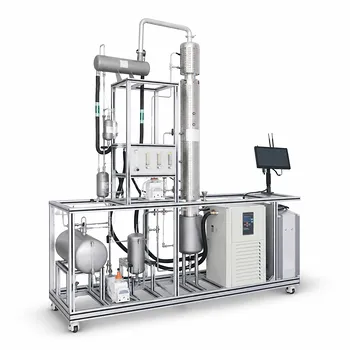
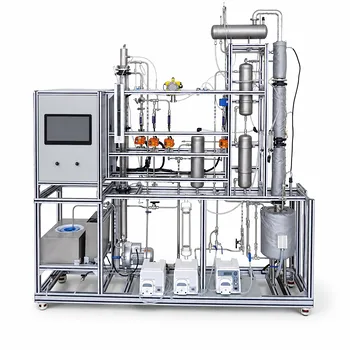
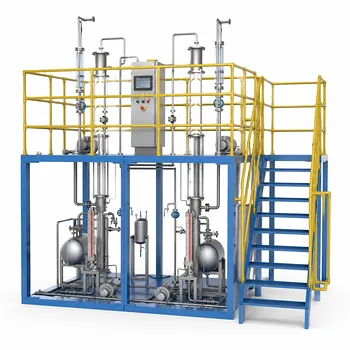
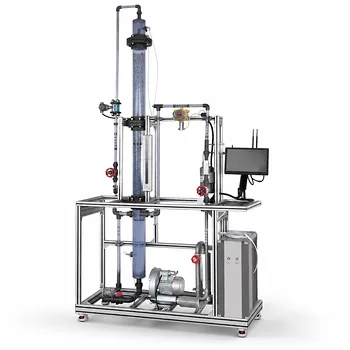
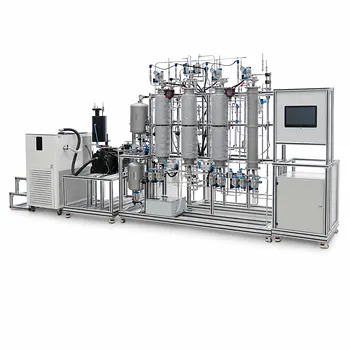
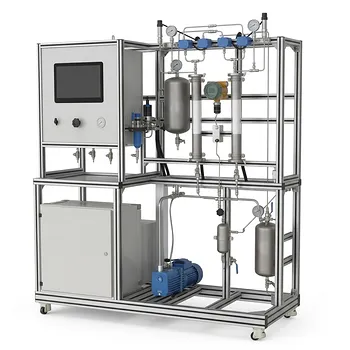
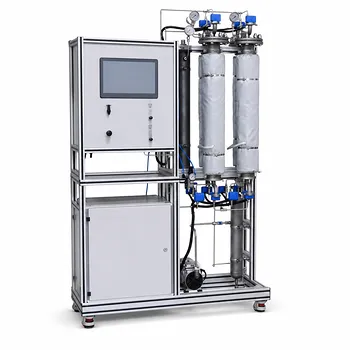
The cost of your pilot plant's column internals isn't a simple line item—it fundamentally dictates the mathematical model you must use to estimate that cost. The choice between trays and packing bifurcates the estimation process. Tray column costs are estimated on a diameter basis using a power-law relationship (Cost = a + b * Diameter^n), while packed column costs are estimated on a volumetric basis (Cost = Volume * unit_price). This distinction means your conceptual design instantly determines whether geometry or material volume dominates your budget forecast.
Understanding the cost influence of internals in a pilot plant requires looking beyond the purchase price of metal or ceramic. The true deep need is designing a teaching tool that balances capital expenditure with the pedagogical value of the physical phenomena it can demonstrate. A tray column’s cost is driven by the complexity and diameter of its discrete stages, making it ideal for visualizing hydraulics; a packed column’s cost scales directly with the volume and material of its continuous contact media, making it a model for pressure drop and HETP studies.
The Two Fundamentally Different Cost Models
The most immediate and practical impact of your internal selection is the alteration of your spreadsheet’s estimation logic. You cannot accurately price a tray column and a packed column using the same independent variable.
Diameter-Driven Costing for Tray Columns
The capital cost of a tray column is overwhelmingly dictated by the column diameter raised to an exponential power. The primary reference specifies a power-law relation (Cc = a + b * D^n) that applies to diameters typically ranging from 0.5m to 5.0m.
The manufacturing complexity of the tray type directly inflates the exponent and base constant. Bubble cap trays, which require intricate risers and caps to be fabricated, have a higher exponent (n=1.9) than the simpler sieve trays (n=1.8). This means that as you scale up the diameter to handle higher throughputs in a pilot setting, the cost of a bubble cap column accelerates faster than that of a sieve tray column.
This model fundamentally ties your budget to the column’s cross-sectional area. It highlights why pilot plants are kept as narrow as possible—small changes in diameter drive exponential cost increases.
Volume-Driven Costing for Packed Columns
Packed column economics pivot to a volumetric logic. You are effectively purchasing a defined volume of transport phenomena surface area. The cost is calculated by multiplying the packing volume (in m³) by a constant linear pricing factor.
This factor varies significantly based on the material and surface area of the packing.
- Random packings, such as 304SS Raschig rings or ceramic saddle rings, have specific unit costs reflecting raw material and manufacturing energy.
- Structured packings command a high premium due to their precise geometric engineering, with factors ranging from 2000 to 8500 as indicated in the primary reference.
In this model, your cost is directly proportional to the bed height required to achieve the separation. This links your capital expenditure directly to the mass transfer performance metric (HETP).
The Critical Impact of Configuration Factors
Beyond the base cost, the final price of tray internals is highly sensitive to specific mechanical configuration choices. Overlooking these factors leads to significant budget underestimation.
The Multiplicative Effect of Tray Spacing
A common pedagogical mistake is to calculate the cost per tray and multiply by a theoretical number of stages, forgetting that tray spacing dictates the total column height and, implicitly, the shell cost and exactly how many trays you can fit.
The supplementary references clarify this with a factor (Fs). Reducing tray spacing from 24 inches to 12 inches, seemingly a small mechanical choice, doubles the factor from 1.0 to 2.0 if you are standardizing cost against a fixed column height. This immediate jump reflects the increased complexity of installing and maintaining a much tighter array of plates.
Material of Construction Multipliers
While the primary reference mentions different packing materials, the supplementary references provide specific, non-linear multipliers (Fm) that dominate the final budget. Using carbon steel as a baseline (Fm = 0):
- Upgrading to stainless steel (
Fm = 1.5) adds a significant premium. - The choice of Monel for corrosive chemical education demonstrations results in an astronomical multiplier (
Fm = 8.5).
This is a vital educational point: the chemical system you choose to separate for your students (e.g., a standard acetone/water mix versus an acidic mixture) directly preselects your material of construction and can inflate your internal costs by nearly an order of magnitude before any other variable is considered.
Understanding the Trade-offs
Objectively, the "best" internal does not exist; only the optimal compromise for a specific teaching and budget constraint exists. A poor choice here results not just in cost overruns, but in a piece of equipment that fails to teach the intended lesson.
- Tray vs. Packing Visibility: Tray columns offer a visual breakdown of each theoretical stage. Students can physically see weir heights and active bubbling areas. Packed columns are a "black box" for continuous contact; flow maldistribution inside the packing is invisible, which can hinder intuitive understanding of weeping or channeling unless destructive inspection is performed.
- Hydraulic Opacity: You cannot easily demonstrate classical flooding or weeping phenomena in a random packed bed in the same visual way you can with a sieve plate. However, packed columns are superior for measuring a smooth pressure drop profile across the entire bed, which correlates cleanly with throughput. A bubble cap tray, by contrast, has a discrete, stepwise pressure drop profile that helps explain stage-by-stage vapor-liquid equilibrium but has a higher dry tray pressure drop cost.
- Operational Trade-offs for Training: Incorrect feed placement in a tray column (a common student error) causes immediate, observable downcomer flooding, providing a powerful active learning moment. In a packed column, improper distribution equally harms separation but might only manifest as a mysterious drop in efficiency on a gas chromatograph, missing the visceral "aha" hydraulic lesson.
- Capital vs. Operating Cost Sensitivity: Trays facilitate the direct study of how adding a physical stage changes the minimum reflux ratio. The high fixed capital cost of Monel bubble caps can be pedagogically compared against the lower operating cost they enable. Packing shifts this trade-off to the relationship between bed height (capital) and pressure drop (operating utility cost), as higher-efficiency packing with high surface area also creates more frictional resistance.
Making the Right Choice for Your Educational Goal
Your selection should be reverse-engineered from the specific mass transfer principles you need your students to measure. Do not let the lower volumetric cost of packing seduce you if the curriculum requires a demonstration of stage efficiency.
- If your primary focus is demonstrating fundamental hydraulic phenomena: Choose a tray column. The ability to visually observe weeping, entrainment, and downcomer flooding on sieve or bubble cap trays provides a direct, visceral understanding that a packed column cannot offer, even if the tray fabrication complexity raises your initial cost exponent.
- If your primary focus is pressure drop analysis and continuous contact theory: Choose a packed column. The smooth pressure curve and the direct calculation of HETP make it the definitive tool for teaching these principles, with costs scaling predictably with the volume of packing media you install.
- If your primary focus is maximizing curriculum flexibility for different chemical systems: Invest in a column with interchangeable internals. While the initial capital cost of the vessel and multiple sets of internals is higher, this eliminates the need for two separate process units. You must simply be prepared to manage the drastic material cost multipliers (
Fm) that come with selecting corrosive distillation mixtures for your advanced labs. - If your primary focus is teaching the cost of separation efficiency: Prioritize a tray column with multiple feed points and adjustable spacing. This configuration allows students to manipulate
Fsand feed location to calculate the optimal trade-off between equilibrium stages (capital) and reflux ratio (operating cost), a calculation that is less intuitive in a purely packed-bed HETP context.
By engineering the cost estimation logic directly into the physical design choice, you transform the pilot plant from a mere piece of hardware into a definitive financial and thermodynamic argument.
Summary Table:
| Feature | Tray Columns | Packed Columns |
|---|---|---|
| Cost Model | Diameter-driven (Power-law: Cc = a + b * D^n) | Volume-driven (Volume x unit price factor) |
| Key Cost Driver | Column diameter, spacing, and tray complexity | Bed height, packing material, and surface area |
| Visual Value | High (students can visualize weeping, flooding, and stages) | Low (continuous contact behaves as a "black box") |
| Best For | Hydraulic studies & stage-by-stage analysis | Pressure drop profiles & HETP calculations |
Optimize Your Chemical Engineering Lab with LABPARK
Choosing the right column internals is crucial for balancing your budget with your pedagogical goals.
LABPARK provides premium Educational and Vocational Unit Operations Pilot Plants in chemical engineering, bioprocess & biotech, and environmental & water treatment. We help universities, research institutes, and enterprises design and build tailored process systems that maximize hands-on learning efficiency while optimizing capital expenditure.
Ready to design your next pilot plant? Contact LABPARK today to receive expert guidance and a customized technical proposal.
Related Products
- Continuous Sieve-Plate Distillation Pilot Plant for Unit Operations Laboratory Education
- Carbon Dioxide Absorption and Desorption Educational Pilot Plant for Carbon Capture Studies
- Multi-Functional Special Distillation Educational Pilot Plant
- Dual-Mode Gas Absorption and Desorption Unit Operations Training Pilot Plant
- Multi-Modal Distillation Unit Operations Training Pilot Plant
People Also Ask
- What are the primary reflux ratio control strategies? Master Distillation Unit Operations
- How to select the right activity coefficient model (Wilson, NRTL, UNIQUAC) for distillation pilot plants?
- How can real-time carbon number prediction improve distillation pilot plants? Optimize control.
- Why is vacuum operation capability an essential feature for a distillation unit operations pilot plant? Unlock Efficiency
- How does catalyst water concentration affect distillation pilot plant design? Key separation train choices.