The calibration sampling paradox isn't a design flaw—it's a predictable tension between two worlds.
You can directly resolve this conflict by modifying how you generate reference data for your online spectrometer or analyzer. The two proven strategies are: deploying a temporary, high-precision online analyzer with optimized sampling protocols to drastically reduce reference measurement error, or injecting laboratory-synthesized calibration standards directly into the field-installed analyzer, so the calibration model sees the exact same optical path and environmental conditions the instrument faces during real runs. The goal is not to choose accuracy or relevance, but to upgrade both sides until they overlap.
The paradox arises because static, lab-made standards are accurate but ignore process dynamics, while real process samples are relevant but carry high reference uncertainty. The resolution lies in a dual strategy: elevate the quality of your process reference data using a high-precision online “gold standard” instrument, and bring your synthetic standards into the plant so they absorb the true spectral signatures of your installed analyzer. Underpinning both is a ruthless focus on sampling protocol optimization—the hidden bottleneck behind nearly every calibration failure.
The Calibration Sampling Paradox: Why It Exists
Two Conflicting Worlds: Lab vs. Process
A laboratory-synthesized standard is pristine. You know the exact concentration, temperature is controlled, and there’s no pipeline vibration or fluctuating pressure. It gives you high accuracy about a sample that never existed in your pilot plant.
A process grab sample drawn from a flowing stream is the opposite. It carries the true chemical fingerprint of your unit operation, but a swarm of factors—dead volume in a sample loop, exposure to atmosphere, a 10-minute lag to the lab, a non-reproducible quench—can shift the composition. The measurement you finally record may be precise, but its accuracy relative to the true inline value is compromised.
That gap is the calibration sampling paradox. Your analyzer model will inherit whatever error exists between the “true” concentration and the reference value you feed it.
Accuracy vs. Precision: Understanding the Real Levers
In process analytical technology (PAT), accuracy is the difference between your online analyzer’s prediction and a reference laboratory result. It’s limited by model error, sampling induced changes, time misalignment, and the lab method itself.
Precision, on the other hand, is simply how repeatable the analyzer’s predictions are for the same sample. In a dynamic pilot plant stream, precision is typically about ten times better than accuracy because it’s driven by far fewer sources of variation—mainly real process fluctuations and instrument noise.
You’re not fighting a precision problem. You’re fighting an accuracy battle, and it’s almost always rooted in the reference side. That insight reframes the entire conflict.
Strategy 1: Elevating Process Reference Data Quality
Deploy a Temporary High-Precision Online Analyzer
Instead of relying on a manual grab-and-lab workflow with its built-in delays and potential for sample degradation, install a second, higher-precision online analyzer temporarily. This instrument becomes your true “gold standard” for the duration of the calibration campaign.
By conditioning the sample exactly the same way—same flow rate, temperature, filtration—and placing it immediately after your pilot plant unit, you eliminate time assignment errors and minimize the chemical changes that happen after sampling.
Optimize Sampling Protocols to Eliminate Error Sources
Sampling is the hidden error multiplier. Even the best reference instrument delivers bad data if the sample it sees is not representative. For online analyzers, this means designing fast-loop sample systems that minimize lag time, prevent dead legs, and maintain the sample at representative conditions.
For the temporary high-precision unit, rigorous consistency is non-negotiable: identical flow conditions, immediate quenching if the reaction is still progressing, and clock-synchronized data tagging. When reference accuracy is limited primarily by sampling, not by the lab method, cleaning up the protocol produces a step-change improvement.
Account for Sample Instability in Dynamic Streams
Pilot plant streams often contain reactive intermediates or sensitive molecules that continue evolving after extraction—a classic challenge in condensation polymerizations or bioprocesses. If the sample keeps reacting or picks up moisture between the plant and the lab, the reference value you assign is already wrong.
The countermeasure is straightforward: quench the reaction instantly upon sampling, and standardize the delay between extraction and laboratory measurement. A repeatable, short, and stopped-reaction workflow yields reference values that genuinely match the inline composition.
Strategy 2: Injecting Laboratory Standards into the Field
Why Field Injection Captures the True Optical Path
Your process analyzer’s spectral response is shaped by everything in its light path—fiber coupling, probe fouling, temperature gradients, and even minor alignment shifts. Laboratory standards measured on a benchtop unit see none of this.
By injecting well-characterized, laboratory-synthesized standards directly into the field-installed analyzer on the pilot plant, you force the calibration model to learn from spectra that include all real-world optical imperfections. The resulting model automatically accounts for environmental drift and pathlength effects that would otherwise appear as systematic errors.
When Synthetic Standards Become Process-Relevant
The common objection is that a synthetic standard lacks matrix effects—the scattering from cells, the bubble background in a sparged reactor, the particulates in a crystallizer. You compensate by creating your standard streams in a fluid matrix that mimics the process background (e.g., using filtered plant liquor as the solvent) and injecting them through the same sample conditioning system.
Now your accuracy baseline is set by a known concentration, yet the model sees the same baseline shifts and scattering that real process samples exhibit. The gap between accuracy and relevance narrows significantly.
Beyond the Start: Maintaining Model Health Over Time
Monitor with Q-Residuals and Hotelling’s T²
Deployment is not the finish line. Process conditions drift, filters foul, reactors change temperature profiles. A calibration model that was perfect at commissioning will silently degrade. Active health monitoring is essential.
Two indicators are your best friends: Q-residuals, which tell you if a new spectrum contains features the model has never seen, and Hotelling’s T², which flags samples that lie outside the calibration space in a multivariate sense. Set boundaries for these at the time of calibration and alarm when they are breached.
Simple Drift Corrections vs. Full Recalibration
Before you rip out a model and start over, check for simple temporal drift. A post-processing slope and bias correction—adjusting the predicted values using a small set of recent, well-verified reference samples—often restores accuracy in minutes.
If the process has moved into a genuinely new state, collect new data covering those operating regions and consider local modeling, where separate sub-models handle distinct conditions. This avoids the dilution of sensitivity that comes with forcing a single global model to cover too broad a space.
Calibration Transfer for Multi-Instrument Environments
Pilot plants often run multiple analyzers on similar streams, or you may upgrade to a new spectrometer. Rather than recalibrating from scratch, use standardization techniques. Piecewise Direct Standardization (PDS) corrects for slight wavelength shifts or response differences between instruments. Orthogonal Signal Correction (OSC) filters instrument-specific spectral variation unrelated to the analyte.
These methods transfer the validated master model to a slave spectrometer, preserving the accuracy you built while accounting for hardware differences.
Understanding the Trade-offs
Cost and Complexity of Dual-Instrument Approaches
Deploying a temporary high-precision analyzer is objectively sound, but it demands capital or rental budget and skilled personnel to set up fast-loop sampling. If a pilot plant runs short campaigns with rapidly changing chemistries, this investment may be hard to justify.
Synthetic Standards Still Lack Real Matrix Effects
Even with refined injection protocols, synthetic standards rarely replicate the full scattering complexity of a fermenter broth or a crystallizing slurry. They calibrate the instrument’s spectral response beautifully, but if the matrix radically alters the optical pathlength, an offset can remain. The combination of field-injected standards and spiked process samples often yields the best of both worlds.
Model Lifecycle Management Demands Continuous Effort
Any calibration strategy that resolves the initial paradox requires a commitment to ongoing vigilance. Health indicators must be reviewed regularly, documentation of model boundaries must be impeccable, and procedures for rapid update or transfer must be written in advance. Without this, the model will eventually become a source of misinformation.
Making the Right Choice for Your Pilot Plant Goal
Pick your dominant objective, and let it guide your investment:
- If your primary focus is long-term accuracy for a stable, well-characterized process: Invest up-front in a high-precision temporary online analyzer with rigorously optimized sampling protocols. Then implement a health dashboard using Q-residuals and T², ready to apply slope/bias corrections as drift appears.
- If your primary focus is rapid deployment with limited budget and simpler streams: Prioritize the field-injected synthetic standard method to capture the instrument’s true optical signature. Supplement with periodic spiked process samples to verify the model hasn’t drifted due to emerging matrix effects.
- If your primary focus is transferring a proven method across multiple pilot plant units or spectrometers: Build calibration transfer into your method’s lifecycle from day one. Use PDS or OSC during the initial rollout to avoid rework and maintain consistency plant-wide.
The calibration sampling paradox isn’t a trap—it’s an invitation to get smarter about the true source of error. When you treat reference data quality and process relevance as two sides of the same coin, you build models that stay accurate where it matters: on the flowing, reacting, living stream.
Summary Table:
| Strategy | Method | Key Benefit | Best For |
|---|---|---|---|
| 1. Elevate Process Reference Data | Deploy temporary high-precision online analyzer & optimize sampling | Eliminates time assignment errors and sample degradation | Long-term accuracy for stable, well-characterized processes |
| 2. Field-Inject Lab Standards | Inject synthetic standards directly into the field-installed analyzer | Accounts for real-world optical path imperfections & drift | Rapid, budget-friendly deployment on simpler streams |
Optimize Your Process Analysis with LABPARK
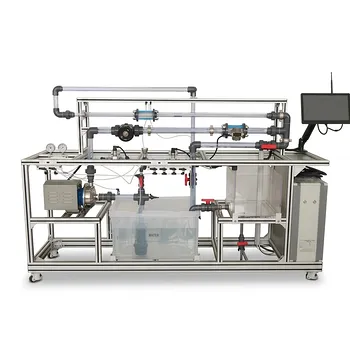
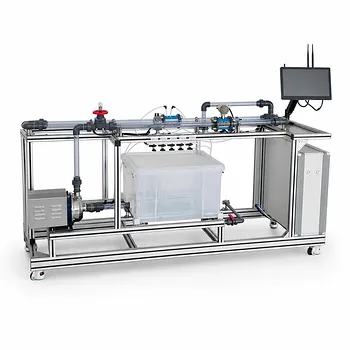
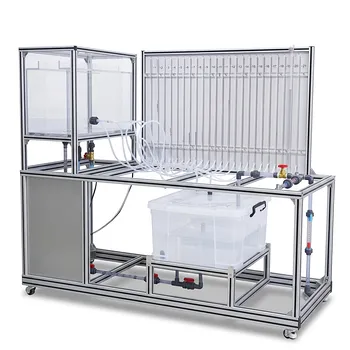
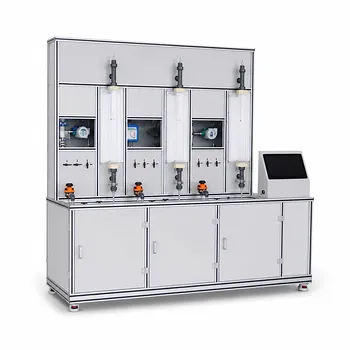
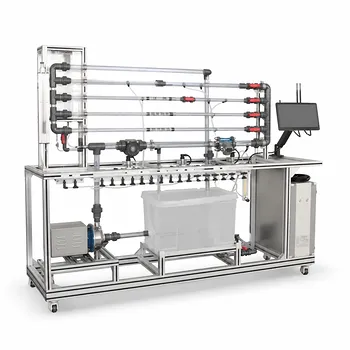
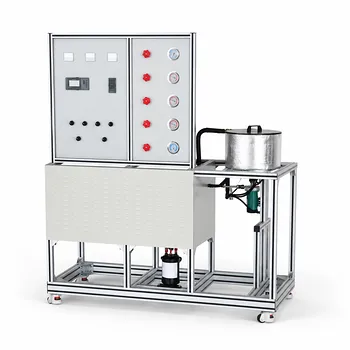
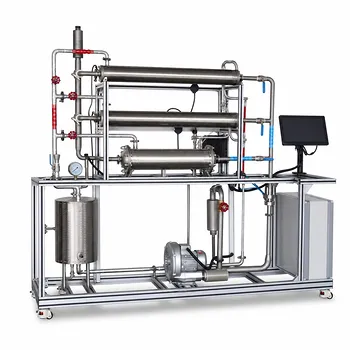
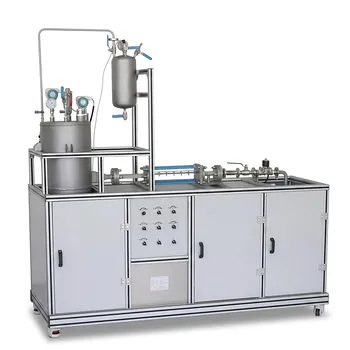
Achieving precise analyzer calibration requires a robust pilot plant infrastructure. LABPARK provides premium Educational and Vocational Unit Operations Pilot Plants across chemical engineering, bioprocess & biotech, and environmental & water treatment.
Designed specifically for universities, research institutes, and enterprises, our pilot plants enable you to bridge the gap between laboratory accuracy and industrial-scale relevance. Build confidence in your process data and train the next generation of engineers with industry-grade systems.
Ready to elevate your pilot plant capabilities? Contact LABPARK today to discuss your custom project requirements!
Related Products
- Centrifugal Pump Performance and Orifice Flowmeter Calibration Educational Pilot Plant
- Orifice and Venturi Flowmeter Calibration Educational Pilot Plant for Fluid Mechanics Laboratory
- Bernoulli Equation Demonstration Unit Operations Pilot Plant
- Multi Functional Catalytic Reaction and Reactor Evaluation Educational Unit Operations Pilot Plant
- Rising and Falling Film Evaporation Educational Unit Operations Pilot Plant
People Also Ask
- What features should instructors look for in pump & flowmeter pilot plants? Key Selection Guide
- Why start a centrifugal pump with a closed outlet valve? Protect your pilot plant motors.
- How to update chemometric calibration models in pilot plants? Best practices for process engineers.
- How can cavitation and slurry erosion be studied and mitigated using fluid transport and centrifugal pump pilot plants?
- How do pilot plants demonstrate siphon pressure variations? Visualizing Bernoulli's Energy Balance