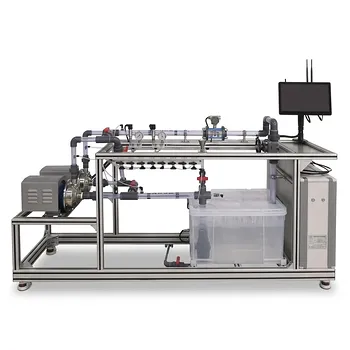
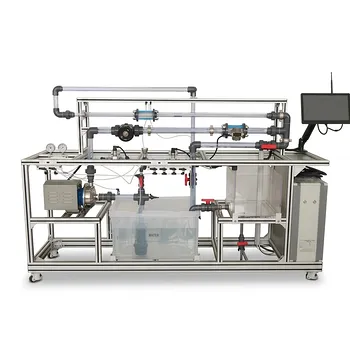
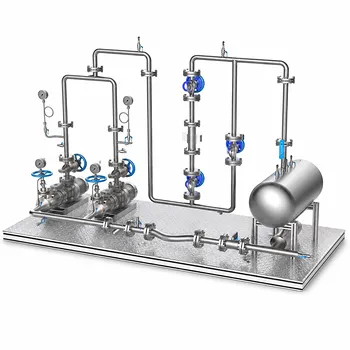
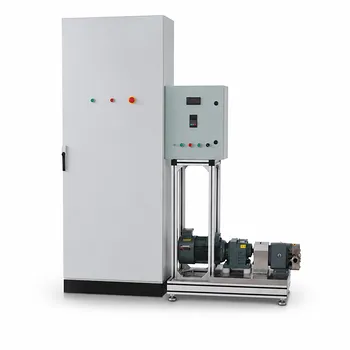
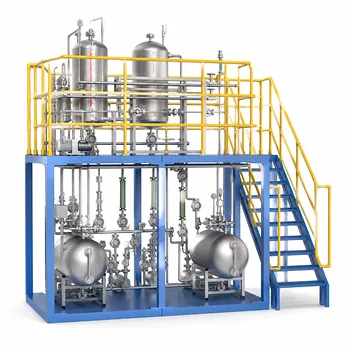
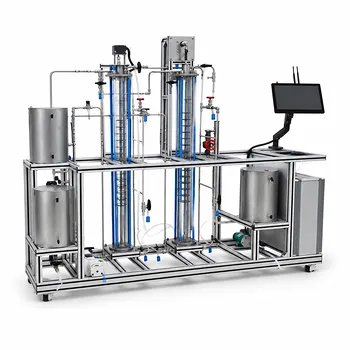
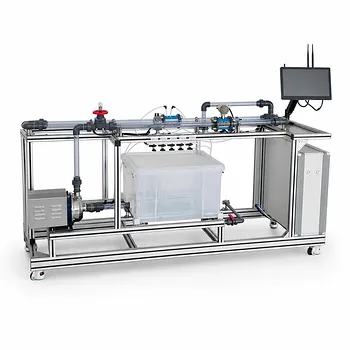
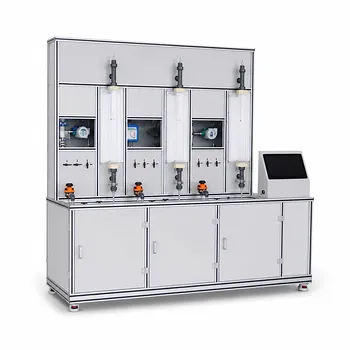
The most effective way to study and mitigate cavitation and slurry erosion is to transform a pilot plant from a simple demonstration tool into a calibrated, high-precision diagnostic instrument. By combining physical experimentation with Computational Fluid Dynamics (CFD) validation, a pilot plant allows you to replicate real-world degradation, precisely control the variables that trigger it, and test the long-term success of protective measures before they are applied at full scale.
A centrifugal pump pilot plant is not just for generating performance curves; it is your primary testing ground for failure analysis. To study cavitation and slurry erosion, you must systematically manipulate a single dominant variable—suction head for cavitation, or particulate concentration for erosion—while using sensors and CFD models to detect the invisible onset of damage. Mitigation then becomes a traceable engineering exercise in adjusting system design, pump selection, and material science based on this real-time data.
The Pilot Plant as a Diagnostic Tool for Cavitation
Cavitation is a thermodynamic phase-change event triggered by pressure dynamics. In a pilot plant, you are not simply waiting for a pump to sound like it is pumping gravel—you are using sensors to spot the problem at its inception before permanent damage occurs.
Detecting the Onset Through NPSH Manipulation
Cavitation occurs when the local static pressure at the pump impeller inlet drops below the fluid’s vapor pressure. In a laboratory setting, you can force this condition by manipulating the system. The key variable to control is the Net Positive Suction Head Available (NPSHa).
By installing a throttling valve on the suction line or varying the height of the supply tank, you progressively lower the NPSHa. Using vibration accelerometers, hydrophones, and suction pressure transducers, you can detect the exact moment vapor bubbles form and subsequently collapse. This is the point where the head begins to drop by 3%, defining the NPSH Required (NPSHr) for that specific pump.
Using CFD to Visualize the Invisible
Physical experiments give you the macro result (noise, performance drop), but Computational Fluid Dynamics (CFD) reveals the micro-mechanism. By validating a CFD model against your pilot plant data at the cavitation inception point, you can visualize the precise locations of low-pressure recirculation zones on the impeller eye.
This allows you to test virtual geometric modifications—like changing the inlet blade angle or the impeller eye diameter—without machining a single part. Once a promising CFD design is identified, a prototype can be installed and validated in the same pilot plant, creating a closed-loop research process.
Unpacking Slurry Erosion Mechanisms
Unlike cavitation, which is a fluid dynamic phenomenon, slurry erosion is a mechanical attack. The pilot plant allows you to isolate this mechanism from chemical corrosion to understand the pure wear rate.
Analyzing Flow Velocity and Particle Trajectory
Slurry erosion occurs when suspended solids in a high-velocity stream physically abrade the protective passivation layer from a metal surface. In a centrifugal pump pilot plant, the most violent wear zones are the impeller cutwaters and the volute tongue.
By running the plant with inert solids (like silica sand) at controlled concentrations and flow rates, you can study erosion-corrosion. High-velocity zones force particles to deviate from the fluid streamlines. These particle trajectories, visualized via CFD, show where solids impact the wall. The pilot plant confirms this: weight-loss measurements from sacrificial coupons or 3D scanning of impeller surfaces correlate almost exactly with CFD-predicted impact zones.
Material Selection as a Mitigation Variable
The pilot plant is your material testing rig. You cannot trust a chemical compatibility chart alone when mechanical abrasion is present. Researchers rotate test pieces of different metallurgies—standard stainless steel versus duplex stainless steel or high-chrome white iron—through the pump casing.
Since the deep need is to extend equipment life, the pilot plant allows you to observe the "synergistic effect" in fast-forward. You might find that an alloy with superior corrosion resistance in static immersion tests fails faster than a slightly less "corrosion-resistant" alloy in a slurry flow, simply because the harder alloy retains its protective film better under particle impact.
Proven Mitigation Strategies You Can Validate
Once cavitation or erosion has been detected, the pilot plant’s true value emerges: testing the fix. These are not just textbook rules; they are operational adjustments you can trace with data.
Inducing Flooded Suction to Kill Cavitation
The most robust physical fix for cavitation is converting a suction lift setup to a flooded suction configuration. This directly raises the NPSHa by adding the static head of liquid above the pump inlet to the system pressure.
In a standard unit operations lab, the allowable installation height ($H_s'$) is calculated using Bernoulli’s equation, correcting for fluid vapor pressure and pipeline friction loss. The pilot plant demonstrates a critical safety rule: you must install the pump 0.5 to 1.0 meters lower than the theoretical maximum. If this calculated height is negative, a gravity-fed installation is non-negotiable. By varying the intake tank level, students can plot the pump curve, observe the steep head drop-off as NPSHa falls below NPSHr, and immediately recover stable performance by raising the tank to restore flooded suction.
Switching to Specialized Impeller Geometries
For slurry mitigation, the fastest change in a pilot plant is swapping the impeller. Clean water pumps typically use closed impellers with tight front wear rings. When these are exposed to slurry, solids pack into the wear ring gap, causing clogging and rapid abrasive wear.
The pilot plant proves why impurity pumps (P-type) with semi-open or open impellers are non-negotiable for slurries. These impellers lack a front shroud, allowing particles to pass through without clogging. Furthermore, their adjustable back clearance means you can compensate for wear by simply re-shimming the impeller, restoring hydraulic performance without replacing the entire unit. In the pilot plant, you can measure the efficiency penalty of the open design versus the catastrophic failure curve of a clogged closed impeller.
Physical Protection with Sacrificial Elements
You can demonstrate an economical mitigation strategy for high-velocity slurry zones by installing sacrificial hard plastic sleeves at inlets. In a pilot plant loop with a heat exchanger or flow restriction, the metal inlet tube forms a high-turbulence eddy. By inserting a replaceable thermoplastic liner, you shift the abrasive damage from the permanent capital asset to a cheap consumable. Pulling a worn sleeve out of the test section after a high-concentration run provides a dramatic, visible proof of concept for this protection strategy.
Understanding the Interplay and Trade-offs
Mitigation is rarely a one-variable problem. A strategy that solves cavitation can worsen erosion, and vice versa.
The Viscosity Trap
A common student error in pilot plants is assuming that a thicker fluid (high viscosity) always inhibits cavitation. While it is true that very viscous fluids dampen bubble collapse intensity, high viscosity fundamentally alters the pump curve. When kinematic viscosity exceeds 20 cSt, internal disc friction losses surge.
The pilot plant demonstrates this trade-off: you must correct the water-based pump curve using empirical coefficients ($C_Q$, $C_H$, $C_\eta$). The measured flow drops, head drops, and power consumption rises. This illustrates that simply switching to a high-viscosity carrier fluid to cushion particle impacts might stall your pump or overload the motor if the correction factors are not factored in.
The System Curve Interaction
There is no universal "safe" pump speed for all slurries. A centrifugal pump’s operating point is always the intersection of the pump curve and the system curve. In a pilot plant, you can stiffen the system curve by closing a discharge valve (increasing dynamic loss).
This shifts the operating point to a lower flow rate. While lower velocity reduces erosion, excessive throttling forces the pump to operate far from its Best Efficiency Point (BEP), inducing suction recirculation that mimics cavitation damage. The pilot plant’s transparent flow loop and pressure sensors display this paradox clearly: you must find the balance between slowing the fluid to save the pipes versus creating a damaging internal flow pattern inside the pump.
Making the Right Choice for Your Research Goal
Your specific objective dictates how you configure the pilot plant and what variables become your primary focus.
- If your primary focus is root-cause identification: Prioritize instrumentation. Equip the pump inlet with a precision absolute pressure transducer and a hydrophone to triangulate the exact NPSHa value at the 3% head drop. Cross-reference this with a strobe-tachometer to rule out mechanically induced vibration.
- If your primary focus is validating a digital twin or CFD model: Run the pilot plant with pure water first to establish a cavitation-free baseline flow field. Then introduce a known quantity of spherical glass beads. Your goal is to match the particle image velocimetry (PIV) or erosion scar patterns in reality to the Reynolds-averaged Navier-Stokes (RANS) or Discrete Element Method (DEM) predictions in your simulation.
- If your primary focus is selecting corrosion-resistant alloys (CRAs) for an aggressive slurry: Use a once-through liquid stream (to maintain chemistry) and a high-solid-loading loop. Do not rely on static coupon immersion. The flow must be continuously turbulent over the metal samples. Mitigation success is only valid if the passive film re-forms faster than the mechanical stripping rate.
- If your primary focus is training or unit operations education: Have students deliberately induce cavitation by lowering the reservoir and record the sound signature. Then, have them induce slurry erosion by spiking the concentration. Measure the specific energy consumption ($kWh/m^3$ transported). This teaches that a "noisy" pump is an expensive pump, as energy is being wasted on destructive fluid mechanics rather than useful flow.
The pilot plant is ultimately a matter of cause and effect. By isolating pressure, velocity, and material properties as independent variables, you move beyond maintenance guesswork and into a predictive understanding of fluid degradation.
Summary Table:
| Phenomenon | Primary Cause | Diagnostic Method | Mitigation Strategy |
|---|---|---|---|
| Cavitation | Low pressure (NPSHa < NPSHr) | NPSH manipulation & CFD | Flooded suction installation |
| Slurry Erosion | Mechanical abrasion by solids | Weight-loss & CFD trajectory | Semi-open impellers & liners |
Optimize Your Fluid Dynamics Research with LABPARK
Are you looking to equip your lab or facility with high-precision testing systems? LABPARK provides state-of-the-art Educational and Vocational Unit Operations Pilot Plants in chemical engineering, bioprocess & biotech, and environmental & water treatment for universities, research institutes, and enterprises.
Our pilot plants enable researchers and students to diagnose real-world challenges like cavitation and slurry erosion with precision.
Contact LABPARK today to discover how our tailored pilot plant solutions can elevate your educational and research capabilities!
Related Products
- Centrifugal Pump Performance Determination Educational Unit Operations Pilot Plant
- Centrifugal Pump Performance and Orifice Flowmeter Calibration Educational Pilot Plant
- Chemical Pipeline Assembly and Fluid Transport Practical Training Unit Operations Pilot Plant
- Multi Pump Fluid Transport Process Piping Unit Operations Training Pilot Plant
- Constant Pressure Filtration Educational Unit Operations Pilot Plant
People Also Ask
- Why start a centrifugal pump with a closed outlet valve? Protect your pilot plant motors.
- How does fluid density affect pump head and pressure? Avoid Pilot Plant Motor Overload
- How does fluid viscosity affect centrifugal pump performance? Key pilot plant correction methods.
- How does fluid density affect centrifugal pump performance & motor safety in pilot plants?
- How to choose between tubular, scraper, and pusher centrifuges? Optimize Your Pilot Plant Separation