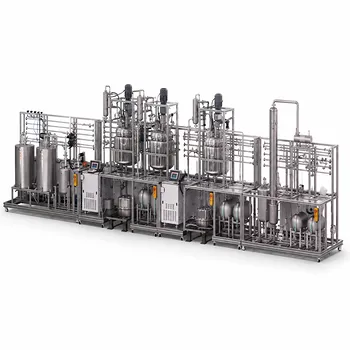
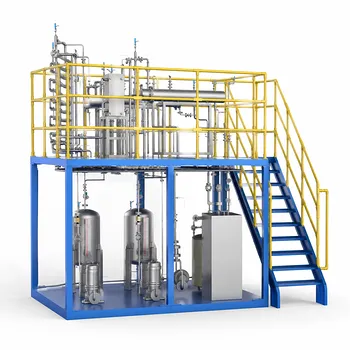
A primary process unit like a dryer or reactor is just the engine—auxiliary equipment is the chassis that makes it drivable in a pilot plant.
A dryer or reactor cannot operate in isolation. To generate meaningful data, maintain safety, and mimic real industrial conditions, you must integrate supporting systems such as pre-heaters, separators, condensers, and utility distribution. Without these, the process loop remains incomplete, and the educational or research value collapses.
The necessity of auxiliary equipment stems from a core process-engineering truth: unit operations are highly interdependent. A stand-alone primary unit teaches fragments; the surrounding auxiliary systems transform it into a whole process, enabling complete mass and energy balance studies, safety protocol validation, and realistic scale-up insights.
The Systems Reality: Why No Unit Operates Alone
A continuous dryer or reactor demands a steady stream of prepared feed, precise energy input, and a reliable outlet for products and wastes. The primary unit defines the core transformation, but auxiliary equipment defines whether that transformation can happen safely, efficiently, and measurably.
Closing the Process Loop
A dryer needs a gas pre-heater to condition the drying medium, and a cyclone separator or filter to capture entrained particles before the gas exits. A reactor often requires a condenser to recover volatile solvents, a scrubber to neutralize off-gases, and pumps to return unreacted materials to the feed. These auxiliary components form a closed-loop system that makes continuous, stable operation possible.
Managing Energy and Utility Flows
Primary units consume utilities—steam for heating, cooling water for condensation, compressed air for control—that rarely arrive in usable form. Auxiliary equipment like steam pressure regulators, cooling water recirculation skids, and instrument air dryers condition these flows. Aligning utility infrastructure with the unit’s specifications is not optional; it’s the difference between reliable data and a trip hazard.
Capturing the Real Cost Structure
In actual industrial plants, the reaction vessel often accounts for only ~20% of the Inside Battery Limits investment, while downstream separation and purification systems consume the other 80%. Integrating auxiliary separation units (distillation columns, extraction modules) alongside a reactor gives students and researchers a front-row view of this capital intensity—no reactor-focused pilot plant can teach plant economics honestly without it.
The Educational & Research Imperative
Academic and research pilot plants exist not to produce a commodity, but to produce understanding. Auxiliary equipment is the vehicle for that understanding.
Teaching True Mass and Energy Balances
A reactor alone gives you conversion. With auxiliary feed preparation, waste treatment, and recycle loops, you can measure material losses, solvent evaporation rates, and energy recovery efficiency. This transforms a theoretical balance exercise into a hands-on investigation of real-world inefficiencies.
Embedding Safety and Environmental Protocols
Cyclones, condensers, and scrubbers are not just process aids; they are engineering controls for dust explosion prevention, volatile organic compound (VOC) capture, and hazardous waste minimization. Including them in a pilot plant forces students to design for inherent safety and environmental compliance, not as afterthoughts but as integral process steps.
Unlocking Comparative and Scale-Up Studies
Research often hinges on benchmarking. Auxiliary equipment enables direct comparison between different operating modes. For example, a dryer with recycle and without recycle reveals the impact of partial gas recirculation on energy consumption. A reactor with a downstream distillation column allows empirical verification of selectivity versus purification ease—insights that are impossible with the reactor alone.
Understanding the Trade-Offs
A fully instrumented pilot plant with every auxiliary component brings undeniable cost, complexity, and space burdens. Acknowledging these trade-offs builds a more credible design rationale.
Initial Capital vs. Long-Term Insight
Adding a solvent recovery condenser, scrubber, and feed pre-heater can double the equipment cost. For a teaching lab with a fixed budget, this may mean sacrificing a second reactor. The value, however, lies in quality over quantity: one complete process system teaches fundamentals more deeply than two stripped-down units.
Educational Clarity vs. Operational Overwhelm
Too many auxiliary loops can obscure the primary unit’s behavior. A common pitfall is making the system so complex that students get lost in piping instrument diagrams (P&IDs) before grasping the core unit operation. The design must layer complexity deliberately—start with the minimum viable auxiliary set to run safely, then add modules as competence grows.
Maintenance and Downtime
Every pump, blower, and filter adds potential failure points. In a research setting, this can mean lost experimental time. The trade-off decision should weigh whether the research question requires the auxiliary system’s data; if not, simplifying may accelerate the learning cycle.
Making the Right Choice for Your Lab or Research Goal
Your specific outcome determines where to strike the auxiliary equipment balance. Apply these guidelines based on your primary focus.
- If your primary focus is teaching core unit operations fundamentals: Include the minimal auxiliary set necessary for safe loop closure—pre-heater, simple dust removal, and basic utility connections—so students see the whole flow without drowning in it.
- If your primary focus is advanced process integration and plant economics: Build in downstream separation units, solvent recovery loops, and heat integration auxiliaries, because understanding the 80% cost structure demands that scope.
- If your primary focus is environmental and safety research: Prioritize scrubbers, condensers, and continuous emissions monitoring as the star of the set-up, using the primary unit as the pollutant source to be controlled.
- If your primary focus is scale-up validation with limited resources: Modularize. Choose a reactor or dryer with standardized connections, and add auxiliary skids (e.g., cyclone, condenser) only when the specific scale-up parameter—like mass transfer coefficient—cannot be inferred without the full loop.
No primary unit in a pilot plant should ever be an island. Surround it with the auxiliary equipment that turns isolated performance into holistic process understanding, and you’ll transform your lab from a collection of gadgets into a true miniature plant.
Summary Table:
| Auxiliary Equipment Type | Core Function | Value to Education & Research |
|---|---|---|
| Pre-heaters & Condensers | Thermal & feed conditioning | Enables accurate mass/energy balance studies |
| Separators & Scrubbers | Dust & emissions control | Embeds safety protocols & VOC capture training |
| Pumps & Recirculation Skids | Utility & flow control | Simulates real-world industrial plant economics |
Build a Fully Integrated Lab with LABPARK
To deliver true educational and research value, a pilot plant must operate as a complete system. LABPARK provides premium Educational and Vocational Unit Operations Pilot Plants in chemical engineering, bioprocess & biotech, and environmental & water treatment tailored for universities, research institutes, and enterprises. We ensure your reactors and dryers are seamlessly integrated with the right auxiliary systems for safe, realistic, and reliable operation.
Contact LABPARK today to design your customized pilot plant solution!
Related Products
- Carbon Dioxide Hydrogen Methanol Synthesis Educational Unit Operations Pilot Plant
- Multi Pump Fluid Transport Process Piping Unit Operations Training Pilot Plant
- Natural Product Extraction Unit Operations Training Pilot Plant
- Multi-Modal Distillation Unit Operations Training Pilot Plant
- Multi-Reactor Educational Pilot Plant for Reaction Engineering Unit Operations
People Also Ask
- How do temp & pressure affect methanol synthesis pilot plants? Optimize equilibrium and catalyst performance.
- Why is a purge system necessary when operating a gas recirculation loop in a methanol synthesis pilot plant? (Guide)
- Why do modern methanol pilot plants operate at lower pressures? Catalyst & Feed Requirements Explained
- What are the operational requirements for catalyst activation? Safe Methanol Pilot Plant Operation
- Why is the chemical plant startup schedule crucial? De-risk scale-up with pilot plants.