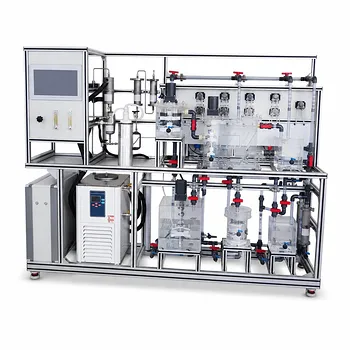
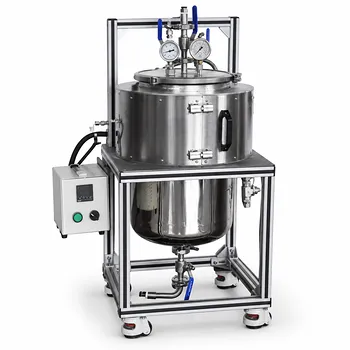
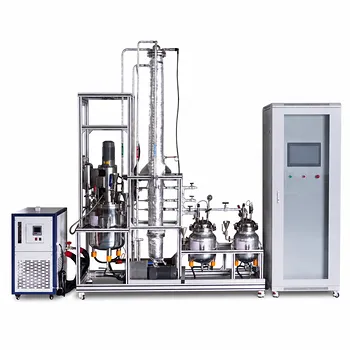
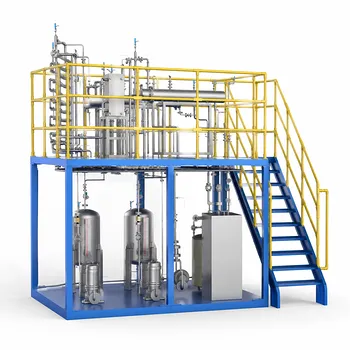
If you're configuring a pilot plant for high-temperature heat transfer experiments, your choice of heating medium will define your lab's safety envelope, operating costs, and experimental integrity. Directly addressing your surface question, a thermal oil system offers three decisive advantages over a high-pressure steam system: it achieves the required high temperatures (up to ~400°C) at dramatically lower system pressure, it eliminates the risk of steam contamination leaking into your process, and it provides a more cost-effective path when serving multiple small-scale experimental units.
The core value of thermal oil in a chemical engineering pilot plant is that it decouples high temperature from high pressure, creating a fundamentally safer, more modular, and contamination-free environment—ideal for educational settings and multi-experiment facilities. This makes it far simpler to build, operate, and reconfigure than an equivalent steam network, while protecting both researchers and experimental results from the inherent hazards and nuisance failures of high-pressure steam.
The Pressure Advantage: Building a Safer Lab
How Steam Creates an Inherent Pressure Problem
To reach temperatures much above 100°C, steam must be contained at elevated pressures. At 200°C, saturated steam exerts roughly 1.6 megapascals (16 bar); at 300°C, that rises to over 8.5 MPa (85 bar). These pressures demand robust, thick-walled piping, large pressure vessels, and rigorous safety protocols that are often incompatible with a dynamic, hands-on teaching or research lab.
Thermal Oil Operates Near Atmospheric Pressure
In contrast, a properly selected thermal oil (mineral oil or a synthetic fluid like Dowtherm A) remains liquid across its entire operating range. It can be pumped through thin-walled tubing at near-ambient pressure while delivering heat at 300°C or 400°C. This fundamentally reduces the blast radius of a potential leak, minimizes stored energy, and allows students and researchers to work close to equipment without facing high-pressure steam hazards.
Eliminating a Silent Contaminant: Steam Leakage
The Unwanted Guest in Your Process
Any heat exchanger—whether a simple tube-in-tube or a shell-and-tube—carries a persistent risk: the high-pressure steam can breach the barrier and mix with your process fluid. In a pilot plant, this is especially damaging because it corrupts material balances, invalidates kinetic data, and can trigger unwanted side reactions you cannot immediately detect.
Dry, Inert Heating with Oil
A thermal oil system eliminates this variable entirely. Because the oil loop operates at low pressure, even a pinhole leak would typically result in oil weeping out rather than a high-pressure blast of steam rushing into the process side. Coupled with the fact that thermal oil is chemically inert (when correctly chosen), it preserves the purity of your experiment, giving you confidence that measured yields, temperatures, and flow rates reflect reality, not a hidden contamination event.
Economic Sense for Modular, Multi-Experiment Setups
The Hidden Cost of a Central Steam Network
High-pressure steam systems require code-stamped boilers, heavy-duty steam traps, expansion loops, and thorough insulation to prevent condensation and water hammer. In a facility with half a dozen small-scale reactor skids, fractionation columns, or dryer units, replicating this overhead for each device is simply untenable. Building a campus-wide steam ring is often justified only for large-scale, continuous processes—not for the agile, ever-changing needs of a pilot plant.
One Thermal Oil Loop Can Serve Many Units
A single, electrically heated thermal oil heater can feed a common header that branches to multiple experiments, each with its own control valve and return line. Because the oil circulates in a closed loop at low pressure, the piping is lighter, insulation is less critical for safety, and the infrastructure is both cheaper to install and easier to rearrange when your next cohort of students tackles a different unit operation. This directly aligns with the modular educational philosophy taught in unit operations laboratories.
Understanding the Trade-offs
While the advantages are compelling, no heating system is without its drawbacks. Recognizing these trade-offs is essential to making a sound decision.
Fluid Degradation and Maintenance Overhead
Thermal oils degrade over time, especially if overheated or exposed to air at high temperature. They can form sludge, lower their flash point, and lose heat transfer efficiency. This demands periodic fluid sampling, topping up, and eventual replacement—a maintenance task that a steam system largely sidesteps (though steam also has its own corrosion and water treatment costs).
Lower Heat Transfer Coefficients
Generally, the film heat transfer coefficient of a thermal oil is lower than that of condensing steam. This means you may need somewhat larger heat exchangers for the same duty, or may have to accept slower heating rates. In a pilot-scale experiment where precise control is more important than absolute speed, this is often an acceptable compromise.
Fire Hazard Considerations
Unlike steam, thermal oil is a combustible fluid, and a leak onto a hot surface can ignite. This requires careful installation: leak containment trays, appropriate fire-rated insulation, and temperature limits well below the oil’s autoignition point. Such precautions are manageable but must be designed in from the start.
Making the Right Choice for Your Pilot Plant
The decision ultimately hinges on which risks and cost structures matter most for your specific experimental goals. Use the following guide to steer your selection.
- If your primary focus is student safety and reducing lab hazards: Choose the thermal oil system. The near-ambient pressure operation and absence of high-pressure steam lines create a forgiving environment where learning can happen without life-threatening consequences.
- If your primary focus is running high-purity reactions or precise kinetic studies: Choose the thermal oil system. Eliminating the risk of steam leaks into your process safeguards your data integrity and prevents unpredictable contamination.
- If your primary focus is building a flexible, multi-experiment facility on a limited budget: Choose the thermal oil system. A single, low-pressure loop can economically feed many different apparatuses, and reconfiguring it is far simpler than re-piping a steam network.
- If your primary focus is achieving the absolute highest heat transfer rates or your process already demands high-pressure steam for other reasons: Use a high-pressure steam system, but only after a thorough job-safety analysis and with strict demarcation from learning zones. In almost every dedicated pilot teaching lab, the thermal oil's safety and simplicity will outweigh the steam's raw thermal performance.
Ultimately, in an environment where exploration, reconfiguration, and hands-on learning define the mission, a thermal oil system transforms the heating challenge from a high-risk utility into a predictable, low-pressure tool that empowers your researchers rather than intimidating them.
Summary Table:
| Feature | Thermal Oil System | High-Pressure Steam System |
|---|---|---|
| Operating Pressure | Near-atmospheric pressure (fundamentally safer) | High pressure (up to 8.5+ MPa at 300°C) |
| Contamination Risk | Low (inert fluid; leaks do not dilute process) | High (steam leakage corrupts process chemistry) |
| Setup Flexibility | High (single loop can easily serve multiple units) | Low (requires complex steam traps and heavy piping) |
| Heat Transfer Rate | Moderate (lower film coefficient) | High (efficient condensing heat transfer) |
| Primary Hazard | Combustibility (preventable via thermal design) | High pressure / explosive energy release |
Design a Safer, High-Performance Lab with LABPARK
Ready to configure a modern, safe, and modular pilot plant for your facility? LABPARK designs and manufactures premium Educational and Vocational Unit Operations Pilot Plants across chemical engineering, bioprocess & biotech, and environmental & water treatment.
We help universities, research institutes, and enterprises build customizable setups that maximize learning outcomes and experimental precision while maintaining the highest safety standards.
Contact LABPARK today to request a custom quote and consult with our engineering experts!
Related Products
- Thermal Desorption Exhaust Gas and Tail Water Treatment Educational Pilot Plant
- Hot Filtration Educational Unit Operations Pilot Plant Laboratory System
- Carbon Material Thermal Pretreatment Multiphase Separation Educational Pilot Plant
- Comprehensive Multi-Modal Heat Transfer Unit Operations Pilot Plant for Engineering Training
- Dual Mode Heat Transfer Pilot Plant for Unit Operations Training
People Also Ask
- How is P, M, and B alkalinity applied in pilot plants? Prevent Boiler Scaling & Corrosion
- What are inline fluorescence sensor risks, and how can they be managed? Key Strategies
- Lime-Soda vs. Cation Exchange Softening: How Do Effluent Characteristics Compare in Pilot Plants?
- How is iron concentration monitored to evaluate corrosion and filtration efficiency in water treatment pilot plants?
- How do anodic & cathodic inhibitors protect heat exchangers? Optimize Your Water Treatment Pilot Plant