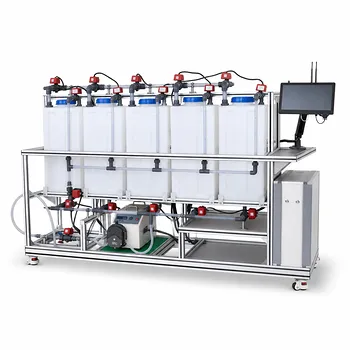
Answering the "what" is just the start. Pilot plants transform the abstract chemistry of metal toxicity from a textbook theory into an operational, scalable reality. They are the critical bridge where researchers and engineers move beyond knowing that solubility dictates danger to actively controlling it, using precipitation, pH adjustment, and filtration to render toxic soluble ions like Hg²⁺ into safe, insoluble, filterable solids.
The core challenge isn't just understanding that soluble mercury is toxic; it's engineering a reliable process to make it insoluble. Environmental water treatment pilot plants are the definitive teaching and research tools for this, providing a controlled, scaled-down environment to master the chemical and physical operations—precipitation, coagulation, and filtration—that directly convert highly toxic, soluble metal ions into non-toxic, insoluble precipitates and then remove them safely.
The Unseen Threat: Why Chemical Form is Everything
Toxicity is not a constant property of an element. It is a function of its chemical state, and this is where the real-world problem begins.
The Solubility Ladder of Risk
A heavy metal's danger is directly tied to its solubility. The primary reference makes this clear: soluble mercuric chloride is a severe hazard, while insoluble mercurous chloride or barium sulfate are relatively benign.
This is because insoluble compounds pass through the body without being absorbed. A pilot plant’s mission is, therefore, deceptively simple on paper: convert every dissolved, bioavailable toxic ion into a stable, insoluble solid that can be physically filtered out.
Beyond a Single Metal: The Industrial Effluent Matrix
The challenge in teaching and research is that real wastewater is never a simple, single-metal solution. Supplementary references highlight that industrial effluents contain a cocktail of heavy metals like chromium, lead, nickel, and mercury, alongside organic toxins.
Pilot plants force users to confront this complexity. You must learn how competing ions, fluctuating pH, and organic contaminants affect the core precipitation chemistry, a critical skill that theory alone cannot provide.
Pilot Plants as the Ultimate Learning Laboratory
The deep need is to develop an intuitive, practical grasp of process design. A pilot plant is a simulator that compresses a full-scale treatment facility's logic into a transparent, controllable system.
From Textbook Concept to Operational Mastery
The primary reference identifies the core unit operations: coagulation, flocculation, and sedimentation tanks. Teaching these concepts in a classroom is abstract; operating them in a pilot plant provides visceral understanding.
A student can add lime to a mixing tank and visually watch the metal hydroxide floc form. They can then trace the flow to the sedimentation basin and see it settle. This tangible connection solidifies the function of each process step far more effectively than a diagram.
Unlocking the Power of Process Variables
The greatest educational value lies in the ability to "break" the process constructively. A pilot plant allows for the systematic manipulation of key variables to see immediate cause and effect.
- pH as a Master Switch: By adjusting the dose of neutralizing agents like lime (calcium hydroxide) , users can track how metal hydroxide solubility plummets at a specific, optimal pH. They learn that overshooting the pH can redissolve amphoteric metals, a common pitfall in real-world design.
- Precipitant Selection and Efficiency: Researchers can test different chemical strategies, such as converting a toxic soluble ion to an insoluble form, directly comparing the settling characteristics and dewaterability of the resulting sludge.
Engineering the Precipitation: A Chemistry-Driven Process
The pilot plant brings the language of coordination chemistry to life. The removal of a metal ion like copper is a direct application of shifting equilibrium.
Controlling the Coordination Sphere
A supplementary reference explains how copper ions (Cu²⁺) coordinate with ligands like ammonia to form a soluble complex, [Cu(NH₃)₄]²⁺. In a pilot plant, this is not just an equation; it's a contamination problem.
A researcher can witness how ammonia in wastewater interferes with simple hydroxide precipitation by keeping the copper protected in a soluble coordination complex. The pilot plant then becomes the platform for testing solutions, such as advanced oxidation to destroy the ammonia ligands first, or using a stronger precipitant like a sulfide.
Integrating Separation and Dehydration
The journey from dissolved ion to landfill-ready solid involves more than a chemical reaction. The primary reference highlights the complete flow: mixing tanks for precipitation, clarifiers for sedimentation, and vacuum filters or centrifuges for dewatering.
Operating this sequence teaches a critical lesson: a perfect chemical precipitation is useless if the resulting sludge particles are too fine to settle or clog a filter. Pilot plants bridge this gap, revealing the importance of flocculants to create large, dense particles (floc) that can be easily separated and dewatered.
Advancing Research Beyond Conventional Precipitation
While precipitation is foundational, pilot plants are modular systems designed for innovation, accommodating a range of advanced separation technologies essential for modern research.
Testing Advanced Separation Technologies
Supplementary references broaden the scope to include ion exchange columns, adsorption units, and membrane filtration. Researchers use these pilot-scale units to find solutions for metals that are difficult to precipitate, such as low-concentration or strongly complexed species.
They can determine optimal flow rates and breakthrough curves for an ion exchange resin, or the fouling rate of a membrane under different pre-treatment scenarios, generating the scale-up data impossible to obtain in a lab beaker.
Addressing Emerging Contaminants
The platform's versatility is its greatest research strength. One supplementary reference notes the rising concern of nanomaterial pollution. A pilot plant can be configured with a specialized membrane filtration train to simulate the capture of nanoparticles from an industrial stream.
This transforms the facility from a teaching tool into a vital research instrument for developing standardized safety and disposal protocols for entirely new classes of environmental pollutants, directly serving the goal of environmental compliance.
Understanding the Trade-offs: The Art of Process Design
No single treatment unit is a panacea. The most profound learning and research outcome from pilot plant work is a sober, practical understanding of trade-offs.
Chemical Cost vs. Sludge Disposal
A cheap reagent like lime might be economically attractive, but it generates a large volume of sludge that is costly to dewater and landfill. A pilot plant quantifies this: you measure the sludge yield per cubic meter of water treated, and you weigh the chemical cost against the disposal fee. This teaches the holistic economic reality of any treatment choice.
Efficiency vs. Complexity
Adsorption on activated carbon is highly effective for polishing water to trace levels, but the carbon must be regenerated or disposed of. Membrane filtration can produce very high-quality water but is energy-intensive and prone to fouling. Running these systems side-by-side in a pilot plant provides the comparative performance data necessary to make an objective, defensible choice between biological, chemical, and physical purification methods for a given wastewater matrix.
Kinetic Reality vs. Ideal Equilibrium
Thermodynamic calculations will tell you what is possible; a pilot plant tells you what is practical. The need to measure Chemical Oxygen Demand (COD) and Biochemical Oxygen Demand (BOD) over time, as mentioned in supplementary references for organic oxidation, has its parallel in metal removal—the kinetics of precipitation and settling dictate the hydraulic retention time (HRT) and, therefore, the size and cost of your full-scale reactor. A pilot plant reveals if a reaction takes minutes, hours, or days to reach completion.
Making the Right Choice for Your Goal
A water treatment pilot plant is a versatile instrument that can be tuned for different objectives. The pathway you follow should align with your primary goal.
- If your primary focus is foundational education: Prioritize performing simple hydroxide precipitation experiments with a single metal. Visually track the formation, settling, and filtration of the floc across clarifiers, connecting the basic chemistry to the physical unit operations.
- If your primary focus is industrial process design: Use the pilot plant to test different chemical precipitants against a real, multi-component effluent sample. Quantify sludge volume, chemical cost, and target metal removal efficiency to determine the most cost-effective sequence of mixing and sedimentation.
- If your primary focus is advanced research on recalcitrant metals: Operate the plant in a comparative mode, running ion exchange, adsorption, and membrane filtration columns in parallel on the same wastewater stream to generate breakthrough curves and rejection rates, identifying the most robust and selective treatment technology.
Ultimately, a pilot plant does something no textbook or simulation can do: it reveals the hidden complexities in a process that looks flawless on paper, turning cautious students into confident engineers who understand exactly what it takes to make the most dangerous soluble metals permanently insoluble and safe.
Summary Table:
| Unit Operation | Mechanism | Key Operational Variables |
|---|---|---|
| Precipitation | Converts soluble toxic ions to insoluble solids | pH levels, precipitant type (lime, sulfide) |
| Flocculation | Aggregates fine particles into larger, heavy flocs | Coagulant dosage, mixing speed |
| Sedimentation | Separates solids from liquid via gravity settling | Hydraulic retention time (HRT) |
| Dewatering | Removes water from sludge using vacuum or centrifuge | Sludge volume, filtration rate |
| Advanced Filtration | Ion exchange, carbon adsorption, membrane filtration | Flow rates, breakthrough curves, membrane fouling |
Bring Industrial Reality to Your Lab with LABPARK
Are you looking to bridge the gap between textbook chemistry and real-world process engineering? LABPARK provides state-of-the-art Educational and Vocational Unit Operations Pilot Plants in chemical engineering, bioprocess & biotech, and environmental & water treatment.
Designed specifically for universities, research institutes, and enterprises, our pilot plants empower your students and researchers to master complex chemical and physical operations in a safe, controlled environment. Whether you are testing emerging contaminant removal, optimizing industrial wastewater processes, or teaching foundational engineering principles, LABPARK offers the scalable technology you need.
Ready to elevate your research and teaching capabilities? Contact LABPARK today to find the perfect pilot plant solution for your institution!
Related Products
- Electrochemical Water Treatment Educational Unit Operations Pilot Plant
- Thermal Desorption Exhaust Gas and Tail Water Treatment Educational Pilot Plant
- Ion Exchange Water Purification Educational Pilot Plant for Engineering Unit Operations
- Water Electrolysis Hydrogen Production and Storage Educational Pilot Plant
- Alkaline Membrane Water Electrolysis Educational Pilot Plant Unit Operations Training System
People Also Ask
- What design features do educational electrochemical pilot plants utilize to manage gas liberation and water loss?
- How can unit operations pilot plants show lead-acid concentration vs state of charge? Real-time monitoring guide.
- How do educational electrochemical pilot plants scale up electrolysis? Master industrial engineering.
- How to Estimate Sulfate in Water Treatment Pilot Plant Deposits: Gravimetric Guide
- How can foaming be managed during steam generation experiments in water treatment unit operations pilot plants? Tips