For a pilot plant running multi-stage ethene oligomerization, the non‑negotiable design essentials are a high-pressure gas-liquid separator with robust level control and demisting, coupled with water-cooled interstage heat exchangers to tame the reaction’s exotherm. At 70–140 bar and 350–390 K, the process demands a separator that cleanly splits unconverted gaseous ethene from liquid oligomers for recycling, while the 95 kJ/mol heat release forces cooling duties between each reactor stage. Without these two carefully integrated unit operations, the plant will either lose product in the gas stream or face an uncontrolled thermal runaway.
The heart of the challenge: ethene oligomerization’s intense exotherm and high pressure require a closed‑loop cooling and separation system that recycles unreacted ethene safely, keeps the reactor temperature in its narrow window, and prevents liquid carryover to the compressor—all while maintaining the mechanical integrity of the pilot plant itself.
Designing the High-Pressure Phase Separation System
Task One: Split a Supercritical-Like Mixture Cleanly
At 70–140 bar, the reaction effluent is a dense, high-pressure mixture. The separator’s primary job is to disengage the gaseous unreacted ethene from the liquid oligomer product so that the gas can be recycled with minimal liquid entrainment.
A vertical knock-out drum with a demister pad is the standard choice. The large disengagement cross-section reduces gas velocity, while the mesh pad captures fine droplets. In a pilot setting, you must install a reliable level measurement (differential pressure or guided-wave radar) that can handle the high pressure, so the liquid level never rises into the gas outlet.
Controlling Pressure and Liquid Level as a Coupled System
The separator’s pressure is intimately tied to the reactor loop pressure. A back-pressure control valve on the gas outlet maintains the entire high-pressure circuit. Meanwhile, the liquid level controller must open a let-down valve to drop the product into a low-pressure receiver, all without causing cavitation or flashing that could destabilize the separator.
If the liquid level control fails high, liquid slugs will enter the recycle compressor, causing catastrophic damage. This is the single biggest operational risk. A second emergency shutdown (ESD) trip on critically high level is essential.
Material Selection for High-Pressure Ethene Service
Even at the moderate 350–390 K range, the combination of high-pressure hydrocarbons can lead to stress corrosion cracking or hydrogen embrittlement over time. Standard carbon steel vessels may be acceptable for short-term educational use, but any pilot plant intended for extended runs should use stainless steel (e.g., 316L) for the separator, piping, and compressor components. The wall thickness is calculated per pressure vessel codes like ASME BPV, ensuring the design accounts for the highest possible upset pressure.
Engineering the Heat Removal Strategy
Why Interstage Cooling Is Not Optional
With 95 kJ of heat released per mole of ethene converted, a multi-stage reactor loop without effective heat removal would quickly reach runaway temperatures. The primary reference puts it plainly: a water-cooled heat exchanger between each reactor stage is mandatory to control the reaction rate and prevent thermal runaway.
In practice, this means a shell-and-tube exchanger with the cooler reaction mixture on the tube side and cooling water on the shell side. The water temperature and flow rate must be tightly regulated, as even small changes shift the reactor’s exothermic equilibrium.
Matching Exchanger Design to the Pilot Scale
For a multi-stage pilot plant, each interstage cooler must deliver a precise, predictable temperature drop without causing excessive pressure loss. Compact, single-pass designs with high heat transfer coefficients are preferred. If the pilot plant uses modular educational equipment, the exchanger is often a small double-pipe unit—simple to disassemble and clean, and easy to instrument for temperature logging.
A control valve on the cooling water supply, linked to the reactor stage outlet temperature, creates a feedback loop. This loop prevents the next reactor inlet from being either too cold (which would quench the reaction) or too hot (which risks a runaway in the subsequent stage).
Learning from Other Exothermic Systems
While the primary reference focuses on water cooling, supplementary insights from Fischer-Tropsch pilot plants show alternative heat-management strategies that can inspire future designs. For instance, slurry-phase reactors suspend catalyst in a liquid that naturally absorbs heat, but for a fixed-bed oligomerization pilot, boiling water in a jacketed reactor shell—generating low‑pressure steam—provides excellent isothermal control. This technique, common in industrial oligomerization loops, can be simulated at pilot scale with a jacketed reactor and a steam condenser, giving students hands-on experience with steam generation curves and heat transfer coefficients.
Understanding the Trade‑offs
- Interstage cooling vs. conversion efficiency: If you cool too aggressively, the reaction rate drops and you lose conversion per pass. You must find a temperature trajectory that balances heat removal with kinetics.
- Separator simplicity vs. carryover safety: A simple gravity separator without a demister pad is easier to build but far more prone to liquid entrainment. In a pilot plant intended for education, you may accept a small mist carryover for visual clarity, but never in a research-grade unit where compressor protection is paramount.
- Water cooling vs. process complexity: Using plant cooling water is straightforward, but any disruption to the water supply (pump failure, blockage) can trigger a rapid temperature spike. You need a redundant pump or an automatic trip that stops ethene feed if cooling flow is lost.
- Material cost vs. lifespan: Carbon steel vessels cost less and are fine for short demonstrations, but they will eventually corrode or become embrittled. Stainless steel adds capital expense but yields much longer, safer service—aligning with the educational goal of teaching long-term industrial best practice.
Making the Right Choice for Your Pilot Plant
Regardless of the specific hardware you choose, design your loop so that the separator and interstage coolers are instrumented, interlocked, and easy to probe. A safe, data-rich pilot plant teaches far more than a bare pressure vessel.
- If your primary focus is maximizing ethene conversion: Opt for multi-stage shell‑and‑tube interstage coolers with precise cascade control and a high‑efficiency demisting separator, so you can recycle the maximum amount of unreacted gas without risking liquid carryover.
- If your primary focus is safety and educational clarity: Select modular, transparent (if pressure rating allows sight glasses) components with redundant level trips, and a water‑cooling loop that students can manually tune while observing temperature profiles across stages.
- If your primary focus is scalable process development: Use stainless‑steel vessels and exchangers designed to industrial codes, incorporate a boiling‑water jacket on at least one reactor stage, and instrument the loop to measure real‑time heat transfer coefficients—generating data that directly translate to full‑scale design.
The true measure of a well‑configured pilot plant is that it never surprises you: it separates the phases crisply, rejects heat smoothly, and gives you an unbroken view into the exothermic heart of ethene oligomerization.
Summary Table:
| Design Aspect | Key Component | Core Function | Critical Safety Risk |
|---|---|---|---|
| Phase Separation | Vertical knock-out drum with demister pad & 316L SS | Splits unconverted ethene gas from liquid oligomers | Liquid carryover leading to compressor failure |
| Heat Removal | Water-cooled interstage heat exchangers | Mitigates intense exotherm (95 kJ/mol per stage) | Cooling loss leading to thermal runaway |
Build Safer, Smarter Labs with LABPARK Pilot Plants
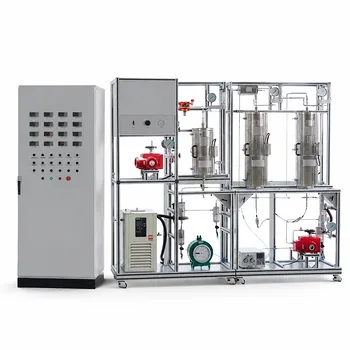
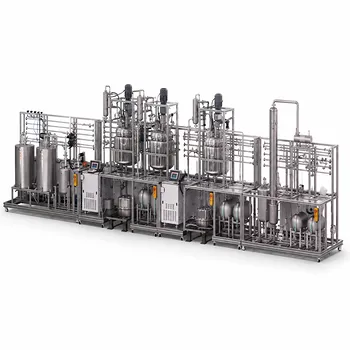
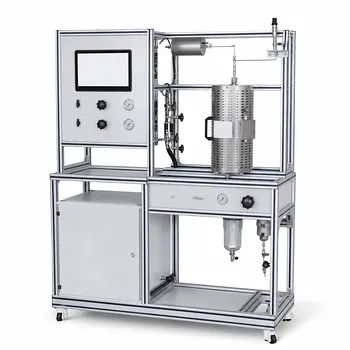
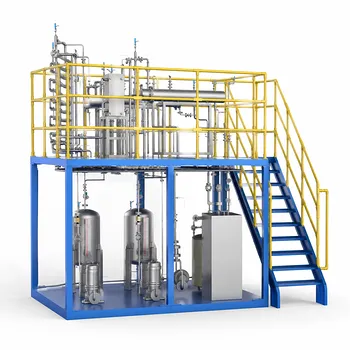
Designing complex high-pressure systems like ethene oligomerization loops requires precise control and industrial-grade safety features. LABPARK provides premium Educational and Vocational Unit Operations Pilot Plants in chemical engineering, bioprocess & biotech, and environmental & water treatment for universities, research institutes, and enterprises. Our systems are engineered to help students and researchers safely master phase separation, heat transfer, and process control.
Looking for a reliable, highly instrumented pilot plant solution? Contact the LABPARK team today to explore our customizable systems!
Related Products
- Multi-Reactor Educational Pilot Plant for Reaction Engineering Unit Operations
- Multi-Modal Distillation Unit Operations Training Pilot Plant
- Fixed-Bed Chemical Reaction and Gas Dust Tar Removal Unit Operations Pilot Plant
- Multi Pump Fluid Transport Process Piping Unit Operations Training Pilot Plant
- Tubular Reactor Flow Characteristics Determination Educational Unit Operations Pilot Plant
People Also Ask
- How do educational unit operations pilot plants address safety and waste management when scaling up?
- How do educational unit operations pilot plants bridge theory and design? Bridge the Engineering Gap
- Why Compare Predicted and Experimental Excess Enthalpy? Key to Accurate Pilot Plant Scale-up
- Why Use PTFE & Hastelloy in Chemical Pilot Plants? Prevent Corrosion & Ensure Safety
- How to study gasification in pilot plants? Compare exit gas composition & efficiency