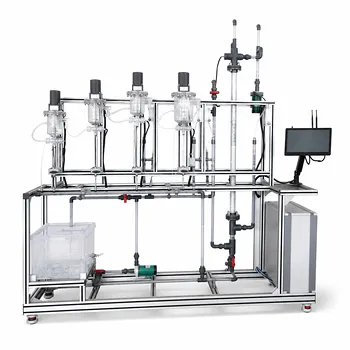
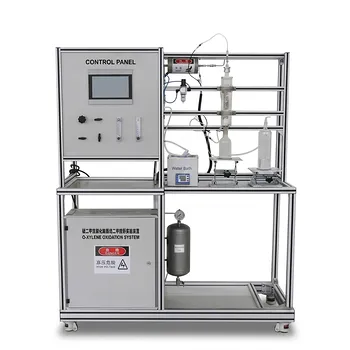
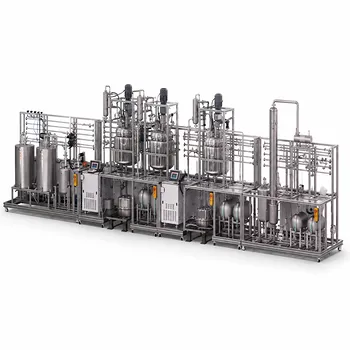
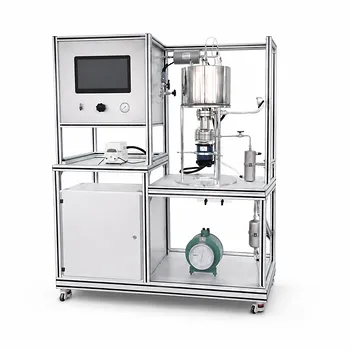
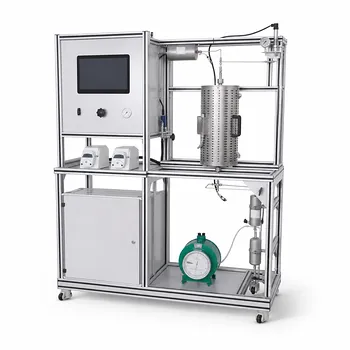
The choice hinges on the interplay between fluid rheology and reactor hydrodynamics. For pilot-scale bubble column reactors, Newtonian fluids offer nearly identical heat transfer coefficients from the vessel wall and from immersed coils—so either surface can work. For non-Newtonian fluids, however, heat transfer coefficients from internal coils are significantly higher, making coils the clear performance winner. But this rule is not universal; in mechanically agitated tanks, highly viscous non-Newtonian media can turn internal coils from a thermal asset into a mixing and cleaning nightmare.
The fluid’s viscosity and flow behavior (Newtonian vs. non‑Newtonian) dictates the optimal heat transfer surface only when you also account for the reactor’s mixing mechanism. In bubble columns, coils excel with non‑Newtonian fluids; in stirred vessels, jackets with wall‑sweeping impellers often beat coils for the same fluids.
Heat Transfer Surfaces in Non‑Isothermal Pilot Plants
The Bubble Column Benchmark
In a non‑isothermal bubble column reactor, the gas‑induced liquid circulation drives heat exchange with the surroundings.
For Newtonian fluids, the heat transfer coefficient measured at the column wall is essentially the same as the coefficient obtained from an internal helical or straight coil bundle.
This symmetry means you can choose based on mechanical simplicity, vessel size, or cleaning requirements without sacrificing thermal performance.
Non‑Newtonian fluids behave very differently.
The apparent viscosity near a heat transfer surface, especially in the low‑shear zones created by coils, can sharply reduce film resistance, boosting the coefficient.
Immersion coils therefore deliver a significantly larger heat transfer coefficient than the reactor wall, making them the preferred option for processing viscous, shear‑thinning media in bubble column pilot plants.
The Axial Location Does Not Matter
Experimental data show that placing the heat transfer section at the top, middle, or bottom of the column axis has a negligible effect on the overall coefficient.
This gives you great flexibility in pilot plant layout—you can position coils where they are easiest to install, clean, or instrument without sacrificing thermal efficiency.
The Critical Role of Fluid Rheology
Newtonian Fluids: A Forgiving Choice
When the fluid’s viscosity is constant regardless of shear rate, the boundary‑layer behavior near a flat wall or a curved tube is very similar.
The Nusselt‑number correlations for both geometries converge, making the reactor wall and internal coils thermally interchangeable.
For thin, low‑viscosity Newtonian liquids, an external jacket may even be the simpler, more cost‑effective pilot‑plant design, as it avoids internals that could trap gas bubbles or complicate sampling.
Non‑Newtonian Fluids: The Coils’ Advantage
Shear‑thinning liquids (e.g., many polymer solutions, fermentation broths, and pulps) exhibit lower apparent viscosity in the higher‑shear region near an immersed coil.
This local thinning reduces the thermal boundary‑layer thickness and raises the heat transfer coefficient well above the wall‑side value.
That is why pilot plants dedicated to highly viscous or shear‑sensitive non‑Newtonian media should standardize on internal coils—the thermal gain often justifies the added complexity of coil fabrication and cleaning.
When the Reactor Type Changes the Rules
Stirred Tanks: Where Coils Become a Problem
The picture shifts dramatically inside a mechanically agitated vessel.
For highly viscous liquids, internal coils hinder fluid circulation and create dead zones between the coil loops.
Instead of uniform mixing, you get stagnant pockets that ruin heat transfer and can lead to hot spots or product degradation.
In such cases, the recommended configuration is a jacketed tank paired with a wall‑sweeping impeller (anchor or helical ribbon).
The impeller continuously scrapes the cooled/heated wall, renewing the fluid film and maintaining high heat transfer without the hydrodynamic penalty of internal hardware.
A Scale‑Up Consideration
Small‑scale pilot bioreactors (typically under 5 m³) can often rely on jacket cooling alone because their surface‑area‑to‑volume ratio is favorable.
When you scale up, the ratio collapses; internal coils or external heat exchange loops become necessary to meet the heat load.
Fluid type then dictates which internal strategy works:
- Low‑ to moderate‑viscosity fluids can successfully use internal coil bundles.
- Highly viscous non‑Newtonian fluids may force you toward an external recirculation loop rather than accepting the mixing penalty of internal coils.
Understanding the Trade‑offs
Heat Transfer vs. Hydrodynamics
Internal coils offer a larger heat transfer area and, for non‑Newtonian fluids, a better coefficient.
But they increase pressure drop, create bypass paths, and demand more aggressive cleaning procedures.
For pilot plants that switch frequently between different fluids or that must meet strict aseptic standards, these operational downsides can outweigh the thermal advantage.
Cleaning and Sterilization
External jackets leave a smooth interior surface ideal for CIP (clean‑in‑place).
Internal coils with their crevices and shadow zones are harder to clean—especially when handling sticky, viscous, or fouling non‑Newtonian media.
You must always balance the heat transfer performance gain against cleaning cycle time and the risk of contamination.
Common Pitfall: Misapplying Bubble Column Data to Stirred Tanks
One of the biggest mistakes is to take the coil‑favoring conclusion for non‑Newtonian fluids from bubble column studies and directly apply it to a stirred reactor.
The gas‑induced turbulence in a bubble column does not create the same dead‑zone problem that a rotating impeller does.
Always match your heat transfer surface selection to the reactor’s primary mixing mechanism.
Making the Right Choice for Your Pilot Plant
Your decision tree depends on fluid type, reactor type, and scale‑up intent. Use these goal‑oriented guidelines.
- If your primary focus is maximizing heat transfer for a non‑Newtonian fluid in a bubble column: Choose internal coils. They deliver a superior coefficient, and axial placement does not affect performance.
- If your primary focus is handling highly viscous non‑Newtonian liquids in a stirred tank: Avoid internal coils. Pair a jacketed vessel with a wall‑sweeping impeller to keep fluid moving and heat transferring.
- If your primary focus is a pilot platform that must frequently switch between Newtonian and non‑Newtonian feeds: Design dual‑mode capability—jacket for Newtonian runs, and a removable coil bundle for non‑Newtonian campaigns—so you never sacrifice performance or cleanability.
- If your primary focus is easy cleaning or aseptic operation: Favor an external jacket and accept the lower area. The operational reliability gain often justifies the investment.
- If your primary focus is scale‑up of a high‑heat‑load non‑Newtonian process: Consider an external pumped heat exchange loop to bypass both the mixing and cleaning limitations of internal coils.
The fluid type sets the thermal physics, but the reactor type writes the engineering rule. Match both to avoid a pilot plant that performs brilliantly in theory and fails in practice.
Summary Table:
| Fluid Type | Reactor Type | Recommended Configuration | Key Advantage |
|---|---|---|---|
| Newtonian | Bubble Column / Stirred | External Jacket / Wall | Thermally interchangeable; simplifies cleaning and avoids internals. |
| Non-Newtonian | Bubble Column | Internal Coils | High shear thinning reduces viscosity, significantly boosting heat transfer. |
| Non-Newtonian | Stirred Tank | Jacket + Wall-Sweeping Impeller | Prevents dead zones, stagnant pockets, and fouling caused by internal coils. |
| Aseptic / High-Fouling | Any | External Jacket / Recirculation Loop | Maximizes cleanability (CIP) and avoids product contamination. |
Design the Perfect Pilot Plant with LABPARK
Configuring non-isothermal reactors requires balancing complex fluid dynamics with thermal efficiency. LABPARK provides premium Educational and Vocational Unit Operations Pilot Plants in chemical engineering, bioprocess & biotech, and environmental & water treatment.
We help universities, research institutes, and enterprises build highly efficient, scalable, and easy-to-maintain pilot systems tailored to their specific fluid rheology and research goals.
Ready to optimize your reactor configuration? Contact LABPARK Today to consult with our engineering specialists.
Related Products
- Fixed Bed Gas Solid Catalytic Reaction Educational Pilot Plant
- Multi-Reactor Educational Pilot Plant for Reaction Engineering Unit Operations
- Residence Time Distribution and Reactor Flow Characteristics Determination Educational Pilot Plant
- Fixed-Bed Chemical Reaction and Gas Dust Tar Removal Unit Operations Pilot Plant
- Tubular Reactor Flow Characteristics Determination Educational Unit Operations Pilot Plant
People Also Ask
- How do reactor pilot plants safely study gas-solid reactions? Master kinetics with thermal & flow control.
- How does the Mears criterion evaluate transport resistance? Key Guide to Intrinsic Kinetics
- Fluidized vs. Fixed Bed Reactors: Comparing Heat & Complexity in Pilot Plants
- Why is a multibed configuration necessary for exothermic reactions? Optimize your pilot plant trajectory.
- How is the friction factor determined for fixed-bed pilot plants? Select the best pressure drop correlation.