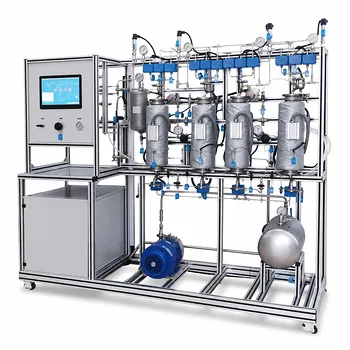
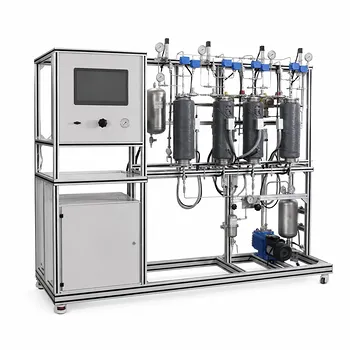
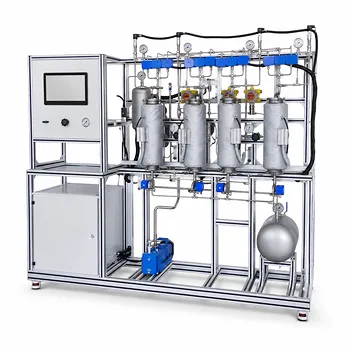
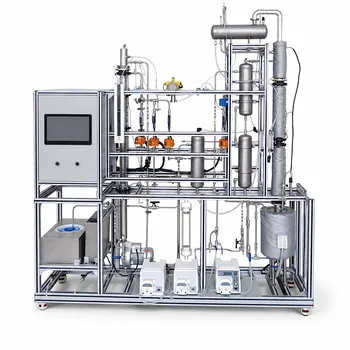
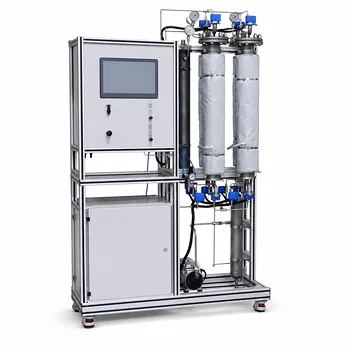
To evaluate waterless dyeing with supercritical carbon dioxide, a pilot plant must integrate a sequence of high-pressure unit operations: CO₂ storage, a high-pressure pump, a precise heating system, a specialized dyeing autoclave, and a downstream separator for CO₂ recovery. These components form a closed-loop process that pressurizes carbon dioxide above its critical point, dissolves the dye without water, transfers it to the textile, and then depressurizes the fluid to recover the solvent. The plant enables systematic study of mass transfer kinetics, dye solubility behavior, and the influence of pressure and temperature on colour yield—all essential for industrial scale-up.
Core Takeaway: The pilot plant is a high-pressure recirculation system where CO₂ is transformed into a solvent with tunable density. Success depends not just on the individual units, but on precise control of pressure and temperature, because supercritical CO₂’s properties—and therefore dyeing performance—can shift dramatically with tiny changes in operating conditions.
The Essential Unit Operations for a scCO₂ Dyeing Pilot Plant
Every component in a waterless dyeing pilot plant must handle pressures well above the CO₂ critical point (73.8 bar) and often up to 250–350 bar. The following five operations form the non‑negotiable backbone.
1. CO₂ Storage and Supply
Liquid carbon dioxide is stored in a refrigerated, pressurized tank or gas cylinders. A clean, reliable feed is crucial because impurities can alter the supercritical solvent’s behaviour and foul downstream equipment. From storage, the liquid CO₂ is drawn into the high-pressure pump; maintaining a vapour-free liquid feed prevents cavitation and pressure surges.
2. High-Pressure Pump
This pump raises the liquid CO₂ to the desired operating pressure, typically 150–300 bar. Diaphragm or piston pumps are commonly used to achieve the required flow rates and minimal pulsation. Because the process operates continuously in many setups, the pump must deliver a steady, controllable flow—any instability directly affects mass transfer inside the dyeing vessel.
3. Heating System and Temperature Control
After compression, the cold liquid must be brought above its critical temperature (31.1°C) to enter the supercritical state. A heat exchanger or electrical heater jacket raises the fluid to the set point, usually between 40°C and 120°C depending on the dye and fabric. Ultra‑tight temperature control is mandatory: near the critical point, a shift of just 1–2°C can change CO₂ density by 10–20%, drastically altering solvent strength and dye solubility.
4. Dyeing Autoclave (High‑Pressure Vessel)
This is the heart of the pilot plant. The autoclave holds the textile material—wound on a beam or in loose stock form—and contains the dye, which may be pre‑dissolved or placed in a separate compartment. The supercritical CO₂ circulates through the vessel, dissolving the dye and transporting it into the fibres. Agitation, either via a magnetic stirrer or a recirculation loop, assures uniform dye distribution. Sampling ports and sight glasses allow researchers to monitor the process without depressurization.
5. Separator and CO₂ Recovery Loop
After leaving the dyeing vessel, the fluid enters a pressure‑reduction valve and flows into a separator where the pressure drops, the CO₂ reverts to a gas, and the dissolved dye and any extracted impurities precipitate. A cyclone or filter aids collection. The gaseous CO₂ is then condensed, stored, and recycled—closing the loop and eliminating solvent waste. This depressurization‑recompression cycle is what makes the process waterless and greatly simplifies downstream purification, eliminating the energy‑intensive distillation steps common with liquid solvents.
Why These Operations Are Necessary: The Science of scCO₂ Dyeing
The pilot plant’s design isn’t arbitrary; it directly responds to the unique physics of supercritical fluids.
Tunable solvent power. Supercritical CO₂ has a liquid‑like density that dissolves disperse dyes effectively, yet gas‑like viscosity and high diffusivity that accelerate penetration into textile fibres. By adjusting pressure and temperature, researchers can fine‑tune the solvent density and, consequently, dye solubility—something impossible with water‑based baths.
Mass transfer and kinetics. The combination of low viscosity and rapid diffusion slashes the film resistance around fibres, so dye uptake is often faster than in aqueous systems. The pilot plant allows measurement of concentration‑time profiles and calculation of effective diffusion coefficients, which are critical for reactor design at commercial scale.
Zero‑residue separation. Depressurization turns the solvent into a gas, leaving dry, dyed fabric and recoverable dye. This avoids the surfactant‑laden wastewater and VOC emissions characteristic of conventional dyeing, aligning with the 60–80% reduction in volatile organic compounds documented in supercritical CO₂ extraction studies.
Understanding the Trade‑offs
While scCO₂ dyeing eliminates water and toxic solvents, pilot‑scale work reveals persistent engineering challenges.
Energy‑intensive compression. Maintaining supercritical conditions demands significant electrical power. The compressor or high‑pressure pump is the primary energy consumer, and its efficiency heavily influences the overall economic viability. Pilot plant data is essential to quantify energy use per kilogram of fabric and identify opportunities for heat integration.
Exquisite sensitivity to process variables. The sharp density variations near the critical point mean that even minor control drift can ruin dye uniformity or colour yield. This sensitivity demands high‑quality instrumentation and robust feedback loops, increasing capital cost and operator training requirements.
Reactor scale‑up complexity. Like supercritical extraction, dyeing processes involve multiphase mass transfer in a packed or moving bed—behaviour that does not scale linearly from bench to pilot. Pilot plant trials are therefore mandatory, as chemical engineering rules of thumb confirm that reactors and solids‑handling systems almost always require empirical scale‑up testing.
Material compatibility. Prolonged exposure to high‑pressure CO₂ with traces of moisture can cause carbonic acid corrosion or polymer swelling in seals and gaskets. The pilot plant serves as a long‑duration testbed for selecting wetted materials that will survive commercial operation.
Making the Right Choice for Your Research Goals
The configuration of your pilot plant’s unit operations should match the specific development phase and question you are trying to answer.
- If your primary focus is fundamental dye solubility and thermodynamic data: Prioritize a small‑volume autoclave with precise pressure and temperature sensors. You will need minimal CO₂ capacity, but the heating and pumping systems must offer ultra‑stable control to map solubility isotherms and isobars.
- If your primary focus is mass transfer kinetics and dyeing uniformity: Design the dyeing vessel with a recirculation loop and sample ports that allow you to pull fluid at different times and locations. Agitation and flow distribution become critical parameters.
- If your primary focus is process scale‑up and economic assessment: Include a full‑scale CO₂ recovery loop with a high‑efficiency condenser and separator. Run extended‑duration trials to gather utility consumption data and model the energy balance of the integrated process.
- If your primary focus is material and colour quality validation: Build a separator that allows easy collection and offline analysis of extracted residuals and excess dye. Test multiple fabric constructions and dye classes to generate a library of industrial applicability.
By selecting a plant that aligns with your deep research need, you transform a collection of unit operations into a platform that systematically de‑risks waterless dyeing for commercial reality.
Summary Table:
| Unit Operation | Key Function | Critical Control Parameter |
|---|---|---|
| 1. CO₂ Storage & Supply | Feeds clean liquid CO₂ into the system | Liquid feed temperature (prevents cavitation) |
| 2. High-Pressure Pump | Elevates CO₂ pressure to 150–300 bar | Flow rate stability and pulsation control |
| 3. Heating System | Brings CO₂ above its critical temperature (>31.1°C) | Ultra-tight temperature control (±1–2°C) |
| 4. Dyeing Autoclave | Dissolves dye and circulates it through textiles | Agitation speed, pressure, and mass transfer |
| 5. Separator & Recovery | Depressurizes CO₂, precipitates dye, and recycles gas | Depressurization rate and phase separation efficiency |
Scale Up Your Research with LABPARK Pilot Plants
Are you looking to evaluate advanced supercritical fluid processes or scale up green chemical engineering technologies? LABPARK designs and delivers state-of-the-art Educational and Vocational Unit Operations Pilot Plants tailored specifically for universities, research institutes, and enterprises.
We provide robust, high-precision systems across key domains:
- Chemical Engineering (including high-pressure, supercritical fluid, and extraction systems)
- Bioprocess & Biotechnology
- Environmental & Water Treatment
Why Partner with LABPARK?
- Industrial-Grade Precision: Get reliable pilot plants equipped with advanced instrumentation to control critical parameters like temperature, pressure, and flow rates.
- Custom Engineering: We configure systems to match your exact research goals, from fundamental thermodynamic studies to full scale-up simulations.
- Comprehensive Support: From design to installation, we ensure your faculty or R&D team has the tools to bridge the gap between lab-scale chemistry and industrial operations.
Ready to elevate your laboratory capabilities? Contact LABPARK today to discuss your project requirements!
Related Products
- Carbon Dioxide Capture and Utilization Educational Pilot Plant for Unit Operations
- Bench Scale Carbon Dioxide Capture Educational Unit Operations Pilot Plant
- Carbon Dioxide Adsorption and Capture Educational Unit Operations Pilot Plant
- Carbon Dioxide Absorption and Desorption Educational Pilot Plant for Carbon Capture Studies
- Carbon Dioxide Hydrogenation Methanol Synthesis Educational Unit Operations Pilot Plant
People Also Ask
- What are the differences between post- and pre-combustion carbon capture training pilot plants?
- How can pilot plants show tail gas vs flue gas CO2 capture differences? Key educational insights.
- What unit operations are critical for CCUS training pilot plants? Build hands-on engineering expertise.
- How do temperature variations affect CO2 transport models in pilot plants? Model vs Reality
- How does operating pressure influence the transition between absorption and desorption in a CO2 pilot plant?