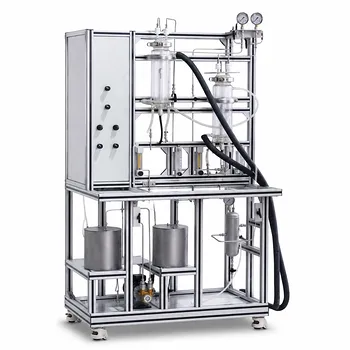
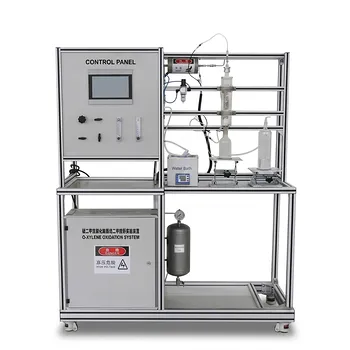
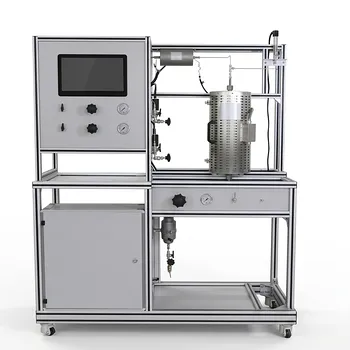
Photochemical gas-liquid reactors hinge on a cascading sequence that starts with standard two-film mass transfer and ends with a uniquely spatial kinetic problem. When analyzing a heterogeneous gas-liquid photoreactor pilot plant—say, for photochlorinations—you must account for the classical diffusion of gas into liquid, the intrinsic reaction kinetics as modified by photon absorption, and the fact that highly reactive, short-lived radical intermediates break the assumption of perfect mixing, making the reaction rate a function of local light intensity rather than just bulk concentrations.
The defining challenge is not just overcoming mass transfer resistance; it is the need to couple traditional macrokinetic models with the spatial distribution of light. Even in a well-stirred vessel where stable species appear perfectly mixed, the ultra-short lifetimes of photogenerated radicals mean they react where photons are absorbed. Thus, predicting selectivity, conversion, and reaction time demands a radiation field model as detailed as any mass balance.
The Step-by-Step Path: From Gas Bubble to Photoreaction
Every gas-liquid reaction follows a sequence of transport steps. In photochemistry, this chain ends not in a homogeneous bulk liquid but in a volume that is microscopically non-uniform due to light.
Gas-Side Diffusion and Interfacial Mass Transfer
The first bottleneck is getting the gaseous reactant to the liquid film. The reactant must diffuse from the bulk gas phase to the gas-liquid interface, driven by a concentration gradient. The rate of this transfer depends on hydrodynamic conditions, bubble size, and gas holdup. In pilot plants, controlling gas sparger design and agitation ensures this step is not the overall rate limiter.
Liquid-Side Diffusion and the Role of the Hatta Number
Once at the interface, the gas dissolves and must diffuse through the liquid film into the bulk. Here the Hatta number (√M) becomes the critical diagnostic: it compares the maximum chemical reaction rate in the liquid film to the maximum physical mass transfer rate. For very fast reactions (√M > 3), conversion is complete within the film, and the process is mass-transfer limited. For slow reactions (√M < 0.3), the reaction occurs in the bulk liquid, and liquid holdup dominates design. In photochemistry, many radical-driven reactions are extremely fast, pushing the Hatta number high and making the liquid film the primary reaction zone.
Intrinsic Photochemical Kinetics – The Radical Lifetime Challenge
Standard kinetics assume reactants can travel to any location before reacting. Photochemistry breaks that assumption. Highly reactive, short-lived intermediate radicals (e.g., chlorine radicals from Cl₂ photolysis) do not live long enough to be mixed evenly. They react within nanometers of their point of generation, which is precisely where a photon was absorbed. This means the intrinsic reaction rate is not only a function of temperature and concentration but is directly coupled to the photon flux at that exact point. Macro-kinetic expressions must therefore integrate the local volumetric rate of photon absorption.
The Photoreactor’s Hidden Variable: The Radiation Field
Traditional reactor analysis treats space as uniform in concentration and temperature. In a photoreactor, even a perfectly back-mixed one, the reaction rate has a persistent spatial structure.
Why Local Light Intensity Matters
Photons do not distribute themselves like dissolved gases. They attenuate exponentially from the light source into the liquid according to the Beer-Lambert law. Near a quartz jacket, intense irradiation can yield a high local radical concentration and extremely fast reaction, while an adjacent dark zone may see almost no chemistry. Because the radicals cannot migrate far, the reaction rate remains spatially dependent on the local radiation intensity. A pilot plant that ignores this will grossly mispredict overall conversion, and even more critically, selectivity—because different reaction pathways may have different photon sensitivities.
Coupling Reaction and Radiation Transport
To model the pilot plant accurately, you must solve for the radiation field in three dimensions. This involves the lamp's emission spectrum, the geometry, and the optical properties (absorption coefficient, scattering) of the liquid phase. The local volumetric rate of photon absorption then enters the kinetic rate law as a modifier, essentially becoming a pseudo-reactant. Only by embedding this spatial light distribution into the transport equations can you predict how long a reaction must run or what product distribution to expect.
Beyond Mass & Light: Momentum and Heat Transport
While mass transfer and photon absorption dominate photochemistry, secondary transport phenomena can still derail a pilot plant campaign.
Momentum transfer (fluid mixing) sets the gas-liquid mass transfer coefficient and the liquid-phase circulation. In stirred bubble columns or falling-film photoreactors, the mechanical power input and impeller choice directly affect bubble break-up, interfacial area, and gas holdup. Heat transfer must be watched because photolamps can impart significant thermal energy, and exothermic radical reactions can cause hot spots that degrade products or alter kinetics. A pilot plant designed to isolate photochemical effects must therefore provide robust temperature control and measure thermal gradients, especially near the light source.
Understanding the Trade-offs
The operator of a photochemistry pilot plant constantly navigates conflicts between transport and photonic requirements.
- Fast kinetics vs. light penetration: Fast reactions demand a high interfacial area (√M > 3), favoring spray towers or thin falling films. But an ultra-thin liquid layer might also reduce optical path length, allowing light to escape before it is fully absorbed. The optimum is a delicate balance between film thickness, mass transfer, and photon utilization.
- Mixing vs. radical immobility: Strong agitation promotes gas-liquid mass transfer and bulk temperature uniformity. Yet no amount of mixing can overcome the intrinsic, lifetime-limited immobility of radicals; the radiation field still dictates where they react. You can’t mechanically homogenize a reaction that completes in microseconds.
- Scale-up data vs. optical complexity: A pilot plant should yield scalable macro-kinetics. But the radiation field in a large reactor will differ fundamentally from a small one due to changes in optical path length and lamp geometry. A top-down model that decouples kinetics from optics becomes essential to translate pilot performance to industrial scale.
Making the Right Choice for Your Photochemical Pilot Plant
Apply these insights to your analysis based on what you aim to achieve.
- If your primary focus is determining intrinsic kinetics: Design the pilot plant to keep the Hatta number low and the radiation field as uniform as possible. Use a thin optical cell with monochromatic light and ensure mass transfer is non-limiting. This isolates the photochemical rate constant from transport artifacts.
- If your primary focus is predicting selectivity in a scaled-up reactor: You must measure the spatial radiation distribution in the pilot plant and develop a coupled radiation-transport-reaction model. Validate it with local product sampling or imaging, then use that same model framework with the larger geometry.
- If your primary focus is process intensification: Screen reactor geometries (falling film, membrane, microreactor) that maximize photon absorption while still providing sufficient interfacial area for fast gas-liquid reactions. Use the Hatta number to guide the required mass transfer regime, then optimize the optical thickness.
- If your primary focus is robust scale-up with minimal modeling: Run the pilot plant at a known, constant, and well-characterized light flux, and maintain the liquid-phase optical density the same as the projected industrial unit. Accept that the kinetic constant you extract will be an “apparent” one, valid only for that optical environment.
A heterogeneous gas-liquid photochemistry pilot plant is a lens that brings transport, kinetics, and light into focus simultaneously—master the radiation field, and you master the scale-up.
Summary Table:
| Key Phenomenon | Core Mechanism | Pilot Plant Impact |
|---|---|---|
| Mass Transfer | Diffusion across the gas-liquid film. | Controls reactant availability; analyzed using the Hatta number (√M). |
| Photo-Kinetics | Extremely fast reaction of short-lived radicals. | Local reaction rates depend on photon absorption rather than bulk mixing. |
| Radiation Field | Exponential light attenuation (Beer-Lambert law). | Creates spatial reaction rate zones, directly affecting product selectivity. |
| Momentum & Heat | Fluid mixing and thermal management. | Influences bubble size, gas holdup, and prevents localized thermal degradation. |
Optimize Your Chemical Engineering Research & Training with LABPARK
Ready to bring advanced reaction engineering to life? LABPARK provides state-of-the-art Educational and Vocational Unit Operations Pilot Plants in chemical engineering, bioprocess & biotech, and environmental & water treatment for universities, research institutes, and enterprises.
Whether you are studying complex gas-liquid photochemistry, analyzing mass transfer kinetics, or scaling up chemical processes, our pilot plants offer the precise control, safety, and reliability you need to succeed.
Contact our team of experts today to find the perfect pilot plant solution for your lab!
Related Products
- Photocatalytic Membrane Separation and Degradation Unit Operations Pilot Plant
- O-Xylene Oxidation to Phthalic Anhydride Educational Unit Operations Pilot Plant
- Multimodal Absorption and Desorption Pilot Plant for Unit Operations Training
- Multi-Reactor Educational Pilot Plant for Reaction Engineering Unit Operations
- Dual Mode Heat Transfer Pilot Plant for Unit Operations Training
People Also Ask
- What are the key differences in membrane configurations? Choose the Right Unit Operations Pilot Plant
- How Do Pervaporation, Vapor, and Gas Permeation Differ in Pilot Plants? Key Comparison
- What are the structural & performance trade-offs of flat-sheet, spiral-wound, & hollow-fiber membrane modules?
- How do PEI, PVDF, and PSU membranes compare in pilot plants? Find the best fit.
- Pervaporation vs. Vapor Permeation: Handling Suspended Solids in Membrane Pilot Plants