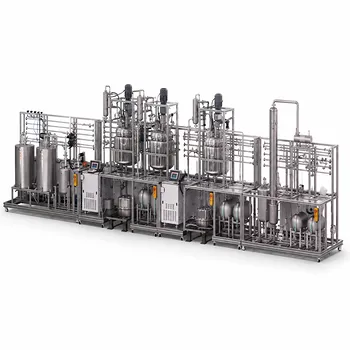
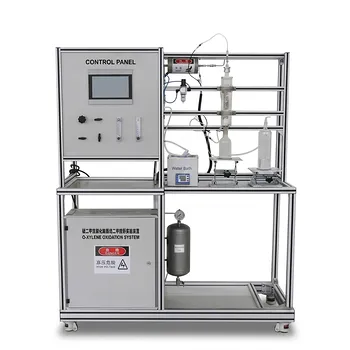
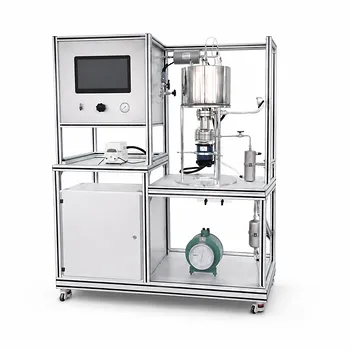
The short answer? Pilot plant reactors control temperature using cooling jackets, internal coils, external recirculation through heat exchangers, split-range utility systems, and—perhaps most elegantly—evaporative cooling. When comparing evaporative cooling to standard jackets, the former delivers near-isothermal operation, far more uniform temperature profiles, and exceptional efficiency by exploiting the latent heat of vaporization, effectively bypassing the surface-area limitations that often constrain sensible-heat jackets.
While jackets and coils transfer heat through a solid surface based on a temperature difference, evaporative cooling uses the phase change of the reaction mixture itself to absorb energy, directly coupling boiling point control with heat removal. This makes it a uniquely powerful, self-regulating tool for managing highly exothermic reactions where conventional jackets may struggle with hot spots or slow response.
The Core Challenge: Why Temperature Control Defines Pilot Plant Success
Pilot plant reactors are not just smaller versions of production units—they are testbeds for scaling chemistry safely. The deep need behind your question is recognizing that temperature is the master variable in reaction engineering. Lose control of it, and you lose selectivity, catalyst life, safety margins, and data quality.
This demands a toolkit of cooling strategies that go far beyond simply wrapping a vessel in a jacket.
The Risk of Thermal Runaway in Exothermic Systems
Exothermic reactions release heat proportionally to their rate. If the removal rate cannot keep up, the temperature rises, accelerating the reaction further. This feedback loop is the textbook definition of runway.
Pilot plants are deliberately designed with multiple, layered cooling methods to break this loop and maintain the stable, reproducible conditions needed for kinetic studies.
A Breakdown of Temperature Control Methods in Pilot Plant Reactors
The specific method chosen always reflects a balance: available surface area versus required cooling rate, the presence of volatile components, and the desired degree of isothermal precision.
The Conductive Workhorses: Jackets and Internal Coils
These are the most common sensible-heat transfer methods. A utility fluid (cooling water, steam, thermal oil) circulates through a jacket or an immersed coil, and heat flows through a metal wall driven by the temperature difference.
- Jackets provide the primary barrier cooling, often in a split-range configuration with heating utilities. This setup, managed by a single temperature controller, switches between steam and cooling water to prevent simultaneous heating and cooling, ensuring smooth transitions from reaction initiation to exothermic peak.
- Internal cooling coils are added when calculations show the jacket area is insufficient to meet the target cooling time. They increase the heat transfer surface but introduce cleaning difficulties and alter mixing patterns through their baffling effects.
The Active Recirculation Loop: External Heat Exchangers
Sometimes even jackets and coils are not enough, or the desired cooling duty demands a much higher heat transfer coefficient. Here, the reaction mixture is pumped out of the reactor, through an external shell-and-tube or plate heat exchanger, and returned.
This method decouples the heat transfer surface from the reactor geometry, allowing for a highly compact, efficient exchanger. However, it requires a pump that can handle potentially viscous or slurry-like process fluids without causing shear damage or cavitation.
The Elegant Alternative: Evaporative Cooling
This is where the strategy shifts from sensible to latent heat. Instead of removing energy by lowering a liquid’s temperature, you allow one or more components of the reaction mixture to boil. The heat of vaporization is enormous—typically one to two orders of magnitude greater than the sensible heat capacity—meaning a small amount of vaporization removes a tremendous amount of energy.
The vaporized solvent rises to an overhead condenser and returns as liquid reflux. The reaction temperature is pinned precisely at the mixture’s boiling point under the operating pressure. If the exotherm intensifies, the boil-up rate simply increases, automatically matching heat generation with removal without any change in the bulk liquid temperature.
Why Evaporative Cooling Outperforms Standard Jackets
The advantages of this method over a simple jacket are rooted in physics, not opinion. When you face a highly exothermic, fast reaction, here is where the jacket falls short and evaporative cooling excels.
Heat Transfer is Decoupled from Surface Area
A jacket’s cooling capacity is limited by the reactor’s wetted surface area and the achievable temperature difference. For large exotherms in small reactors, there simply isn’t enough metal wall. Evaporative cooling moves the heat removal duty to the overhead condenser, which can be arbitrarily sized with a massive surface area and high tube-side velocity, independent of the reactor vessel.
True Near-Isothermal Control, Not Just Cooling
A jacket cools the bulk liquid by creating a sensible temperature drop. The fluid nearest the wall is colder, creating thermal gradients. Evaporative cooling uses boiling, which occurs at a constant temperature throughout the liquid. The entire reactor sees exactly the boiling point, eliminating cold spots that could lead to poor conversion or hot spots that degrade product.
Inherently Self-Regulating Safety Buffer
A jacket requires a control loop to sense a temperature spike, calculate an error, and open a valve. There is always a lag. With evaporative cooling, an increase in heat generation instantly raises the vapor generation rate. The pressure (or condenser duty) acts as the regulating variable, providing a passive, physics-driven defense against runaway that acts faster than any electronic loop.
Maximized Driving Force for Condenser Duty
The vapor leaving the reactor is at the reaction temperature, but the condenser operates with a cold utility at a much lower temperature. This large logarithmic mean temperature difference, combined with the high heat transfer coefficients typical of condensing vapors, makes the overhead system exceptionally efficient at dumping large heat loads rapidly.
Understanding the Trade-offs
Evaporative cooling is not a universal solution. Objectively, it introduces constraints that can break a process if ignored.
The Requirement for a Volatile Component
The method mandates that a significant component of the reaction mixture has a boiling point at the target reaction temperature under the chosen pressure. If your chemistry is completely non-volatile (e.g., a high-molecular-weight polymerization in a melt phase), you have nothing to boil and cannot use this method.
Pressure Control Becomes Paramount
Temperature is now directly linked to pressure through the vapor-liquid equilibrium curve of the mixture. Any fluctuation in system pressure changes the boiling point and, therefore, the reaction temperature. This demands tight pressure control and potentially a vacuum system for lower temperature reactions.
Solvent Management and Reflux Stability
You must condense the boiled solvent and return it reliably to the reactor to maintain inventory and concentration. Foaming, entrainment, or flooding in the condenser can destabilize the reflux, change the liquid composition, and crash the temperature control. The system requires careful hydraulic design.
Cleaning and Fouling Shift to the Condenser
While you avoid fouling a jacket, the overhead system—particularly the condenser and vapor line—can now become the fouling surface if the vapor carries entrained droplets, monomers, or subliming solids.
Making the Right Choice for Your Pilot Plant Goal
Your decision framework must start with the reaction’s heat release rate, the available surface area, and the chemistry’s tolerance for a boiling solvent.
- If your primary focus is maximizing heat removal per unit volume of reactor: Choose evaporative cooling. Its reliance on latent heat bypasses the fundamental area limitations of jackets, making it the superior choice for intense exotherms.
- If your primary focus is absolute temperature uniformity for kinetic studies: Choose evaporative cooling. Boiling at constant pressure enforces a physically perfect isothermal condition that no jacket, no matter how well-designed, can replicate.
- If your primary focus is operational simplicity and handling non-volatile mixtures: Choose a jacketed system, potentially augmented with internal coils or an external recirculation loop, as it avoids the added complexity of vapor handling and solvent recovery.
- If your primary focus is testing a scale-up to a jacketed production reactor: Use a jacketed pilot vessel, even if limited, to generate representative heat transfer data (UA values) and wall effects that directly model the full-scale design.
The most robust pilot plants don't choose one method; they integrate both, using a jacket for baseline heating and sensible cooling, while the reflux condenser handles the intense exothermic peak—giving you a complete, flexible platform for any chemistry.
Summary Table:
| Cooling Method | Heat Transfer Type | Key Advantage | Best Application |
|---|---|---|---|
| Jackets | Sensible | Simple design & operation | Baseline control / scale-up modeling |
| Internal Coils | Sensible | Expanded surface area | Supplementary cooling |
| External Loops | Sensible | High heat transfer coefficient | Viscous fluids / high heat loads |
| Evaporative Cooling | Latent | Near-isothermal & self-regulating | Highly exothermic reactions |
Optimize Your Scale-Up with LABPARK
Achieve precise temperature control and reliable process data. LABPARK provides state-of-the-art Educational and Vocational Unit Operations Pilot Plants in chemical engineering, bioprocess & biotech, and environmental & water treatment.
Tailored for universities, research institutes, and enterprises, our pilot plants ensure safe, flexible, and highly efficient operation.
Contact our engineering team today to find the perfect reactor configuration for your facility!
Related Products
- Fixed Bed Gas Solid Catalytic Reaction Educational Pilot Plant
- Multi-Reactor Educational Pilot Plant for Reaction Engineering Unit Operations
- Residence Time Distribution and Reactor Flow Characteristics Determination Educational Pilot Plant
- Fixed-Bed Chemical Reaction and Gas Dust Tar Removal Unit Operations Pilot Plant
- Tubular Reactor Flow Characteristics Determination Educational Unit Operations Pilot Plant
People Also Ask
- How do reactor pilot plants safely study gas-solid reactions? Master kinetics with thermal & flow control.
- How does the Mears criterion evaluate transport resistance? Key Guide to Intrinsic Kinetics
- Fluidized vs. Fixed Bed Reactors: Comparing Heat & Complexity in Pilot Plants
- Why is a multibed configuration necessary for exothermic reactions? Optimize your pilot plant trajectory.
- How is the friction factor determined for fixed-bed pilot plants? Select the best pressure drop correlation.