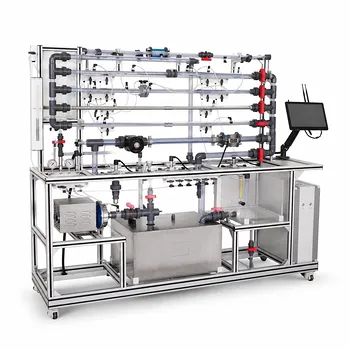
The formal safety review report for commissioning a chemical engineering or bioprocess pilot plant must contain six core sections. These include a comprehensive process overview, a hazard assessment of all materials, detailed equipment documentation, complete operating and safety procedures, a pre-startup checklist, and the material safety data sheets for every chemical in use. This structured report acts as the definitive safety control document, ensuring that no hidden risk goes unaddressed before the first experimental run.
A pre-commissioning safety report is not a bureaucratic form—it is a compact, actionable proof that your team has systematically identified every hazard, verified all engineering controls, and armed every operator with clear, validated procedures. Without these six sections, you are essentially commissioning blind.
Why This Report Is Your Deepest Safety Defense
The surface requirement is a document that satisfies institutional or regulatory review. The deeper need is to create a single, irrefutable source of truth that protects students, researchers, and expensive equipment from preventable incidents. A well-crafted safety review report does three things: it forces thorough preparation, it standardizes verification, and it becomes the reference that outlasts individual memory.
Every section in the report serves to close a specific gap that commonly leads to pilot plant accidents. Missing engineering data results in overpressurization. Incomplete waste disposal steps lead to uncontrolled releases. An absent checklist allows a distracted operator to skip a critical interlock test. The six sections together form a coherent safety narrative that moves from “what are we doing” to “how do we do it safely.”
The Critical Role of a Single, Binding Document
In educational and research settings, pilot plants are often run by rotating teams of students or visiting researchers. The report bridges the experience gap. It forces the supervising engineer to capture tacit knowledge—like the sound of a failing pump or the smell of a leaking seal—into explicit, written warnings and procedural steps.
When the document is treated as sacred, every new team member must read, understand, and sign off before entering the lab. This elevates safety from a one-time training lecture to a continuous, verifiable practice.
The Six Non-Negotiable Sections of Your Safety Review Report
1. Process Overview and Engineering Data
This section grounds the entire report in hard facts. It must include the full reaction equations, stoichiometry, a process flow diagram, and the safe operating envelope—explicit ranges for temperature, pressure, flow rates, and pH.
Operating limits must be unambiguous. If a reactor’s pressure relief valve is set at 10 bar, the maximum working pressure must be stated as 8 bar, with a high-high alarm at 9 bar. Any exothermic runaway risk must be clearly linked to a specific temperature threshold. This section proves you have identified the physical boundaries of safety, not just the desired setpoints.
2. Raw Materials and Products: Hazard Assessment and Risk Reduction
Every chemical entering or leaving the pilot plant must be listed. But a simple list is not enough. The report must classify each substance’s primary hazard—flammable, toxic, corrosive, reactive, or environmentally damaging—and specify the specific risk-reduction methods for that material.
For a flammable solvent, highlight the grounding and bonding procedure, the nitrogen inerting of the reactor headspace, and the location of the nearest fire extinguisher rated for that solvent. For a highly toxic intermediate, detail the closed-transfer system, the fume hood use requirement, and the medical surveillance protocol. This section transforms MSDS data into actionable plant-specific controls.
3. Equipment Setup and Technical Documentation
This section must include the manufacturer’s specifications, P&ID drawings with all piping and instrumentation, and the installation qualification records. It proves that the physical plant matches the design.
Critical details like gasket material compatibility, pressure relief valve set pressures, and interlock logic diagrams must be present. A simple note like “all wetted parts are 316L stainless steel” can prevent someone from introducing hydrochloric acid into a system with unprotected mild steel components. This documentation also becomes vital during a root‑cause investigation after any incident.
4. Operating, Safety, Cleanup, and Waste Disposal Procedures
A single document that combines normal operating steps, emergency shutdown procedures, equipment cleanup after a run, and waste handling creates a frictionless path for the operator. The report must contain step-by-step, concise instructions that leave no room for dangerous improvisation.
Safety procedures here are the active controls: what to do if a pump cavitates, how to handle a minor leak, the emergency stop sequences. Cleanup and waste protocols prevent cross-contamination and environmental release—often overlooked in early-stage pilot plant safety reviews but a leading cause of regulatory violations.
5. Pre-Startup Safety Checklist for Operators
This is the final gate before every run. The checklist must be embedded in the report to make the safety verification auditable. It should include checks like:
- All utility master valves (water, electricity, gas) are in proper state.
- Emergency shower and eyewash station functional, with clear access.
- Required PPE verified (lab coat, goggles, chemical‑resistant gloves appropriate for the run).
- All interlock and alarm tests completed and signed off.
The checklist locks the link between the paper review and the physical world. Any “no” answer automatically halts the startup until the issue is resolved. This section transforms the report from a reference into an operational safety tool.
6. Material Safety Data Sheets (MSDS)
Including the full MSDS for each chemical in an appendix ensures that first responders and operators have immediate access to detailed toxicology, first aid, and spill response information. When integrated into the safety review report, they become part of the official record rather than a separate binder that might be ignored.
This section also signals that you have done the prerequisite due diligence: you have obtained and reviewed the latest MSDS from the supplier, and you have extracted the relevant handling requirements into section 2.
Beyond the Report: How Complementary Practices Strengthen It
The safety review report doesn’t exist in a vacuum. It relies on, and reinforces, broader safety practices that strengthen every section.
Integration with CQV and Equipment Qualification
The report’s equipment setup section is validated by the Factory Acceptance Test, Site Acceptance Test, and Installation/Operational Qualification stages. Your report should reference the successful completion of these tests, confirming that all safety instrumented systems, alarms, and interlocks function as designed.
A Living Process Hazard Strategy
The report should be informed by a systematic hazard identification exercise—reviewing chemical inventories, inspecting for corrosion, evaluating storage compatibility, and identifying ignition sources. While not a separate section, the findings of that exercise permeate sections 1 through 5, ensuring that no hazard was omitted because it looked “obvious.”
Operator Training and Commitment
The report assumes trained operators. It should include a reference to the mandatory safety education, examination, and signed safety commitment for all personnel. Without that human element, even the best checklist can be performed mechanically with no understanding of why each step matters.
Understanding the Trade-offs and Common Pitfalls
A formal safety review report that is too generic becomes shelfware. A report that is too granular becomes unreadable and is never updated. The most common mistake is to treat the document as a one‑time requirement instead of a dynamic living document that must be revised after every major modification.
Another pitfall is omitting the cleanup and waste disposal procedures from the report, leaving them to verbal instructions. This creates a dangerous gap where spent catalysts, biologically active waste, or solvent-contaminated materials accumulate with no defined disposal path.
Finally, including MSDS without extracting the plant‑specific controls leads to information overload. The report must connect “what the safety data sheet says” to “what you actually do at this facility.”
Making the Right Choice for Your Facility
The sections you include must reflect the specific risk profile of your pilot plant. A bioprocess skid with live culture requires different emphasis than a high‑pressure hydrogenation unit. Use the following goal‑based logic to prioritize your report’s detail.
- If your primary focus is educational clarity for rotating student teams: Amplify the pre-startup checklist and operating procedures with photographs of each critical valve and control, and embed clear pass/fail criteria.
- If your primary focus is research flexibility where experimental recipes change frequently: Create a modular report skeleton where sections 2 and 4 are updated per experimental campaign, but the base equipment and checklist remain fixed.
- If your primary focus is regulatory readiness and institutional audit trail: Ensure the report explicitly cross‑references qualification test reports, training records, and chemical inventory logs, creating a single audit‑ready package.
- If your primary focus is minimizing downtime from near‑misses: Strengthen section 5 with detailed verification of interlocks and alarms, and mandate a post‑run feedback loop to update the report with lessons learned.
Your safety review report is the only document that stands between an ambitious experiment and a catastrophic failure. Build it with the same rigor you apply to your research, and it will protect both your people and your science.
Summary Table:
| Section | Core Focus | Key Deliverable |
|---|---|---|
| 1. Process Overview | Operating limits, PFDs & stoichiometry | Defined safe operating envelope |
| 2. Hazard Assessment | Chemical properties & risks | Material-specific mitigation controls |
| 3. Technical Docs | Equipment specs, P&IDs & compatibility | Verification of physical plant design |
| 4. Procedures | Normal, emergency, cleanup & waste | Actionable step-by-step instructions |
| 5. Safety Checklist | Pre-startup checks, interlocks & PPE | Auditable final gate before runs |
| 6. MSDS Appendix | Supplier safety data sheets | Immediate first aid & spill references |
Ensure Safety and Compliance in Your Lab Operations
Building a safe, compliant research environment starts with the right equipment and procedures. LABPARK provides premium Educational and Vocational Unit Operations Pilot Plants in chemical engineering, bioprocess & biotech, and environmental & water treatment. Designed specifically for universities, research institutes, and enterprises, our systems integrate fail-safe designs and comprehensive technical documentation to simplify your safety reviews.
Ready to upgrade your laboratory or pilot plant safely? Contact LABPARK today to discuss your custom project requirements!
Related Products
- Natural Product Extraction Unit Operations Training Pilot Plant
- Fixed-Bed Chemical Reaction and Gas Dust Tar Removal Unit Operations Pilot Plant
- Ethyl Acetate Synthesis Unit Operations Pilot Plant for Practical Training
- Methanol Synthesis and Catalyst Performance Evaluation Educational Unit Operations Pilot Plant
- Electrolytic Hydrogen Production Educational Unit Operations Pilot Plant
People Also Ask
- How to Demo Solubility Sensitivity in SFE Pilot Plants? Practical Thermodynamics
- How do pilot plants differentiate physical vs chemical extraction? Enhance Chemical Engineering Training
- How are HTU and NTU applied to determine extraction column height? Guide to Pilot Plant Scaling
- Why use split-plot designs in pilot plants instead of CRD? Optimize process parameters effectively.
- How can Hotelling's T² & Q statistics detect pilot plant abnormalities? Optimize Safety