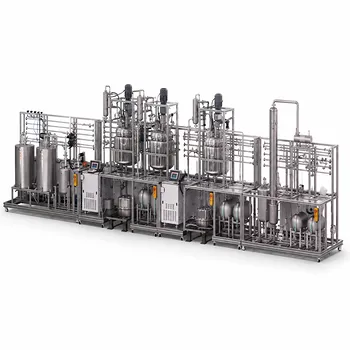
To prevent exothermic runaway in a pilot plant, you must integrate three interconnected layers of defense: active cooling jackets, intelligent automated interlocks, and vapor mitigation systems. These features form the backbone of an educational reactor, allowing students to safely observe, control, and even intentionally disturb a reaction in order to master the principles of thermal stability.
The ultimate goal goes far beyond installing hardware. A well-designed teaching pilot plant must make the invisible visible—it lets students map the kinetic boundary between safe operation and runaway, then manipulate parameters like cooling duty and feed rate to personally experience how those boundaries shift. The safety features described here are chosen not just for protection, but for the clarity they bring to concepts like criticality classes, heat transfer limitations, and the adiabatic temperature rise.
Layered Defense: The Core Hardware That Prevents Runaway
The primary reference outlines three physical systems that every educational pilot plant should have. Each serves a distinct pedagogical purpose, moving from direct thermal control to automated hazard mitigation.
Rapid Heat Removal with Jackets and Metered Addition
The first and most immediate barrier is an active cooling system—typically a refrigeration unit coupled with a jacketed reactor. For teaching, the jacket must demonstrate how heat transfer capacity directly limits safe operation.
Students can actively manipulate the jacket temperature and flow rate, then measure the resulting change in the reactor’s heat accumulation. This is essential for reactions with an adiabatic temperature rise (ΔTad) greater than 50 °C or a time to maximum rate under adiabatic conditions (TMRad) below 24 hours, because those conditions demand that the cooling system can outpace the reaction’s own heat generation.
A critical control complement is metered addition of reagents. For highly hazardous processes, such as Grignard reagent formation, the system should physically allow students to limit the initial charge to no more than 20 % of the reagent before confirming a controlled reaction initiation. This teaches the principle of semibatch operation, where the dosing rate directly governs the instantaneous heat release and keeps the system within the available cooling capacity.
Real-Time Monitoring and Automated Interlocks
Cooling hardware alone is insufficient without the intelligence to act on data. The pilot plant needs advanced instrumentation—temperature and pressure sensors, flow meters, and ideally online spectroscopic tools like FTIR—to track reaction progress continuously.
This sensory layer is connected to automated interlocks. When a measured parameter exceeds a predefined safe threshold, the system must autonomously trigger an emergency response: stopping the feed pumps, opening the jacket’s cooling valve fully, or initiating a quenching agent. The pedagogical value lies in allowing students to intentionally trigger these interlocks by stepping into the "runaway region" (under controlled, low-hazard conditions) and immediately seeing how the automated safety system restores a safe state.
FTIR monitoring is particularly instructive. It reveals delayed exotherms or the accumulation of an intermediate that may propagate a secondary runaway, giving students a real-time window into the chemical kinetics that simple temperature readings can miss.
Vapor and Overpressure Mitigation Systems
Even with cooling and interlocks, a teaching plant must simulate how industrial facilities handle the worst-case scenario. Integrated small-scale scrubbers, relief systems, and flame arrestors serve this function.
The relief system should be sized according to the worst-case pressure generation scenario, teaching students the principles of DIERS (Design Institute for Emergency Relief Systems) methodology. A small scrubber can neutralize any generated toxic or volatile vapors, demonstrating how a safety barrier absorbs the consequence when the prevention layer fails. For pressure systems, material compatibility and proper vent sizing are non-negotiable—these features must be transparent and modifiable so students can verify the adequacy of their relief design.
Teaching the Science: What Students Can Only Learn by Doing
Hardware sets the stage, but preventing runaway ultimately depends on understanding kinetic stability. The pilot plant must be a laboratory for mapping the safe operating envelope.
Mapping the Stoessel Criticality Class
By using scaled-down jacketed reactors equipped with precise temperature sensors, students can measure the process temperature (Tp) and the maximum temperature of the synthesis reaction (MTSR). From these, they calculate the adiabatic temperature rise and assign the reaction to one of the Stoessel criticality classes (1 to 5).
This classification exercise is perhaps the single most powerful teaching tool. A class‑3 or class‑4 scenario immediately shows why keeping the operating temperature a safe distance from the initiation temperature of secondary decomposition exotherms is mandatory. Students see the numerical thresholds that dictate industrial HAZOP recommendations.
Finding the Kinetic Stability Boundary in Tubular Reactors
For tubular reactor pilot plants, the concept is expressed through the relationship between the Heat of Reaction Parameter (B) and the Heat Transfer Parameter (δ/Da). Runaway becomes highly likely when B is large (more heat generated) and δ/Da is small (less heat removed).
Students can systematically vary the inlet temperature, feed flow rate, and cooling jacket flow, then plot the resulting temperature profiles. The critical heat of reaction parameter, Bc, is the threshold where the second and third derivatives of temperature with respect to conversion vanish. Configuring the plant to maintain the heat transfer parameter above this critical boundary teaches reactor stability theory in a tangible way, without imposing arbitrary limits. Manipulating activation energy (by choosing different reaction systems or temperatures) and reaction order (by selecting specific chemistries) further cements the link between fundamental kinetics and industrial safety.
Simulating Deviations to Embed Hazard Awareness
A teaching pilot plant without the ability to simulate process deviations misses half its value. Students need to deliberately fail the cooling water, stop the agitator, or spike the feed concentration while monitoring the consequences in real time.
Controlled Deviation and HAZOP Thinking
These simulations directly support the skills required to lead HAZOP (Hazard and Operability) studies. By experiencing how a loss of agitation creates a hot spot that accelerates a decomposition, students internalize the very guide words they will later use to audit full-scale plants.
The pilot plant should allow for a range of deviations: cooling water failure to test maximum jacket response time, overcooling to study potential solidification or secondary exotherms, and intentional contamination to explore how material incompatibilities can trigger sudden pressure rise. Each simulation is a micro‑lesson in identifying the heat of reaction, temperature control limits, and emergency relief requirements that must be documented in any safety evaluation.
Understanding the Trade-offs
No educational setup is perfect, and an honest technical assessment must acknowledge the limitations.
Cost and Complexity Versus Validity
A heavily instrumented, fully interlocked pilot plant is expensive and can overwhelm undergraduates if not carefully scaffolded. There is a real risk that students memorize button sequences rather than grasping the underlying thermodynamics. The instructor must design experiments that shift the focus from the hardware to the physical insight.
Scaling and Hazard Fidelity
Pilot‑scale runaway is inherently safer because the total energy content is small, but this also makes the temperature response faster and the adiabatic effect more difficult to sustain. The thermodynamic lessons transfer readily, but students must understand that the heat transfer parameter in a 2‑liter vessel behaves very differently from a 20,000‑liter industrial reactor. The pilot plant is a conceptual model, not a direct replica.
The Danger of Over‑Automation
If the automated interlocks always intervene perfectly, a student might never develop the intuition to anticipate a crisis. A well-designed curriculum intentionally turns interlocks off (with strict, multi‑person safety oversight) for certain exercises, so that learners must interpret pressure and temperature curves and make manual decisions. The safety feature set must allow this flexibility without compromising the inherent safety of the facility.
Making the Right Choice for Your Educational Goals
The ideal safety feature set is determined by the specific learning outcomes you want to achieve. Prioritize your investments as follows.
- If your primary focus is teaching fundamental thermodynamics and kinetic modeling: Invest first in precise temperature and pressure sensors, a high‑quality jacket with variable‑speed circulation, and the ability to run semibatch addition. These allow students to measure ΔTad, determine rate constants, and directly calculate Stoessel criticality.
- If your primary focus is developing HAZOP and process safety decision skills: The non‑negotiable features are automated interlocks that students can program and test, along with the ability to simulate cooling loss, agitation failure, and feed errors. Integrate a small scrubber and relief system so that consequence analysis becomes a concrete exercise rather than a paperwork drill.
- If your primary focus is control engineering for safe reactor operation: Include a tubular reactor configuration where students can manipulate feed temperature, flow rates, and jacket duty to map the B versus δ/Da boundary. The automated interlock becomes a feedback loop to be tuned, and the pilot plant is essentially a live stability‑demonstration rig.
Every reading, every deviation exercise, and every interlock activation should bring the student closer to a visceral understanding that runaway is not a mysterious event but a predictable crossing of a well‑defined thermal boundary. Build that clarity into your hardware, and you will have built an engineer who can prevent it.
Summary Table:
| Safety Feature Layer | Key Components | Pedagogical Value / Learning Outcome |
|---|---|---|
| Active Cooling & Feed Control | Jacketed reactor, metered addition pumps | Understand heat transfer limits & semibatch operations |
| Automated Interlocks | Temp/pressure sensors, FTIR, auto-quench | Experience safe state restoration & track kinetics |
| Vapor & Pressure Mitigation | Relief valves, scrubbers, flame arrestors | Practice DIERS relief design & analyze safety consequences |
Bring Industrial-Grade Safety to Your Chemical Engineering Lab
Empower your students to safely master process safety and thermodynamic limits. LABPARK provides state-of-the-art Educational and Vocational Unit Operations Pilot Plants in chemical engineering, bioprocess & biotech, and environmental & water treatment.
Our systems are engineered with advanced cooling, programmable interlocks, and safety mitigation systems designed specifically for universities, research institutes, and enterprises.
Contact LABPARK today to customize a safe, hands-on learning pilot plant for your institution.
Related Products
- Fixed-Bed Chemical Reaction and Gas Dust Tar Removal Unit Operations Pilot Plant
- Multi-Reactor Educational Pilot Plant for Reaction Engineering Unit Operations
- Tubular Reactor Flow Characteristics Determination Educational Unit Operations Pilot Plant
- 100L Continuous Loop Hydrogenation Educational Unit Operations Pilot Plant
- Multi Pump Fluid Transport Process Piping Unit Operations Training Pilot Plant
People Also Ask
- When to transition from PID to adaptive control in pilot plants? Key process indicators.
- How do deviations in estimating latent heat impact pilot plant thermal systems? Avoid hardware mis-sizing.
- Why Compare Predicted and Experimental Excess Enthalpy? Key to Accurate Pilot Plant Scale-up
- How to study gasification in pilot plants? Compare exit gas composition & efficiency
- Why Use PTFE & Hastelloy in Chemical Pilot Plants? Prevent Corrosion & Ensure Safety