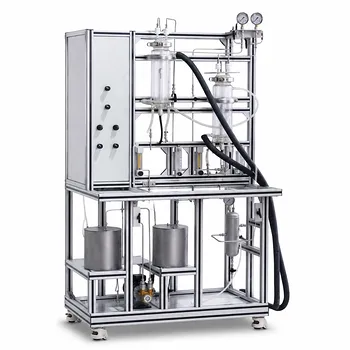
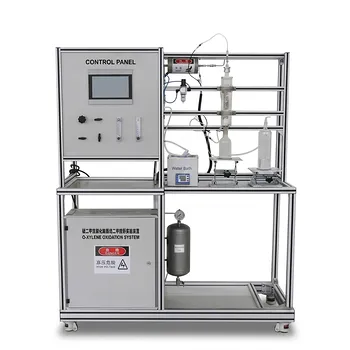
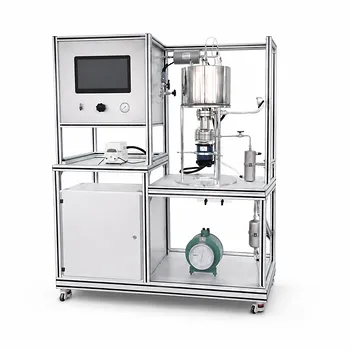
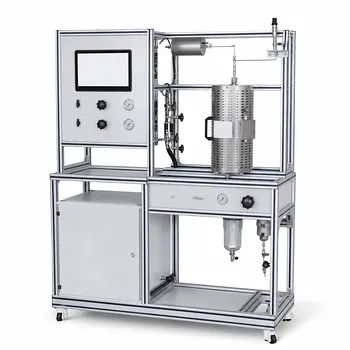
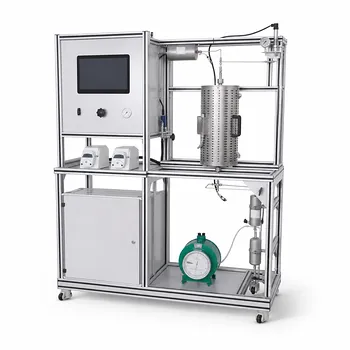
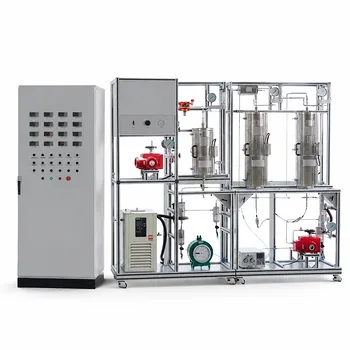
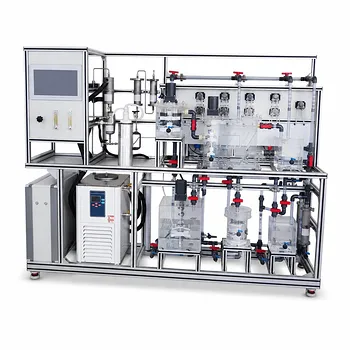
Here’s the reality: a catalytic oxidation pilot plant for a reaction like propylene selective oxidation must be engineered as a failure-containment system first and a research tool second. It demands multi-zone precision cooling, automated explosive-limit monitoring, and failsafe inert-gas purging to neutralize the inherent risks of runaway exotherms and deflagration.
A safe pilot plant for studying highly exothermic selective oxidation is not defined by a single feature, but by the seamless integration of thermal management, concentration control, and automatic safety interlocks. The plant must actively prevent the uncontrolled heat release that leads to complete combustion, using real-time data to keep the oxygen-to-hydrocarbon ratio strictly outside the explosive envelope and to trigger an instant, inert shutdown if a threshold is breached.
Understanding the Hazard: Why Selective Oxidation Demands Extreme Caution
The core risk stems from the reaction’s thermodynamic and kinetic nature. Selective oxidation, like converting propylene to acrolein, is highly exothermic and involves a network of parallel-consecutive reactions.
The Runaway Pathway to Total Combustion
The desired partial oxidation products are more reactive than the initial hydrocarbon. If heat removal fails, the temperature spike accelerates the reaction rate exponentially.
This thermal runaway instantly pushes the selectivity from valuable intermediates toward total combustion to CO₂ and H₂O, which releases significantly more heat. The result is a self-feeding cycle that can rupture a reactor in seconds.
The Invisible Flammability Trap
The reactants and products form explosive mixtures within specific concentration ranges. A localized hot spot can initiate an ignition source, triggering a deflagration even when the average bulk composition is thought to be safe.
Studying these reactions safely therefore requires a control architecture that manages heat and composition dynamically at every point in the catalyst bed.
Core Safety Design Features for the Reactor
The physical hardware must be selected and configured to survive and neutralize the worst-case scenario. These features form the passive and active barriers against catastrophe.
Explosion Mitigation and Pressure Relief
The reactor vessel and its connected piping must incorporate explosion-proof disks (rupture disks) and safety relief valves calibrated to the maximum allowable working pressure.
These devices direct a rapid overpressure event—whether from a thermal runaway or an accidental ignition—away from personnel and into a safe vent or scrubber system. Blast vents on the reactor housing provide an additional layer of protection against equipment shattering.
Thermal Management and Multi-Zone Cooling
A single cooling jacket is insufficient. The pilot plant requires high-precision, multi-zone temperature control with independent cooling loops along the reactor’s length.
Multi-point thermocouples must be embedded directly in the catalyst bed to detect localized hot spots the moment they form. This data must be linked to an automated system that instantly increases coolant flow to the affected zone, suppressing the temperature before a runaway front can propagate.
Inert Gas Purge and Emergency Shutdown Systems
An automatic nitrogen purge system is non-negotiable. It must be triggered by safety interlocks connected to high temperature, high pressure, or off-spec gas compositions.
The moment a critical limit is breached, emergency shutdown (ESD) valves instantly isolate the hydrocarbon feed while a high-volume inert gas flow floods the reactor to dilute the reactants, quench the reaction, and render the atmosphere non-flammable.
Process Control Strategies for Safe Operation
Hardware is meaningless without a real-time control philosophy that prevents the reaction from entering a hazardous state in the first place.
Precise Feed Dosing and Flammability Limit Control
The single most critical control variable is the oxygen-to-hydrocarbon ratio. The dosing system, built from high-accuracy mass flow controllers, must keep this ratio strictly outside the explosion limits.
This means operating either fuel-rich or with sufficient inert dilution. Continuous calculation of the real-time ratio, based on measured flows and online compositional analysis, is essential. A drift in a single flow controller must immediately trigger an alarm and a pre-programmed correction.
Real-Time Analytical Monitoring and Interlocks
An online gas chromatograph or a suite of dedicated gas analyzers provides the eyes on the process. This system continuously measures reactant and product concentrations, validating that the feed ratio is on target and that the reaction selectivity has not shifted toward dangerous over-oxidation.
This analytical data is hardwired to the safety interlock logic. If the oxygen concentration spikes unexpectedly or the carbon dioxide signature of runaway combustion appears, the system initiates an automatic inert gas purge without operator intervention.
Controlled Reactant Dosing via Structured Reactor Internals
Beyond simple premixed feeds, advanced pilot plant designs can fundamentally eliminate the flammability hazard. A membrane reactor physically separates the hydrocarbon stream from the oxygen stream.
Oxygen permeates through the membrane gradually along the reactor length. This keeps the local oxygen concentration low at all points, inherently avoiding explosive mixtures while also promoting higher selectivity to the partial oxidation product and suppressing total combustion.
The Critical Role of Pilot Plant Data in Risk Mitigation
A well-instrumented pilot plant does more than react chemicals; it generates the kinetic data needed to design full-scale industrial safety systems.
Validating Kinetic Models for Relief Sizing
The real-time temperature, pressure, and concentration data collected under controlled, nearly-adiabatic excursions allows researchers to fit accurate reaction rate equations.
These kinetic models are the foundational input for sizing emergency relief valves and rupture disks for production-scale reactors. Without this pilot-scale data, industrial safety systems are based on guesswork.
Understanding the Trade-offs
Safety integration is not free. You must balance the desire for maximum experimental flexibility with the non-negotiable demands of hazard containment.
Research Scope vs. Hardware Complexity
Adding multi-zone cooling, membrane internals, and complex interlock logic significantly increases the system’s cost and complexity. This can limit the ease with which you can reconfigure the reactor for a new catalyst test, creating a tension between a dedicated safety platform and a versatile research tool.
The Trap of Over-Reliance on Automation
Automated emergency shutdowns can create operator complacency. The pilot plant must still be designed with passive safety features—like inherent cooling capacity and blast protection—so that if the logic solver or a valve actuator fails, the system does not immediately become a bomb.
The flexible reactor packing zones mentioned in some designs, while excellent for studying catalyst selectivity, can also introduce reproducibility risks if not packed identically each time. A channeling effect in the packing can create a low-flow hot spot that multi-zone cooling struggles to detect, bypassing your primary thermal defense.
Making the Right Choice for Your Research Goal
Integrate safety features based on the specific hazard profile of your chemistry. A one-size-fits-all solution will either be dangerously inadequate or prohibitively complex.
After a brief analysis of your experimental objectives, align your design choices accordingly:
- If your primary focus is catalyst screening and intrinsic kinetics: Prioritize a flexible reactor with multi-zone cooling and online gas analysis. Focus on real-time composition control to keep feed ratios safe while collecting the precise data needed for kinetic modeling.
- If your primary focus is studying the runaway reaction itself for industrial process safety: Integrate high-fidelity multi-point thermocouples, adiabatic calorimetry capabilities, and emergency relief sizing. The goal is to deliberately trigger and contain small-scale runaways to gather relief design data.
- If your primary focus is maximizing selectivity for a specific partial oxidation product: Integrate a membrane reactor or a structured monolith catalyst with controlled dosing. This physically separates reactants to eliminate the flammability hazard at its source while inherently favoring partial over total oxidation.
A safe catalytic oxidation pilot plant is the intelligent synthesis of cooling capacity, gas monitoring, and an uncompromising automatic inert-gas shutdown logic—a system that transforms a dangerous reaction into a controlled and deeply understood scientific instrument.
Summary Table:
| Safety Feature / Strategy | Function | Key Benefit |
|---|---|---|
| Rupture Disks & Relief Valves | Directs overpressure safely away from personnel | Prevents catastrophic vessel rupture |
| Multi-Zone Cooling | Independently cools localized hot spots | Suppresses thermal runaway propagation |
| Automated Nitrogen Purge | Floods the reactor with inert gas during emergencies | Quenches reaction and eliminates flammability |
| Feed Ratio Control | Maintains oxygen-to-hydrocarbon ratios dynamically | Prevents the formation of explosive mixtures |
| Membrane Reactors | Separates reactant streams along the reactor length | Inherently avoids explosive concentrations |
Scale Up Safely with LABPARK Pilot Plants
Are you looking to study complex chemical reactions without compromising on safety? LABPARK provides state-of-the-art Educational and Vocational Unit Operations Pilot Plants in chemical engineering, bioprocess & biotech, and environmental & water treatment for universities, research institutes, and enterprises.
Our custom-engineered pilot plants integrate advanced thermal management, precise feed dosing, and automated safety interlocks to protect your team and validate your process data.
Contact us today to discuss your pilot plant requirements and see how we can bring safety and precision to your laboratory or facility.
Related Products
- Photocatalytic Membrane Separation and Degradation Unit Operations Pilot Plant
- O-Xylene Oxidation to Phthalic Anhydride Educational Unit Operations Pilot Plant
- Fluidized Bed Gas Solid Catalytic Reaction Educational Pilot Plant
- Micro-Scale Gas-Solid Catalytic Reaction Educational Pilot Plant
- Fixed Bed Gas Solid Catalytic Reaction Educational Pilot Plant
People Also Ask
- What are the key differences in membrane configurations? Choose the Right Unit Operations Pilot Plant
- How Do Pervaporation, Vapor, and Gas Permeation Differ in Pilot Plants? Key Comparison
- What are the structural & performance trade-offs of flat-sheet, spiral-wound, & hollow-fiber membrane modules?
- Pervaporation vs. Vapor Permeation: Handling Suspended Solids in Membrane Pilot Plants
- How do PEI, PVDF, and PSU membranes compare in pilot plants? Find the best fit.