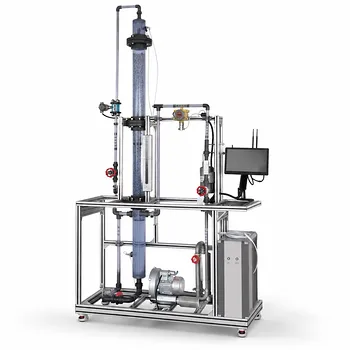
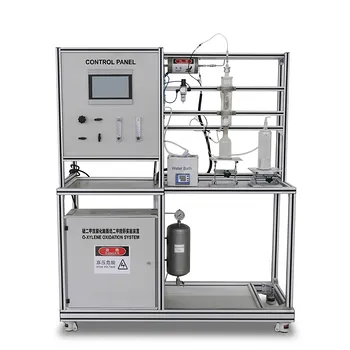
The key to unlocking accurate pilot plant data lies in three often-overlooked structural parameters. Bed voidage fraction, pellet porosity, and tortuosity directly shape how fluids flow through a packed bed and how reactants move inside catalyst pores. You cannot scale up a packed‑bed or trickle‑bed reactor reliably without first quantifying and calibrating these properties against your pilot plant’s measured pressure drop, holdup, and conversion rates.
Pilot‑plant hydrodynamics are governed by a dual transport problem: external flow through the bed’s voids and internal diffusion inside the pellets. Bed voidage controls the external pressure drop and liquid distribution, while pellet porosity and tortuosity together determine the effective diffusivity that dictates the true reaction rate. Calibrating all three against experimental data transforms a geometric description into a predictive scale‑up model.
The Critical Role of Bed Voidage Fraction
What Bed Voidage Defines
Bed voidage (or bed porosity) is the fraction of the total reactor volume that is empty space between catalyst pellets. It is critically not the same as pellet porosity, which refers to the void space inside a single particle.
In pilot plants, this value is rarely the ideal closest‑packing figure you would calculate from a perfect geometry. Real packing creates localized variations due to wall effects, particle shape irregularities, and loading technique, making direct measurement essential.
Direct Impact on Pressure Drop
The bed voidage fraction appears explicitly in the Ergun equation, squared and cubed in the denominator. Small shifts in voidage cause disproportionately large changes in pressure drop. For example, a decrease from 0.40 to 0.38 can increase ΔP by more than 15% at the same superficial velocity.
In a pilot plant, you intentionally vary flow rates and measure the resulting pressure drop to back‑calculate an effective, spatially averaged voidage. This calibrated value captures all real‑world non‑idealities (wall channelling, particle breakage, end effects) that a geometric estimate would miss.
Influence on Liquid Holdup and Flow Distribution
In two‑phase trickle‑bed operation, voidage sets the physical space available for liquid and gas to coexist. A lower bed voidage reduces the overall liquid holdup capacity, which directly affects wetting efficiency and the average residence time of the liquid phase.
Crucially, the void distribution controls flow uniformity. In pilot‑scale columns, walls can create higher voidage near the periphery, leading to preferential liquid channeling. Only by measuring global holdup and tracer residence‑time distributions can you calibrate an effective flow model that accounts for these maldistributions.
Pellet Porosity: The Gateway to Internal Diffusion
How Porosity Governes Internal Mass Transport
Pellet porosity is the volume fraction of internal pores within the catalyst particle. It creates the pathway for reactants to diffuse from the pellet surface to the active sites deep inside.
Even if external film mass transfer is fast, a low‑porosity pellet can starve the interior of reactant. The effective diffusivity inside the pore network is directly proportional to the pellet porosity—if porosity halves, the maximum possible diffusion rate also roughly halves, all else being equal.
The Calibration Link in Pilot Plants
You cannot simply rely on the manufacturer’s mercury‑porosimetry value for pellet porosity. The accessible porosity under reaction conditions may differ due to pore plugging, liquid‑phase condensation, or support swelling.
By running a pilot‑scale reactor across a range of flow rates and measuring overall conversion, you can fit the Thiele modulus and thus back‑out an effective pellet porosity. This calibrated parameter then guarantees that your kinetic model correctly captures the diffusion‑limited regime when scaled up.
Tortuosity Factor: The Hidden Multiplier
Understanding Tortuosity: The Maze Inside the Pellet
Tortuosity (τ) accounts for the fact that pores are not straight, parallel cylinders. The actual path a molecule travels is longer and more convoluted than the pellet’s radial distance. Tortuosity is a dimensionless factor, always greater than 1, that amplifies the diffusion path length.
In many catalyst formulations, tortuosity can range from 2 to 10, meaning that the effective diffusion coefficient is reduced by a factor of 2 to 10 compared to the straight‑pore ideal. Its impact is easily underestimated because it is difficult to measure directly.
How Tortuosity Modifies Effective Diffusivity
The standard model for the effective diffusion coefficient inside a catalyst pellet is:
D_eff = (ε_pellet / τ) × D_molecular
Porosity (ε) and tortuosity (τ) therefore act as a pair. A material with high porosity but extremely high tortuosity can still exhibit poor internal diffusion. The ratio ε/τ is the single most important term for predicting whether a pellet will be diffusion‑limited.
In pilot‑plant characterization, you rarely separate ε and τ from a single experiment. Instead, you measure the overall effectiveness factor versus flow rate and fit the lumped ratio. Knowing this calibrated ε/τ is sufficient for reliable scale‑up, even if you never isolate the individual values.
Integrating the Parameters for Pilot‑Plant Hydrodynamic Characterization
Building a Predictive Hydrodynamic Model
For a packed‑bed or trickle‑bed pilot plant, the sequence is:
- Bed voidage → from pressure drop versus velocity data, fitted to Ergun or similar models.
- Liquid holdup and distribution → from tracer studies, interpreted with voidage and flow models.
- Effective diffusivity factor (ε/τ) → from conversion data across a range of space velocities, fitted to a reaction‑diffusion model.
Only when all three parameters are calibrated against the same pilot‑plant dataset do you get a model that simultaneously predicts pressure drop, holdup, and conversion. This internal consistency is what prevents scale‑up disasters.
Preventing Liquid Channeling and Energy Waste
Without calibrated bed voidage, you risk designing a commercial reactor that operates with severe liquid maldistribution. The result is bypassing, hot spots, and reduced selectivity.
Without calibrated pellet transport properties, you may under‑predict diffusion limitations at commercial scale. This leads to ordering a reactor with insufficient catalyst volume and a massive increase in energy consumption to pump fluids through a longer bed to compensate. The pilot plant’s role is to identify these pitfalls before they become capital‑intensive mistakes.
Understanding the Trade‑offs
- Voidage versus flow uniformity: A higher bed voidage lowers pressure drop and energy cost, but it can promote local bypassing if packing is not uniform. In trickle beds, excessively high voidage reduces liquid‑solid contacting efficiency because the liquid films become thinner.
- Pellet porosity versus mechanical strength: High‑porosity pellets enhance internal diffusion and active‑site accessibility, but they are more prone to crushing and attrition. In large commercial beds, pellet breakage can collapse bed voidage and skyrocket pressure drop.
- Tortuosity as a black‑box parameter: Because tortuosity is rarely measured directly, it becomes a convenient “fudge factor” that can absorb errors in other assumptions (e.g., incorrect dynamic liquid holdup). Relying too heavily on a fitted tortuosity without independent verification can lead to a model that fits the pilot plant but fails at a different scale.
- Trade‑off in calibration effort: Isolating ε/τ from conversion data requires accurate kinetic constants. If the intrinsic kinetics are uncertain, the fitted diffusivity will compensate incorrectly, hiding true mass‑transfer limitations.
Making the Right Choice for Your Pilot Plant Design
Your approach to these three parameters must match your primary pilot‑plant objective.
- If your primary focus is minimizing pressure drop and pumping costs: Prioritize an accurate determination of effective bed voidage from pressure‑drop data. Use this to optimize pellet shape and loading method, knowing that pumping energy scales with the inverse cube of voidage.
- If your primary focus is maximizing reaction rate and catalyst utilization: Concentrate on the ε/τ ratio. Design your pilot campaigns to operate in the diffusion‑limited regime so that effectiveness factor differences become visible, and then fit a robust value that will drive commercial catalyst sizing.
- If your primary focus is reliable scale‑up of trickle‑bed hydrodynamics: Treat voidage, holdup, and ε/τ as an interconnected set. First calibrate voidage against pressure drop, then use that voidage to interpret holdup data, and finally use both to constrain the effective diffusivity from conversion experiments. This sequential validation eliminates hidden compensating errors.
- If your primary focus is reducing development time: Use a validated pilot‑plant model with these calibrated parameters to run virtual “what‑if” studies on flow distribution and diffusion limitations, minimizing the number of expensive pilot‑scale experiments.
A pilot plant is not just a smaller reactor—it is an instrument to extract the physical constants that make your commercial design mathematically inevitable. Bed voidage, pellet porosity, and tortuosity are the numbers that make that transformation possible.
Summary Table:
| Parameter | Definition | Hydrodynamic Impact | Calibration Method |
|---|---|---|---|
| Bed Voidage | Empty space fraction between pellets | Controls pressure drop and liquid distribution | Pressure drop vs. velocity fitting |
| Pellet Porosity | Internal pore volume fraction | Governs internal mass transport & diffusion | Conversion vs. flow rate fitting |
| Tortuosity | Convoluted pore path multiplier | Reduces effective diffusivity inside pellet | Fitted lumped ratio from conversion data |
Optimize Your Chemical Engineering Lab with LABPARK
Are you looking to enhance your research precision or vocational training capabilities? LABPARK provides state-of-the-art Educational and Vocational Unit Operations Pilot Plants in chemical engineering, bioprocess & biotech, and environmental & water treatment.
Designed specifically for universities, research institutes, and enterprises, our pilot plants enable accurate hydrodynamic characterization and reliable scale-up modeling.
Take your research and teaching to the next level—contact our technical experts today to find the perfect pilot plant solution for your needs!
Related Products
- Packed Bed Absorption Educational Unit Operations Pilot Plant
- Micro-Scale Gas-Solid Catalytic Reaction Educational Pilot Plant
- High-Gravity Emulsification and Mass Transfer Educational Pilot Plant
- Fixed-Bed Chemical Reaction and Gas Dust Tar Removal Unit Operations Pilot Plant
- Fixed Bed Gas Solid Catalytic Reaction Educational Pilot Plant
People Also Ask
- How Do Flow Regimes Transition in Packed Bed Pilot Plants? Key Scale-up Insights
- How does reactant concentration determine absorption column control? Gas-film vs. dual-film.
- How is the packing height of an absorption column calculated? Master HTU & NTU Concepts
- How does the wall effect impact packed-bed conversion? Essential pilot plant scale-up tips.
- How does static vs. operating holdup affect pilot plant calibration? Avoid Critical Scale-Up Errors