The moment you rely on simple total metal concentration to predict solubility at high temperatures, you’ve already introduced a critical modeling error. Aqueous speciation is the essential chemical framework that transforms a raw dissolved metal measurement into an actionable prediction of scaling, transport, and corrosion risk. It defines exactly which chemical forms — free ions, hydroxides, or neutral complexes — a dissolved metal oxide like NiO will take, and therefore dictates its true solubility limit and deposition potential under the specific pH and temperature of your pilot plant.
The role of aqueous speciation is to resolve the “total dissolved metal” into its distinct charged and neutral species, each with its own stability and transport behavior. Without this, solubility models cannot predict the sharp pH-dependent onset of metal precipitation, making it impossible to design reliable pH control strategies that prevent scaling and equipment degradation in high-temperature pilot plants.
The Chemistry at Play: Metal Oxides in Hot Water
A metal oxide surface does not dissolve into a simple soup of identical atoms. In water, it hydrolyzes, forming a dynamic family of species whose relative populations shift dramatically with even a tenth of a pH unit or a few degrees of temperature. Understanding this is the prerequisite to any meaningful modeling.
What Is Aqueous Speciation?
Aqueous speciation is the calculation of the equilibrium distribution of all dissolved species derived from a single metal. In a nickel oxide system, the nickel that leaves the solid surface does not remain as a single “Ni²⁺” ion.
It immediately reacts with water molecules or hydroxide ions to create species like NiOH⁺, Ni(OH)₂(aq), or even anionic complexes like HNiO₂⁻ at highly alkaline pH. Each species has a distinct charge, size, and chemical potential.
Speciation Defines True Solubility, Not Just Total Concentration
Total dissolved nickel measured by ICP-OES (Inductively Coupled Plasma Optical Emission Spectroscopy) gives you a single number. But the solubility limit of the oxide is not a single number — it is the sum of the concentrations of all individual species in equilibrium with the solid phase, each governed by its own thermodynamic stability constant.
The total concentration alone is meaningless for predicting precipitation. A solution might hold a high total metal content yet remain stable if most of the metal is in a highly soluble neutral hydroxide form. Conversely, a lower total concentration could already be supersaturated with respect to a charged species that will rapidly precipitate or deposit on a surface.
Why Standard Models Fail Without Correct Speciation
Many early-stage pilot plant models use empirical correlations or simplistic solubility products (Ksp) that assume only one dominant dissolved species. This works at ambient temperature but collapses in the complex hydrolysis landscape of high-temperature water.
The Hidden Complexity of Hydrolysis
The primary reference correctly notes that selecting the correct speciation scheme prevents modeling errors. The reason is hydrolysis. A divalent metal ion in water undergoes a sequence of hydrolysis reactions, each with a temperature-dependent equilibrium constant.
Missing an intermediate species like NiOH⁺ flattens the shape of the solubility curve. Your model will predict too much solubility at near-neutral pH and fail to anticipate the sharp rise in solubility at very high pH. This directly impacts the predicted critical pH window for scaling control.
Temperature’s Amplifying Effect on Speciation Errors
At high temperatures, the dielectric constant of water drops dramatically. This fundamentally alters solvation and ion pairing. Hydrolysis constants shift, often making neutral species like Ni(OH)₂(aq) dominant at temperatures above 150 °C, whereas charged species governed behavior at ambient conditions.
A speciation model fitted to room-temperature data will systematically misplace the solubility minimum at high temperatures. In a pilot plant steam generator or hydrothermal reactor, this leads to scaling predictions that are off by an order of magnitude or more, converting a supposedly safe operating window into a severe deposition zone.
Understanding the Trade-offs and Modeling Pitfalls
No modeling approach is without its compromises. The art lies in matching the complexity of your speciation scheme to the engineering need without falling into paralyzing over-parameterization.
The Danger of Over-Simplification
The most common pitfall is the use of a single thermodynamic constant (the solubility product for the neutral oxide) to describe a multi-species system. This approach cannot reproduce the V-shaped solubility curve characteristic of amphoteric metal oxides.
It fails at both low and high pH. It will lead you to believe that raising pH indefinitely decreases solubility, while in reality, for metals like nickel or zinc, high pH triggers the formation of soluble anionic hydroxo-complexes and dramatically increases dissolution. The result is a failed pH control strategy and catastrophic scaling in downstream piping.
The Cost of Over-Complexity
Including every conceivable polynuclear species or high-order hydroxide complex that can be found in academic databases is equally dangerous. Many of these species have formation constants with high uncertainty, especially above 100 °C.
A model overloaded with uncertain parameters becomes brittle and non-robust. It may fit a specific set of lab data perfectly but fail to extrapolate to the dynamic temperature and pressure gradients of a flowing pilot plant. The most robust practice selects the minimal set of mononuclear hydrolysis species that captures the charge balance and solubility minimum correctly.
From Speciation to Strategy: How It Informs Plant Operations
A correct speciation model is not an academic exercise. It is the direct computational foundation for the chemical control protocols that keep a pilot plant running and intact.
Guiding pH Control to Minimize Scaling
The entire purpose of an engineered pH setpoint is to place the dissolved metal at its minimum solubility — the sweet spot where precipitation driving force is lowest. This pH of minimum solubility is entirely a function of the distribution of charged versus neutral species.
A speciation model reveals the precise pH where the dominant species switches. By operating just on the acidic or basic side of that point, you can maintain a safe margin while avoiding the rapid precipitation that occurs exactly at the solubility minimum. Without this, operators are essentially flying blind, using trial-and-error chemical dosing.
Predicting Deposition Hotspots
As cooling water or process fluid moves through a thermal gradient, speciation shifts continuously. A neutral hydroxide species that is stable in the hot core of a heat exchanger may become a charged, precipitating species as it cools in the outlet piping.
Coupled with a fluid dynamics model, speciation enables the prediction of exactly where on a heat exchanger surface or within a pipe bend deposition will begin. This allows the pilot plant team to target inspection resources, optimize chemical injection points, and validate the performance of corrosion inhibitors under realistic, local chemical conditions.
How to Apply This to Your Pilot Plant
Your choice of modeling workflow depends on your primary operational risk. Use the correct speciation complexity to match your objective without exceeding the data you can reliably validate.
- If your primary focus is preventing scaling: Build a mononuclear hydrolysis model (Mᴶ⁺, MOH⁽ᴶ⁻¹⁾⁺, M(OH)₂⁰, M(OH)₃⁻, M(OH)₄²⁻) that captures the full amphoteric curve. This is the minimum viable scheme to find the true pH of minimum solubility and avoid both acidic corrosion and alkaline scaling.
- If your primary focus is accurate corrosion prediction: Couple the speciation model with surface complexation or electrochemical potentials. The concentration of a specific adsorbed species, not total metal, often controls passive layer stability. Ensure your scheme includes the charged species that will interact with a charged alloy surface.
- If your primary focus is process optimization under thermal gradients: Avoid static speciation models. Implement a reactive transport model where speciation recalculates at every computational node as temperature changes. This will reveal the critical cooling zone where neutral species convert and deposit, often far from where you’d expect.
The role of aqueous speciation is to give you a chemical map of what you cannot see. Use that map to stop fighting symptoms like scaling and start controlling the fundamental chemical drivers, and your pilot plant data will finally translate into robust, full-scale operational success.
Summary Table:
| Modeling Aspect | Simplistic Model (Ksp Only) | Advanced Speciation Model | Operational Impact |
|---|---|---|---|
| High-Temp Accuracy | Poor; misses hydrolysis shifts | High; captures neutral/charged species | Prevents scaling hotspots |
| pH Optimization | Assumes linear relationship | Identifies true V-shaped curve minimum | Pinpoints exact dosing setpoints |
| Predictive Power | Fails to locate deposition zones | Accurately maps local thermal gradients | Extends equipment lifespan |
Scale Up Your Research with Precision
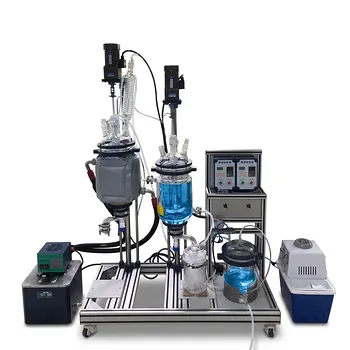
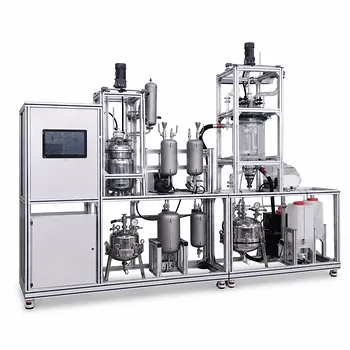
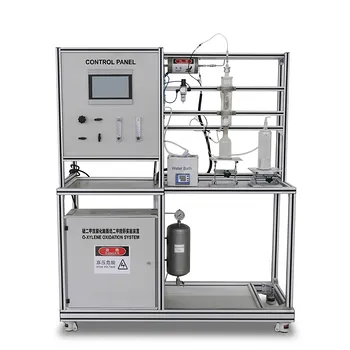
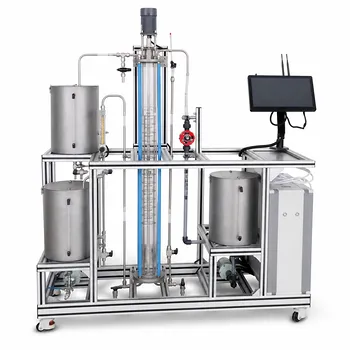
Accurately simulating high-temperature corrosion and scaling requires reliable physical hardware. LABPARK provides state-of-the-art Educational and Vocational Unit Operations Pilot Plants in chemical engineering, bioprocess & biotech, and environmental & water treatment. Designed specifically for universities, research institutes, and enterprises, our pilot plants enable real-world validation of your thermodynamic and speciation models.
Ready to elevate your chemical engineering research? Contact LABPARK today to find the perfect pilot plant solution for your facility!
Related Products
- Potassium Salt Thermal Dissolution and Crystallization Separation Educational Unit Operations Pilot Plant
- Ion Exchange Water Purification Educational Pilot Plant for Engineering Unit Operations
- Gallium and Indium Selective Extraction Educational Pilot Plant
- Photocatalytic Membrane Separation and Degradation Unit Operations Pilot Plant
- Educational Unit Operations Pilot Plant for Intraparticle Diffusion Effective Factor Measurement
People Also Ask
- How does solubility modeling assist crystallization pilot plants? Master the BETA parameter.
- What are the benefits of integrating online PAT tools like ATR-FTIR into crystallization unit operations pilot plants?
- How do crystallization pilot plants improve student learning? Shift from manual observation to process control.
- Control Crystallization Pilot Plant Secondary Nucleation: 4 Key Adjustments
- Why is precise temperature control critical in crystallization pilot plants? Key to Scale-Up Success