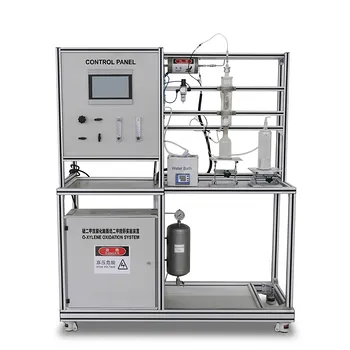
Catalytic reforming unit operations pilot plants act as miniature, interactive refineries that make the isomerization of linear alkanes concrete. Instead of merely reading about octane number improvement, students and researchers use these plants to physically convert low-value straight-chain hydrocarbons into high-value branched isomers. By manipulating reactor temperatures, space velocities, and feed compositions on a real fixed-bed catalyst, they directly witness the shift from linear to branched alkanes, measure the jump in fuel quality, and internalize the thermodynamics that drive these endothermic reactions.
These pilot plants transform the abstract chemistry of octane enhancement into a visceral, data-rich learning experience. The core value lies not just in seeing isomerization happen, but in the ability to correlate operating variables with measurable product outcomes—linking process decisions to the fuel’s anti-knock performance in a way that no textbook or simulation can replicate.
Bridging Theory and Practice in Fuel Upgrading
The Chemistry of Octane Enhancement
Linear alkanes in the gasoline boiling range knock badly in an engine—their straight chains ignite unevenly. Branched alkanes burn far more smoothly, delivering a higher octane number. Catalytic reforming exists to reshape those linear molecules into branched, cyclic, and aromatic structures that boost fuel quality.
The isomerization pathway specifically transforms, for example, n-heptane into iso-heptane. This subtle rearrangement of atoms dramatically increases the fuel’s resistance to knocking, yet understanding it fully requires more than a reaction equation.
From Linearity to Branching: The Isomerization Pathway
On a bifunctional catalyst like platinum on alumina, linear alkanes undergo dehydrogenation to alkenes on metal sites, then skeletal rearrangement into branched carbocations on acid sites, followed by re‑hydrogenation. This sequence is sensitive to temperature, pressure, and hydrogen partial pressure.
A pilot plant makes these sensitivities tangible. As students raise the reactor temperature, they observe the equilibrium shift toward more branched isomers—until side reactions like cracking begin to compete. The endothermic nature of the reaction becomes clear when they see the need for a preheater and the temperature profile along the fixed bed.
How Pilot Plants Enable Deep Learning
Hands-On Manipulation of Critical Process Variables
These educational units are engineered with fixed-bed reactors, feed preheaters, and pressure control loops that mirror industrial hardware. Students can deliberately alter:
- Space velocity to see how residence time affects conversion and selectivity.
- Reactor temperature to map the trade‑off between isomerization rate and thermal cracking.
- Feed composition to test the robustness of the catalyst with different n‑alkane cuts.
Every change produces a different branched‑to‑linear alkane ratio in the product, a number that can be measured via gas chromatography. This direct correlation between a knob twist and a quality metric cements the principle of process control in fuel refining.
Real-Time Analysis and Product Quality Assessment
The learning extends beyond the reactor. By analyzing the liquid product’s composition, students calculate research octane number (RON) improvements and verify how each branched isomer contributes differently. This connects the molecular world to the practical specification that determines a fuel’s market value.
When the pilot plant is integrated with distillation or other separation modules—as many unit operations setups are—the experience becomes richer. Students isolate the isomerized stream, perform mass balances, and compute yields, bridging the gap between reaction engineering and the broader chemical value chain described in supplementary references.
Integrating Reaction and Separation for Process Understanding
The supplementary references emphasize that unit operations pilot plants are designed to replicate sequential transformation stages. In a catalytic reforming unit, the reaction step is naturally followed by product cooling and phase separation. This integration forces learners to think about the entire process: how unreacted linear alkanes might be recycled, how hydrogen is managed, and how purity and yield interact.
Such process-level thinking is essential for fuel quality improvement. It teaches that isomerization is not an isolated reaction but part of a system where separation efficiency determines the final octane uplift.
Understanding the Trade-offs and Limitations
Scale-Down Compromises in Kinetics and Heat Transfer
A bench‑scale fixed‑bed reactor does not perfectly replicate the adiabatic, multi‑stage reactors of a commercial refinery. Heat losses and wall effects can distort the temperature profile, making the apparent kinetics differ from true industrial performance.
Students must be taught to recognize these artifacts. A colder bed section may artificially favor isomerization over cracking, producing an overly optimistic selectivity unless heat management is carefully controlled.
Catalyst Deactivation and Idealized Feeds
Educational pilot plants often use clean, single‑component feeds or simple naphtha surrogates. Industrial reforming feeds contain sulfur, nitrogen, and polycyclic aromatics that accelerate catalyst deactivation and necessitate continuous regeneration.
While the platinum‑alumina catalyst in the pilot unit will lose activity over time, the deactivation mode is usually milder. This simplification is pedagogically useful—it allows focus on the isomerization chemistry—but it must be pointed out that commercial catalyst lifetimes and reactor designs are driven by much harsher conditions.
Safety and Simplification vs. Industrial Reality
The hydrogen atmosphere and high temperatures in a reforming pilot plant demand rigorous safety protocols. Educational units incorporate interlocks and pressure relief, but they often operate at lower total pressures than commercial reformers. This reduces risk at the cost of some realism in thermodynamic equilibrium and hydrogen partial pressure effects.
Furthermore, the pressure control loops, while instructive, may be less sophisticated than the advanced model‑predictive controls used in industry. Acknowledging these gaps prepares students for the complexity they will encounter in a real refinery.
Leveraging Pilot Plants for Your Educational Goals
The catalytic reforming pilot plant is a flexible teaching tool. Its impact depends entirely on how the curriculum aligns with specific learning objectives. Below are targeted approaches based on common goals.
- If your primary focus is teaching reaction engineering fundamentals: Manipulate temperature and space velocity while tracking the branched‑to‑linear ratio. Have students calculate apparent activation energies and discuss how endothermic equilibrium limits conversion.
- If your primary focus is demonstrating fuel quality improvement: Directly couple the reactor with simulated or actual octane number determination, requiring students to optimize conditions for maximum RON while minimizing low‑value cracked gas.
- If your primary focus is process integration and scale‑up thinking: Include downstream separation like distillation, and emphasize mass and energy balances across the entire pilot plant. Ask students to project how purity, yield, and recycle flows would change at commercial scale.
By moving beyond static diagrams, catalytic reforming pilot plants turn the isomerization of linear alkanes into a tangible, measurable step in the journey from crude oil to cleaner‑burning fuel.
Summary Table:
| Aspect | Key Details & Educational Focus |
|---|---|
| Core Process | Isomerization of linear alkanes to branched isomers |
| Key Variables | Reactor temperature, space velocity, feed composition |
| Hardware Used | Fixed-bed reactor, feed preheater, pressure control loops |
| Learning Outcome | Understanding octane enhancement (RON) & process integration |
| Limitations | Scale-down heat transfer differences, milder catalyst deactivation |
Bring Industrial Reality to Your Lab with LABPARK
Ready to elevate your chemical engineering curriculum or research capabilities? LABPARK provides state-of-the-art Educational and Vocational Unit Operations Pilot Plants in chemical engineering, bioprocess & biotech, and environmental & water treatment. Designed specifically for universities, research institutes, and enterprises, our pilot plants bridge the gap between textbook theory and industrial reality.
- Hands-on Learning: Enable students to manipulate real-world process variables like temperature and flow.
- Research-Grade Quality: Get reliable, scalable data for catalytic and process optimization.
- Tailored Solutions: Custom-engineered systems to match your curriculum or research goals.
Equip your institution with the tools to train the next generation of engineers. Contact our specialists today to find the perfect pilot plant solution for your lab!
Related Products
- Multi Functional Catalytic Reaction and Reactor Evaluation Educational Unit Operations Pilot Plant
- Fixed-Bed Chemical Reaction and Gas Dust Tar Removal Unit Operations Pilot Plant
- Methanol Synthesis and Catalyst Performance Evaluation Educational Unit Operations Pilot Plant
- Dual-Mode Rectification Pilot Plant for Practical Training Unit Operations
- Crude Benzene Hydrogenation Educational Unit Operations Pilot Plant
People Also Ask
- What reaction engineering principles are shown in a catalytic reactor pilot plant? SO2 Oxidation Guide
- How does feed gas flow rate affect catalytic RFR yields? Optimize Pilot Plant Performance
- Why is FTIR integration in catalytic pilot plants important? Real-Time Student Insights
- How to analyze active metal distribution & identify catalyst poisoning in pilot plants? Expert Diagnostic Guide
- How to study catalyst poisoning & regeneration? Master catalytic reaction life cycles.