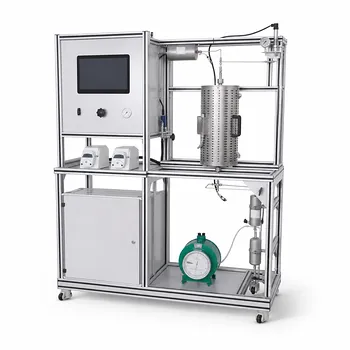
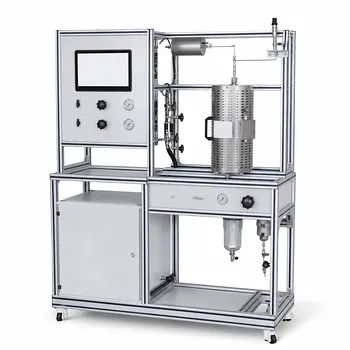
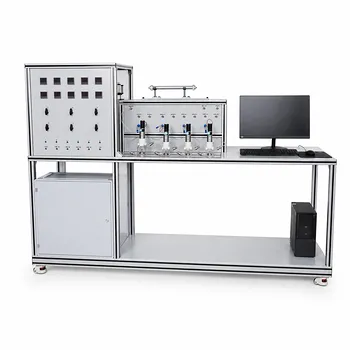
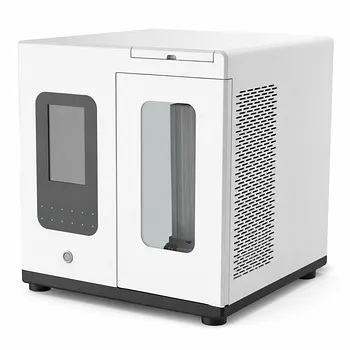
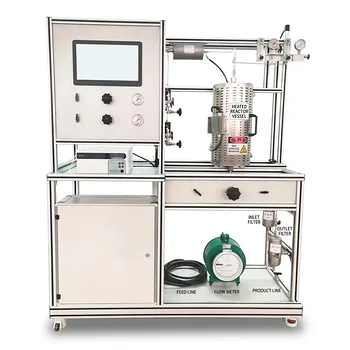
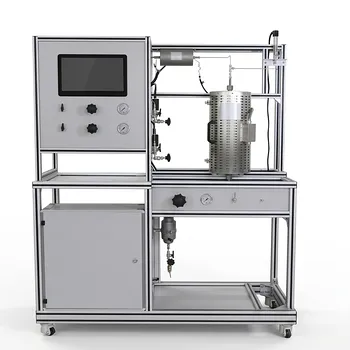
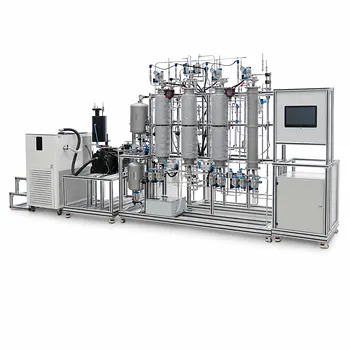
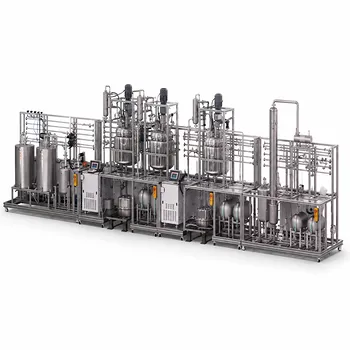
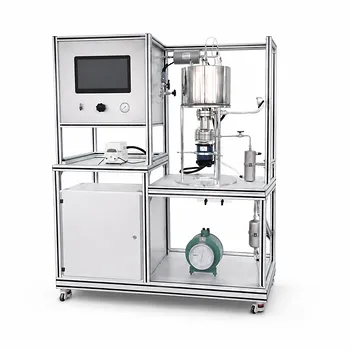
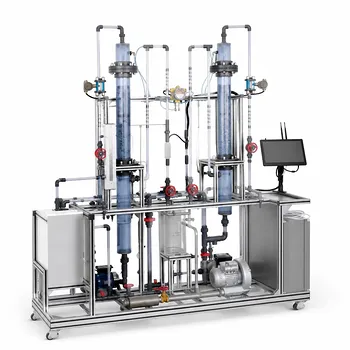
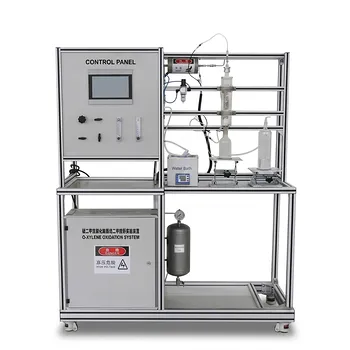
A pilot plant for studying gas-phase ethylbenzene alkylation must center on a multi-stage adiabatic fixed-bed reactor coupled with a three-column separation train. This configuration mimics the industrial Mobil/Badger process, allowing researchers to safely investigate the highly exothermic reaction between benzene and ethylene over a ZSM-5 zeolite catalyst. The reactor operates at 370–425 °C and 1.37–2.74 MPa, while the separation section recovers and recycles both unreacted benzene and polyethylbenzenes, maximizing raw material efficiency and making the plant a faithful testbed for kinetic, thermodynamic, and operability studies.
To truly study gas-phase alkylation, a pilot plant must do more than just react benzene and ethylene. It needs a multi-stage adiabatic reactor with interstage quenching to control the exotherm, and an integrated separation train (benzene recovery, ethylbenzene purification, polyethylbenzene recycle) to close material loops. These two elements—reactor staging and full recycle—are what transform a simple test rig into a meaningful unit operations platform.
Reactor Configuration: Why Staging and Quenching Are Non‑Negotiable
The alkylation of benzene with ethylene is highly exothermic. Without proper thermal management, temperature runaways accelerate coke formation on the catalyst and destroy selectivity toward ethylbenzene. The solution in both industry and the pilot plant is a multi-stage adiabatic fixed-bed reactor.
Adiabatic Beds with Interstage Ethylene Injection
In an adiabatic bed, the liberated heat raises the process fluid’s temperature as it flows through the catalyst. To prevent the outlet temperature from exceeding safe limits (typically remaining well below 425 °C), the reactor is broken into multiple beds in series. Between these beds, cold ethylene is injected as a direct quench stream, cooling the mixture and simultaneously adjusting the feed composition before the next bed.
This design teaches critical heat‑integration and selectivity principles. The quench itself is a control variable—students and researchers can map how the distribution of ethylene among stages affects the overall temperature profile, benzene conversion, and by-product formation.
The Dominant Role of the Benzene-to-Ethylene Ratio
Even with staging, a single‑bed quench strategy is insufficient unless the overall benzene-to-ethylene (B/E) molar ratio is intentionally high. Industrial wisdom—and a key learning objective in the pilot plant—shows that a B/E ratio of 8–15 mol/mol at the reactor inlet acts as a thermal diluent. The excess benzene absorbs reaction heat, dampening the temperature rise per pass and suppressing side reactions such as the formation of di‑ and tri‑ethylbenzenes.
The pilot plant must therefore be instrumented to allow precise ratio adjustments, demonstrating how this single parameter simultaneously governs reactor outlet temperature, catalyst lifetime, and overall yield.
Process Stages: From Feed Preheating to a Three‑Column Separation Train
Studying alkylation in isolation is educationally incomplete. The full pilot plant must integrate the reaction section with a realistic downstream separation sequence, exactly as outlined in the primary reference.
Raw Material Preheating and Reaction Section
Downstream of the feed system, benzene and a portion of the ethylene are preheated to reaction temperature before entering the first catalyst bed. The multi-stage adiabatic reactor—with interstage ethylene injection—forms the core reaction section. Precise temperature sensors at the inlet and outlet of each bed, along with online analytics, allow real‑time monitoring of conversion and selectivity.
The Three‑Column Separation Train
The reactor effluent contains ethylbenzene, unreacted benzene, and heavier alkylation products (mainly di‑ and tri‑ethylbenzenes). To recover product and close the material loop, the pilot plant requires a separation train consisting of:
- Benzene Recovery Column: Distills unreacted benzene overhead for recycle back to the reactor, drastically improving benzene utilization and mimicking the tight integration of a commercial plant.
- Ethylbenzene Column: Separates the desired ethylbenzene product to a purity suitable for downstream applications (e.g., styrene monomer production). This column provides a clear product stream for yield and quality analysis.
- Polyethylbenzene Column: Recovers heavy polyethylbenzenes from the bottoms. Instead of discarding them, these are recycled to the reactor, where they undergo transalkylation with benzene to form additional ethylbenzene. This loop is essential for demonstrating how overall selectivity can exceed the single‑pass alkylation selectivity.
Only with all three columns can the pilot plant replicate the mass‑balance closure and recycle dynamics that make industrial alkylation units so efficient. It’s this holistic view—reaction plus separation plus recycle—that turns the platform into a true unit operations learning environment.
Critical Operating Conditions and Instrumentation
The primary reference specifies 370–425 °C and 1.37–2.74 MPa as the operating window for the reaction section. The catalyst (typically a H‑ZSM‑5 zeolite) is highly sensitive to temperature, and the pilot plant must therefore feature:
- Multi‑point thermocouples inside each bed to capture axial temperature profiles.
- High‑pressure mass‑flow controllers for ethylene and benzene to maintain precise feed ratios.
- Back‑pressure regulation to explore the effect of pressure on thermodynamic equilibrium and coking.
These measurement capabilities turn the pilot plant into a rigorous kinetic and process‑control testbed.
Understanding the Trade‑offs
While the multi‑stage adiabatic reactor with interstage quenching is the industrial standard, replicating it at pilot scale exposes several design tensions that researchers must manage.
Adiabatic Behavior at Small Scale
Achieving true adiabatic conditions is difficult in a small‑diameter reactor because the surface‑area‑to‑volume ratio is high. Heat losses to the environment can mask the exotherm and lead to misleading kinetic data. Careful insulation, heat‑tracing, or compensatory external heating may be needed—and students must learn to quantify the resulting uncertainty.
Pressure Drop vs. Catalyst Particle Size
Industrial catalysts are often 3.2–4.8 mm extrudates, but in a pilot reactor, smaller particles may be required to avoid internal mass‑transfer limitations. However, small particles increase bed pressure drop, which can distort flow distribution and limit throughput. The pilot plant must allow researchers to experiment with particle size and bed height to understand this classic scale‑up dilemma.
Coke Management and Catalyst Deactivation
High temperatures, even when controlled by quenching, inevitably lead to coke deposition over time. The pilot plant must be designed for periodic catalyst regeneration (e.g., oxidative burn‑off) and teach strategies to extend cycle length—such as adjusting the B/E ratio or ethylene split—without sacrificing data continuity.
Educational Complexity vs. Operational Safety
A fully integrated pilot plant with multiple columns and high‑pressure operation poses safety risks and operational complexity. In a university setting, scaled‑down pressure and temperature, along with robust relief and purge systems, are necessary to keep the unit safe while still conveying the essential unit operations. The educational value lies in the process layout and control logic, not in exact industrial tonnage.
Making the Right Choice for Your Pilot Plant
The specific configuration of your pilot plant should align with your primary educational or research goal. The following recommendations will help you tailor the design:
- If your primary focus is demonstrating industrial reactor control: Prioritize a multi‑stage adiabatic reactor with interstage ethylene injection and precise on‑line temperature monitoring at each bed. The separation train can be simplified to a single benzene‑recovery column if product purity is not a core objective.
- If your primary focus is teaching full reuse and mass‑balance closure: Build the complete three‑column separation train with recycle loops for both benzene and polyethylbenzene. Even if ethylene quench is absent, the recycle dynamics alone make the pilot plant a powerful learning tool.
- If your primary focus is reaction kinetics and catalyst evaluation: Opt for a single‑bed isothermal reactor (or a small‑diameter adiabatic bed with compensatory heating) so you can decouple mass‑transfer effects and collect clean kinetic data on the ZSM‑5 catalyst. This trades away some industrial realism for scientific rigor.
- If your primary focus is safety and educational throughput in a limited lab space: Scale down the reactor and columns, use a fixed‑bed reactor with a high benzene‑to‑ethylene ratio as a thermal management strategy, and consider simulated recycle streams using feed‑forward controls. This retains the core process insights while minimizing hazards.
In the end, a well‑designed gas‑phase alkylation pilot plant doesn’t just study a single reaction—it teaches the fundamental interplay of heat management, catalyst performance, and separation‑recycle integration that defines modern chemical manufacturing.
Summary Table:
| Process Stage / Component | Key Function | Operating Conditions & Parameters |
|---|---|---|
| Multi-Stage Adiabatic Reactor | Houses ZSM-5 catalyst; facilitates gas-phase alkylation while managing exothermic heat via interstage ethylene quenching. | 370–425 °C, 1.37–2.74 MPa; Benzene-to-Ethylene (B/E) ratio of 8–15 mol/mol. |
| Benzene Recovery Column | Separates and recovers unreacted benzene from the reactor effluent. | Overhead product is recycled back to the reactor feed. |
| Ethylbenzene Column | Purifies the target ethylbenzene product. | Produces high-purity ethylbenzene suitable for downstream analysis or styrene synthesis. |
| Polyethylbenzene Column | Recovers heavy di- and tri-ethylbenzenes from the column bottoms. | Bottoms are recycled to the reactor for transalkylation to increase overall yield. |
Build the Perfect Unit Operations Lab with LABPARK
Are you looking to bridge the gap between classroom theory and industrial reality? LABPARK provides state-of-the-art Educational and Vocational Unit Operations Pilot Plants in chemical engineering, bioprocess & biotech, and environmental & water treatment.
Designed specifically for universities, research institutes, and enterprises, our pilot plants help you:
- Replicate Complex Industrial Processes: Safely simulate high-pressure, high-temperature reactions like gas-phase alkylation.
- Enhance Research & Training: Equip your labs with advanced instrumentation for precise kinetic modeling, thermodynamic study, and process control.
- Ensure Operational Safety: Benefit from scaled-down, robustly engineered setups featuring advanced emergency relief and purging systems.
Ready to design a custom pilot plant tailored to your curriculum or research goals? Contact LABPARK today to collaborate with our engineering experts!
Related Products
- Ethylbenzene Dehydrogenation Educational Unit Operations Pilot Plant
- Crude Benzene Hydrogenation Educational Unit Operations Pilot Plant
- Ethyl Acetate Synthesis Unit Operations Pilot Plant for Practical Training
- Methanol Synthesis and Catalyst Performance Evaluation Educational Unit Operations Pilot Plant
- Methane Cracking Educational Unit Operations Pilot Plant
People Also Ask
- What parameters & reactor configurations are needed for ethylbenzene dehydrogenation pilot plants?
- Why is steam dilution critical in dehydrogenation? Pilot Plant Control Guide
- Isothermal vs Adiabatic Reactors: Key Differences in Ethylbenzene Dehydrogenation Pilot Plants
- How do pilot plants help students verify material balances? Bridge Theory with Real-world Data
- Why is the steam-to-feedstock ratio critical in catalytic dehydrogenation? Learn the 3 key roles of steam.