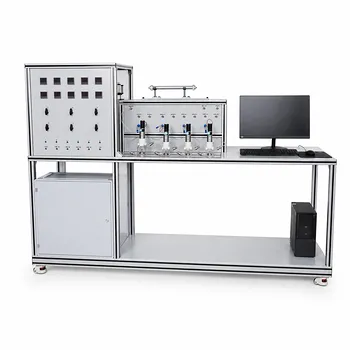
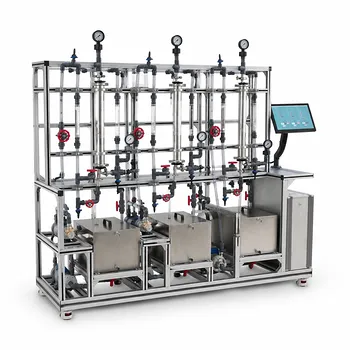
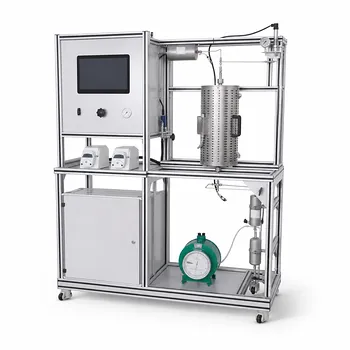
Reactive chromatography transforms equilibrium-limited reactions by merging chemical conversion and product separation into a single, intensified step. For reactions like esterifications, continuously pulling products away from the catalyst zone drives the equilibrium forward, dramatically raising conversion while simplifying downstream purification. Unit operations pilot plants provide the essential, hands-on environment to explore these integrated dynamics—allowing you to optimize flow rates, map adsorption behavior, validate models, and assess the true economic potential before committing to full scale.
Process intensification through reactive chromatography overcomes thermodynamic constraints and slashes separation costs, but its real-world potential is only unlocked through systematic pilot-plant evaluation. These scaled-down systems reveal how multifunctional reactors behave under realistic conditions, exposing both the performance gains and the practical engineering hurdles that must be mastered for successful implementation.
How Reactive Chromatography Reshapes Chemical Processes
Overcoming Equilibrium Limitations
Many valuable reactions—esterification, transesterification, and certain condensations—are equilibrium-limited, meaning they stall before reaching high conversion. Reactive chromatography continuously removes one or more products from the reaction zone, preventing the reverse reaction and pushing the net conversion well beyond the thermodynamic ceiling of a simple batch reactor. The result is higher single-pass yield and a drastically reduced need for downstream recycling or product recovery loops.
Process Intensification in a Single Unit
Traditional processes pair a reactor with separate separation trains. Reactive chromatography collapses these two unit operations into one fixed-bed adsorptive reactor or a simulated moving bed (SMB) reactor. This integration slashes capital costs, equipment footprint, and the energy and solvent demands associated with standalone purification. In a well-designed SMB configuration, stationary phase capacity is fully utilized, valuable product loss is minimized through near-quantitative yields, and internal solvent recycling curbs fresh solvent consumption—making the process both economically and environmentally leaner.
The SMB Advantage for Continuous Operation
Simulated moving bed chromatography couples reaction and separation in a counter-current mode that approximates true moving-bed behavior. Three distinctive advantages emerge: first, the stationary phase is used at maximum capacity, meaning less sorbent is needed for the same throughput. Second, operational parameters can be tuned to achieve arbitrarily high purity with almost no yield loss. Third, solvent is recycled internally, reducing overall solvent consumption by a significant margin compared to batch chromatography. For continuous, binary separations with reactive chemistry, SMB reactors exemplify the efficiency gains that reactive chromatography promises.
Pilot Plants: The Engine for Understanding Reactive Chromatography
Why Pilot Plants Are Indispensable
Reactive chromatography is a multifunctional process, coupling reaction kinetics, adsorption equilibria, and mass transfer in a single column. Mathematical models alone cannot capture the full picture—realistic flow maldistribution, packing heterogeneity, and resin aging are difficult to predict. Unit operations pilot plants give researchers and students a concrete platform to validate models, observe dynamic interactions, and map out the precise conditions (temperature, flow rate, feed composition) that yield the best conversion, selectivity, and adsorbent utilization.
Mapping Adsorption Isotherms and Kinetics
Understanding the competitive adsorption behavior of reactants and products on the chosen resin is fundamental. Pilot columns allow systematic measurement of breakthrough curves under reaction conditions. This generates accurate adsorption isotherms and kinetic constants, which feed directly into process models. Without this data, scale-up remains a guesswork exercise with a high risk of underperformance.
Demonstrating Process Intensification Principles
Students and researchers using these pilot units can witness firsthand how coupling reaction with separation shifts conversion boundaries. They can contrast a conventional packed-bed reactor with an identical column that also acts as a separator, measuring the jump in conversion and purity in real time. These experiments cement the foundational lesson that overcoming equilibrium is not a theoretical abstraction but a tangible, engineerable outcome.
Practical Training on Scale-Up and Column Hardware
Chromatography pilot plants teach a critical scale-up rule: bed height and linear flow velocity are kept constant, while column diameter and bed volume are increased to handle higher throughput. This simple rule brings complex challenges—ensuring uniform flow distribution, managing increased pressure drops, and packing large-diameter columns without channeling. Pilot units reveal the essential role of headplates, flow distributors, and screens in maintaining plug flow. They also allow evaluation of modern high-capacity resins that can load well over 30 g/L and withstand high operating pressures, connecting material properties directly to real-world performance.
Integrating Process Analytical Technology
A pilot-scale production environment is the ideal proving ground for process analytical technology (PAT). Placing in-line analyzers on a reactive chromatography skid delivers feasibility data under realistic flow conditions, tests analyzer compatibility with process streams, and creates a solid proof of concept. This early validation ensures that analytical tools will truly support robust process control when the technology moves to full production.
Understanding the Trade-offs and Practical Limitations
Increased System Complexity
Integrating reaction and separation introduces new control variables—temperature must serve both the reaction rate and the adsorption equilibrium, flow rates influence both conversion and separation quality, and resin deactivation can alter the performance of both functions simultaneously. Operators must master this interplay, which demands a more sophisticated understanding and control infrastructure than a standalone reactor.
Column Packing and Hardware Demands at Scale
As columns are scaled in diameter while keeping height constant, packing uniformity becomes exponentially harder. Even minor inhomogeneities cause flow maldistribution, reducing effective resolution and local reactant contact. The cost and precision required for high-quality distributors and packing systems can erode some of the expected capital savings, especially for smaller production volumes.
Resin and Solvent Trade-offs
High-capacity, pressure-tolerant resins that work well for adsorptive separations are not always optimal catalysts. A reactive medium must balance catalytic activity, adsorption selectivity, and mechanical stability. In SMB units, the internal solvent recycling minimizes fresh solvent use, but it also means that any solvent decomposition products or reaction by-products can accumulate, requiring periodic purges or resin regeneration that complicate continuous operation.
Cycle Time and Unproductive Periods
Even in a semi-continuous reactive chromatography setup, non-productive periods—column regeneration, cleaning, or product switching—reduce time-averaged throughput. Pilot plants allow direct measurement of how catalyst deactivation or fouling impacts these idle windows. The data guides the optimization of run length: extending a run may increase yield but the rising probability of channeling or performance drift must be balanced against the downtime cost, identifying the economic optimum for unit production cost.
Making the Right Choice for Your Development Goals
How you leverage pilot-plant insights depends on where you are in the technology readiness spectrum. Target your experimental program to your primary objective.
- If your primary focus is maximizing conversion for an equilibrium-limited reaction: Design pilot studies to map conversion as a function of space velocity and product removal rate. Use breakthrough experiments to select the resin that simultaneously catalyzes the reaction and selectively adsorbs the key product, driving equilibrium displacement.
- If your primary focus is simplifying downstream purification: Run the pilot unit in a mode that mimics a realistic feed with impurities. Quantify how much the integration reduces the number of post-reaction unit operations—often a single polishing step can replace an entire train.
- If your primary focus is cost reduction and scale-up readiness: Pay close attention to column packing quality, flow distribution, and pressure drop data at increasing diameters. Use the pilot to benchmark solvent consumption and sorbent lifetime under cyclic operation, feeding these hard numbers into a total cost-of-ownership model.
- If your primary focus is training and model validation: Use the pilot plant to systematically vary one parameter at a time—temperature, flow rate, feed concentration—and compare the dynamic column response against process simulations. This is the fastest way to build intuition and confidence in the predictive tools that will guide commercial design.
Investing in rigorous pilot-plant exploration transforms reactive chromatography from an elegant concept into a bankable process decision, equipping you with the physical evidence and engineering know-how to implement intensification with confidence.
Summary Table:
| Process Advantage of Reactive Chromatography | How Unit Operations Pilot Plants Help |
|---|---|
| Overcoming Equilibrium Limits | Measures breakthrough curves under real reaction conditions to map kinetics. |
| Process Intensification (Single-Unit) | Evaluates integrated reactor-separator setups to reduce footprint and energy. |
| Continuous SMB Operation | Optimizes flow rates, purity targets, and internal solvent recycling loops. |
| Scale-Up & Hardware Feasibility | Identifies column packing issues, pressure drop challenges, and PAT integration. |
Bring Process Intensification to Life with LABPARK
Ready to bridge the gap between chromatography theory and industrial scale-up? LABPARK provides advanced Educational and Vocational Unit Operations Pilot Plants in chemical engineering, bioprocess & biotech, and environmental & water treatment.
Designed specifically for universities, research institutes, and enterprises, our pilot skids empower your team to validate thermodynamic models, master column packing, and optimize complex reaction-separation dynamics.
Accelerate your research and training today — Contact LABPARK now to find the perfect pilot plant solution for your lab!
Related Products
- Multi-Reactor Educational Pilot Plant for Reaction Engineering Unit Operations
- Internal Circulation Gradient Free Catalytic Reaction Educational Pilot Plant
- Fixed-Bed Chemical Reaction and Gas Dust Tar Removal Unit Operations Pilot Plant
- Fluidized Bed Gas Solid Catalytic Reaction Educational Pilot Plant
- Multi-Functional Special Distillation Educational Pilot Plant
People Also Ask
- How do educational unit operations pilot plants address safety and waste management when scaling up?
- How do educational unit operations pilot plants bridge theory and design? Bridge the Engineering Gap
- Why Compare Predicted and Experimental Excess Enthalpy? Key to Accurate Pilot Plant Scale-up
- How to study gasification in pilot plants? Compare exit gas composition & efficiency
- Why Use PTFE & Hastelloy in Chemical Pilot Plants? Prevent Corrosion & Ensure Safety