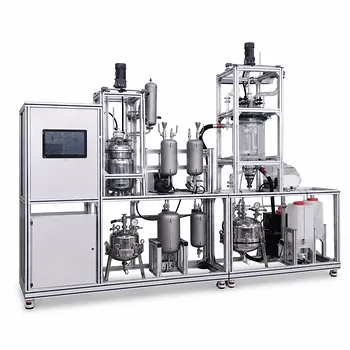
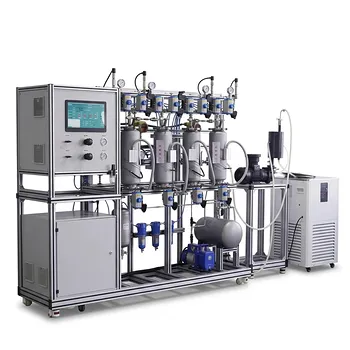
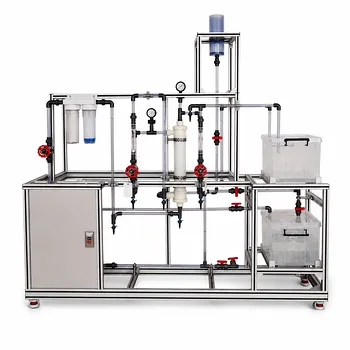
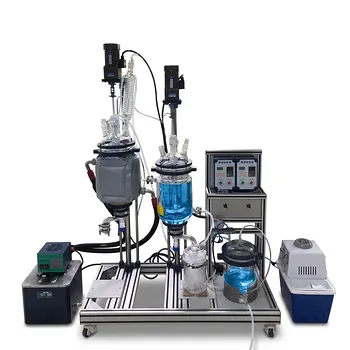
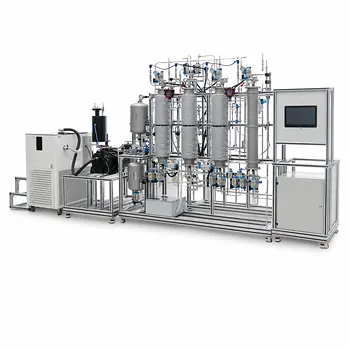
If you’re transitioning students from a Buchner funnel and vacuum flask, the educational pilot plant units used to teach solid-liquid separation scale-up are rotary vacuum drum filters, plate-and-frame filter presses, and centrifugal separators. These systems replace manual laboratory vacuum filtration with controlled, measurable, and continuous processes that mimic industrial operations. They let students directly quantify the engineering parameters—cake resistance, filtration rate, washing efficiency, and pressure drops—that design scale-up decisions.
Laboratory vacuum filtration teaches the basics of solid-liquid separation, but it obscures the compressibility, media resistance, and rate-limiting mechanisms that govern real process scale-up. Educational pilot plants like rotary vacuum filters, plate-and-frame presses, and centrifuges turn filtration theory (the Ruth equation) into hands-on, measurable practice—bridging the critical gap between glassware and industrial plant design.
From Glassware to Industrial Reality
The manual Buchner funnel is a simple batch device that works under low vacuum. It shows that a pressure difference can pull liquid through a cake, but it does not let students explore the dynamics of continuous operation, cake compressibility, or washing optimisation.
Why Lab Glassware Falls Short for Engineering Training
In a bench-scale vacuum filtration, the cake is thin and the filter area is tiny. Students cannot easily vary and control the pressure drop across the cake in a repeatable way, nor can they measure the rate at which the filter medium itself blinds.
Manual operation hides the time-dependent behaviour of filtration. Industrial separations must handle high solids loads, sustained pressure differences, and multi-cycle washing—factors that demand a quantitative understanding of flow resistance and yield.
The Value of Controlled Pilot Plant Environments
Educational pilot units provide repeatable, instrumented settings. Students can set and record the pressure driving force, feed slurry concentration, and filtrate volume over time. This transforms filtration from a qualitative “it worked” lab exercise into a quantitative design task.
They introduce continuous processing and automation. A rotary vacuum filter, for example, demonstrates how a single piece of equipment can simultaneously feed slurry, form a cake, wash it, and discharge solids—an impossible feat with a Buchner funnel.
The Core Pilot Plant Units for Solid-Liquid Separation
Three unit operations dominate vocational and university laboratories because they span a wide range of industrial scenarios and provide direct, measurable linkages to filtration theory.
Rotary Vacuum Drum Filters
A rotating drum, partially submerged in a slurry trough, applies vacuum internally. As the drum rotates through the slurry, liquid is drawn through the filter cloth, forming a cake on the drum’s external surface. After the cake emerges from the slurry, it passes through washing and drying zones before being scraped off.
Students learn to measure the effect of drum speed, vacuum level, and submersion depth on filtration rate and cake moisture. They can also study washing efficiency by sampling the impurity concentration in the filtrate after each spray zone—an essential skill for processes like the recovery of pharmaceutical intermediates or fine chemicals.
Plate-and-Frame Filter Presses
This pressure-driven batch unit consists of alternating plates and frames holding filter cloths. Slurry is pumped into the chambers under positive pressure; the filtrate passes through the cloth while solids accumulate as a cake inside the frames.
The plate-and-frame press is often the best platform for teaching classical filtration theory. Students can stop the process at different times, measure cake thickness directly, and calculate specific cake resistance and filter medium resistance using the Ruth equation. Because pressure can be precisely controlled, it also illustrates cake compressibility—how increasing pressure actually reduces cake permeability.
Centrifugal Separators (Industrial Centrifuges)
A high-speed rotating basket uses centrifugal force to drive liquid through a filter medium. This unit operation is common when very fine particles or high-value solids are present, and when rapid dewatering is critical.
Pilot-scale centrifuges demonstrate how increasing rotational speed (g-force) impacts filtration kinetics and final cake dryness. Students also confront practical challenges like vibration, feed consistency, and solids unloading, bridging fluid dynamics theory with hands-on process safety.
What Students Actually Measure and Learn
Moving to pilot plant units unlocks the ability to quantify parameters that directly feed into equipment sizing and process troubleshooting.
Applying the Ruth Filtration Equation
The classic Ruth equation relates filtrate volume to time, cake resistance, and medium resistance. With a pilot unit, students plot t/V versus V, determine the slope and intercept, and extract the specific cake resistance (α) and medium resistance (Rm). This exercise is barely possible with a Buchner funnel due to uncontrolled vacuum and small volumes.
Measuring Cake Compressibility
When cake resistance depends on the pressure drop, the solids are compressible. Students can run the same plate-and-frame press at increasing operating pressures, calculate α at each pressure, and derive the compressibility coefficient. This gives them a vivid picture of why one cannot simply scale up a lab filtration by increasing the vacuum pump.
Optimising Washing and Drying Cycles
On a rotary vacuum filter, washing efficiency is analysed by tracking the conductivity or concentration of a tracer salt in the filtrate stream over time. Students learn that displacement washing followed by diffusion governs impurity removal, and that over-washing wastes solvent and energy—knowledge directly transferable to processes like post-crystallisation purification.
Tracking Crystal Size and Filtration Rate
If a crystallisation step precedes filtration, the particle size distribution heavily influences filtration behaviour. Using the pilot filter, students can correlate median particle size (measured offline) with the observed filtration rate and cake porosity. This reinforces why process engineers care about both crystallisation conditions and filtration performance.
Understanding the Trade-offs and Limitations
No single pilot unit perfectly mimics every industrial filtration challenge. Recognising where each excels and falls short is part of building engineering judgment.
Representativeness of Full-Scale Conditions
Small pilot units suffer from wall effects and disproportionate heat loss or vapour loss. A 0.2 m² filter cloth may not compress the cake in exactly the same way as a 20 m² industrial unit. Students must learn to interpret pilot-scale data as trend information, not directly scaled numbers, and to apply dimensionless analysis.
Operating Window and Feed Variability
A plate-and-frame press is superb for controlled cake analysis, but it struggles with highly compressible, slimy cakes that block the cloth quickly. A vacuum drum filter handles continuous feeds well but may be oversensitive to drum level fluctuations. The instructor must match the slurry characteristics to the unit’s practical range, or the experiment can become a frustrating filter-clogging exercise.
Maintenance, Safety, and Throughput
Pilot centrifuges involve high-speed rotating parts and require routine balancing and cleaning. If the teaching goal is quick turnaround between student groups, a simple pressure filter with quick-change cloths may be more practical. Safety considerations—especially with flammable washing solvents—require robust ventilation and spark-proof systems, which aren’t trivial at the educational scale.
Choosing the Right Pilot Unit for Your Curriculum
The best unit for your programme depends on what foundational skills you want to embed in your chemical or process engineering students.
- If your primary focus is teaching classical filtration theory and cake analysis: Select a plate-and-frame filter press, because it allows direct measurement of cake thickness, precise pressure control, and clean data for the Ruth equation while keeping the process inherently safe.
- If your primary focus is continuous processing, washing efficiency, and manufacturing reality: A rotary vacuum drum filter exposes students to multi-zone cake handling, wash optimisation, and the nuances of continuous vacuum operation—directly mirroring many pharmaceutical and bulk chemical processes.
- If your primary focus is separation of very fine solids or biotechnology applications: Use a centrifugal separator to demonstrate how acceleration multiples enhance dewatering and to familiarise students with high-g operation and the practical limits of filter media.
A well-chosen pilot plant unit turns fuzzy lab observations into clear, quantifiable evidence—empowering your students to scale up not just with hope, but with data.
Summary Table:
| Pilot Unit | Operating Mechanism | Key Learning Parameters | Best Curricular Fit |
|---|---|---|---|
| Rotary Vacuum Drum Filter | Continuous vacuum on rotating drum | Drum speed, washing efficiency, continuous cake drying | Industrial & pharma processes |
| Plate-and-Frame Press | Batch positive-pressure chambers | Ruth equation, specific cake resistance, compressibility | Classical filtration theory |
| Centrifugal Separator | High-g rotational force filtration | Dewatering kinetics, rotation speed, fine solids separation | Biotech & fine chemicals |
Modernize Your Engineering Lab with LABPARK
Transitioning students from laboratory glassware to industrial-scale reality requires the right educational tools. LABPARK provides state-of-the-art Educational and Vocational Unit Operations Pilot Plants in chemical engineering, bioprocess & biotech, and environmental & water treatment.
Designed specifically for universities, research institutes, and enterprises, our robust pilot plants for solid-liquid separation allow students to safely and effectively quantify real-world parameters like cake resistance and compressibility.
Ready to upgrade your curriculum? Contact our team of experts today to find the perfect pilot plant solution for your laboratory.
Related Products
- Hot Filtration Educational Unit Operations Pilot Plant Laboratory System
- Gas-Solid Heterogeneous Separation Demonstration Educational Unit Operations Pilot Plant
- Pressure Swing Adsorption Educational Unit Operations Pilot Plant
- Gallium and Indium Selective Extraction Educational Pilot Plant
- Comprehensive Liquid-Liquid Extraction Pilot Plant for Engineering Education
People Also Ask
- How to Determine Specific Cake (r) & Filter Medium (Rm) Resistance Using Filtration Pilot Plant Data
- How can researchers identify and resolve filter medium blinding? Optimize Your Pilot Plant Runs
- How to select solid-liquid separation equipment for pilot plants? A Step-by-Step Guide
- Why Demo Constant-Rate to Constant-Pressure Filtration on a Pilot Plant? Key Practical Insights
- Why Analyze Filtration Flux & Cake Compressibility in Pilot Plants? Master Solid-Liquid Separation