The non-negotiable foundation for reliable ion exchange data begins long before you collect the first sample. In environmental engineering pilot plants, students must internalize two absolute operational rules to avoid catastrophic experimental failure: first, the column must be packed perfectly—densely, uniformly, and saturated—using a wet-loading technique to eliminate air pockets; second, the liquid level must be held in a strict, narrow band of 2–3 millimeters above the resin bed for the entire run, never allowing the meniscus to drop and expose the media to air.
The central operational truth is that an ion exchange column is not merely a filter; it is a precisely engineered liquid-solid contactor. Any gap, bubble, or exposed surface creates preferential flow paths. This destroys the assumed plug-flow hydraulics, making your mass transfer calculations meaningless long before you can spot a visible leak or crack.
The Critical Art of Column Packing: Integrity Over Speed
Packing a column is not simply dumping media into a tube. The goal is to create a perfectly uniform, randomly distributed bed where every resin bead has intimate liquid contact. A flawed packing process introduces structural defects that mimic poor chemistry, leading students to incorrect conclusions about the resin’s true capacity.
The Wet-Loading Mandate
Resin must always be loaded as a slurry, never as a dry pour. A dry pour traps interstitial air pockets between the beads.
- The Mechanism: When you pour dry resin, beads bridge together, forming high-surface-tension pockets of trapped air.
- The Fix: Partially fill the column with water first. Pour the resin slurry into this standing water, maintaining the water level above the settling media. This forces air out and ensures the pores inside the beads remain saturated.
Eliminating Bed Defects
Even with wet loading, resin beads can stack imperfectly against the column wall or settle in non-random configurations. Gently tapping the column wall is a required step, not an optional one.
- Energy Dissipation: Use a rubber mallet or the heel of your hand. Sharp shocks can fracture brittle ceramic or older polymeric beads, creating fines that clog the bed’s interstitial spaces.
- Visual Inspection: Backlight the column. A properly packed bed appears uniformly translucent. Even a single static bubble clinging to the wall introduces a point of local dryness and short-circuiting.
Liquid-Level Control: The 2-3 Millimeter Rule
If poor packing creates a hidden fault, liquid-level control is the visible, dynamic discipline that defines a competent operator. The rule is simple: keep the resin bed submerged by exactly a few millimeters.
Why Air Exposure is a Catastrophic Error
Allowing the liquid level to drop to the top of the bed—or worse, below it—does not simply pause the experiment. It actively destroys the column’s integrity. The introduction of air channels is a physical disaster that requires a complete repack.
- Channeling Physics: As liquid drains into an exposed bed, gravity pulls it along the path of least resistance. Instead of a uniform wet front, the liquid channels through the dry pores, leaving large sections of the resin capacity completely unutilized.
- Surface Wetting: Once a hydrophobic or semi-dry surface forms, the subsequent re-wetting of those internal pores is slow. Simply raising the liquid level again will not instantly purge those air pockets; high backpressure or vacuum regeneration is needed, which is rarely feasible mid-experiment.
The Hydraulic Balance
Maintaining 2–3 mm of head is a battle against gravity and surface tension. This thin layer ensures the bed inlet acts as a proper liquid distributor.
- Too Low: You risk exposure. The meniscus becomes unstable, and the surface tension can rupture, instantly sucking air into the bed.
- Too High (Excessive Head): This introduces unnecessary dilution or, worse, disturbs the top layer of the resin bed. An energetic inlet stream splashing onto the bed can fluidize the top beads, destroying the random close-packing you achieved during loading.
Understanding the Trade-offs and Operational Limits
Adhering strictly to these precautions ensures that your pilot data reflects ion exchange chemistry, not fluid dynamics defects. However, students must be aware that these "perfect" operational windows also have physical constraints.
Flow Rate Constraints and Residence Time
The strict liquid-level control must coexist with a strict outlet flow. A target of 3 to 4 drops per second is standard for typical pilot-scale columns (often ~1-2 cm in diameter).
- Kinetics vs. Hydraulics: Run the column too fast, and you'll drain your protective liquid head, crashing the level. This forces you to close the outlet valve, creating a "stop-start" flow that confuses breakthrough curve data.
- Mass Transfer Zone: The residence time is directly tied to the depth of the mass transfer zone. Insufficient contact time means the exchange reaction never reaches equilibrium. You will record premature breakthrough not because the resin is exhausted, but because you failed to give the ions time to diffuse.
Bed Integrity During Shutdowns
A common student mistake is turning off the feed pump and forgetting the column. Stagnant pools evaporate, and resin beds drain via siphon effects through the bottom outlet.
- Siphon Prevention: Always ensure an air-break or anti-siphon valve is present on the feed line, or physically disconnect the feed tube at shutdown.
- Preservation: If pausing the experiment overnight, the bed should be left with several centimeters of clear liquid head. A "capped" bed with stagnant water eventually stagnates and can promote biological growth.
Making the Right Choice for Your Goal
Operational precision must match your experimental objective. Adjust your vigilance on these variables based on what you are trying to prove.
- If your primary focus is accurate breakthrough curve modeling: Prioritize perfect packing and liquid-level consistency above all else. Any premature breakthrough is likely a flow distribution artifact, not a true chemical signal.
- If your primary focus is scale-up feasibility: Focus on the resin damage threshold. Minimize tapping force and observe the pressure drop across the bed—if it rises slowly, you have generated fines from a flawed packing technique.
- If your primary focus is training safe, repeatable practices: Wet-load the column with the outlet closed and wear chemical-resistant gloves. The discipline of the 2–3 mm rule builds the foundational muscle memory for all future packed-column operations.
Mastering the art of the wet pack and the steady meniscus transforms an ordinary column into a precision measurement tool.
Summary Table:
| Operational Step | Key Action | Critical Objective |
|---|---|---|
| Wet-loading | Pour resin as slurry into standing water | Eliminates dry air pockets and ensures bead saturation |
| Bed Tapping | Gently tap column wall with rubber mallet | Removes wall-clinging bubbles without fracturing beads |
| Level Control | Maintain liquid level 2–3 mm above resin bed | Prevents air channeling and avoids bed fluidization |
| Flow Rate Control | Limit outlet flow to 3–4 drops per second | Ensures sufficient residence time and stable liquid head |
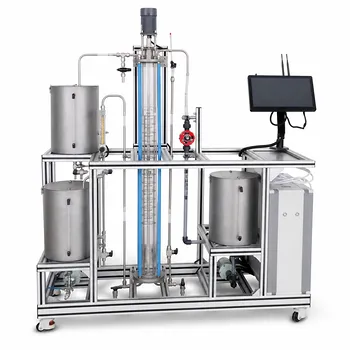
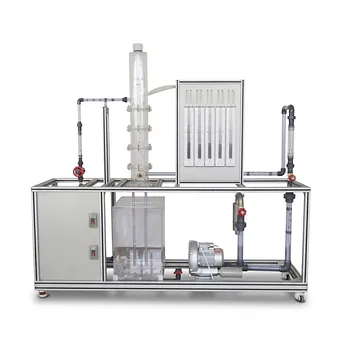
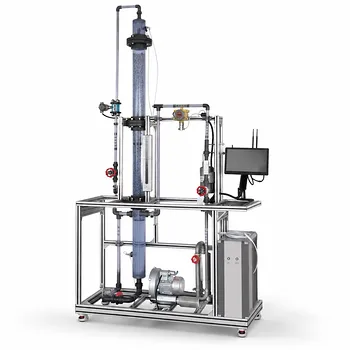
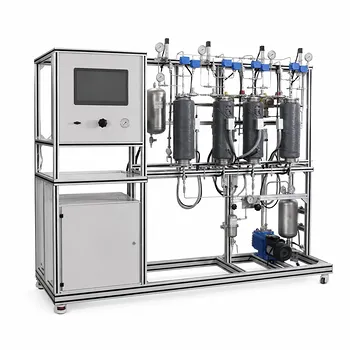
Ensure your students and researchers achieve precise, repeatable experimental data with industry-grade training systems. LABPARK provides high-performance Educational and Vocational Unit Operations Pilot Plants in chemical engineering, bioprocess & biotech, and environmental & water treatment for universities, research institutes, and enterprises. Help your team master critical operational skills—contact us today to discuss your lab's equipment needs!
Related Products
- Ion Exchange Water Purification Educational Pilot Plant for Engineering Unit Operations
- Educational Rotary Disc Liquid-Liquid Extraction Pilot Plant
- Comprehensive Liquid-Liquid Extraction Pilot Plant for Engineering Education
- Plate Column Hydrodynamics Tray Demonstration Educational Pilot Plant
- Absorption and Desorption Educational Unit Operations Pilot Plant
People Also Ask
- How to Prevent Ion Exchange Channeling? Expert Solutions for Pilot Plants
- How does ion exchange work in water treatment pilot plants? Cost & process guide.
- What operational precautions should lab operators take for resin volume changes and air pockets? Key Guide
- How to use ion exchange pilot plants to verify alkalinity? A hands-on guide for engineering students.
- How can students use ion exchange pilot plants for column sizing? Master Wastewater Design