The operational lynchpins of fermentor scale-up are the agitation power per unit volume, the superficial gas velocity, and the broth’s physical properties—chiefly its viscosity. From a design and economic standpoint, you must then balance these against the agitation rate, gas flow rate, operating pressure, and heat load. The core trade-off is that boosting the fermentation rate slashes capital costs but inflates aeration and cooling expenses, so the true goal is to minimize the net present value of those combined costs.
Pilot-plant scale-up of mechanically agitated fermentors isn’t just about hitting a target oxygen transfer coefficient (kLa). The deeper need is to find the set of operational parameters that satisfies the biological demand for oxygen and heat removal at the lowest total cost—while avoiding shear damage and mixing dead zones. A pilot plant is your experimental testbed to resolve the conflicting scaling laws before committing to a full-scale design.
The Central Role of Mass Transfer (kLa)
Oxygen is almost always the limiting substrate in high-density fermentations. The volumetric mass transfer coefficient, kLa, quantifies how fast oxygen travels from gas bubbles into the liquid broth and then to the cells.
How kLa Connects to Operational Parameters
Agitation power per unit volume (P/V) is the primary driver of kLa. Higher power input breaks gas bubbles into smaller sizes, increasing the interfacial area for mass transfer. Superficial gas velocity—the volumetric air flow rate divided by the fermentor cross‑sectional area—determines bubble residence time and the driving force for oxygen partial pressure. Broth viscosity directly suppresses kLa; thicker broths reduce turbulence and slow bubble breakup, demanding more energy to maintain the same oxygen delivery.
The Economic Twist
Higher fermentation rates lower the fermentor capital cost per unit of product. Yet they simultaneously require more aggressive aeration and more intensive cooling, which drives up operating costs. That’s why the gas flow rate and operating pressure become critical economic dials: increasing the vessel pressure raises oxygen solubility and kLa, but it also adds to compressor power and vessel wall thickness. A pilot plant lets you map out the total cost curve by running experiments at different combinations of agitation, gas flow, and pressure.
Balancing Agitation, Aeration, and Heat Removal
Scaling up a mechanically agitated fermentor forces you to manage three interrelated process duties—mixing, gas dispersion, and cooling—within a single vessel.
The Agitation‑Aeration Couple
At the pilot scale you can independently vary the impeller speed and the gas flow rate to see how they jointly affect kLa and bubble behavior. These experiments often reveal a point of diminishing returns: beyond a certain gas velocity, the impeller can flood, the power draw drops, and kLa plateaus or even falls. The optimal point isn’t the maximum possible aeration; it’s the combination that gives the required kLa with the least energy and at a tolerable shear level.
Heat Transfer Becomes the Silent Constraint
As vessel volume increases, the surface‑area‑to‑volume ratio shrinks. Even if you meet the oxygen demand, the metabolic heat must still be removed. In a pilot plant you test the adequacy of external jackets, internal cooling coils, or external heat‑exchange loops. If the cooling duty outstrips what a simple jacket can provide, the pilot‑plant data guide the design of additional internal coils—often requiring a re‑optimization of the impeller configuration to avoid flow blockages.
Pressure as an Overlooked Lever
Running the fermentor under elevated headspace pressure increases the driving force for oxygen dissolution without adding extra gas flow. However, higher pressure raises the partial pressure of CO₂, which can inhibit cell metabolism. The pilot plant is the place to quantify this trade‑off and determine the maximum allowable back‑pressure for your specific culture.
Using Pilot Plants to Validate Scale‑Up Criteria
Mechanically agitated fermentors cannot be scaled up on geometric similarity alone. The mixing, mass transfer, and shear profiles shift with scale, so you must evaluate different scale‑up rules using the pilot facility.
The Constant P/V Criterion
Keeping power per unit volume constant is the most common starting point for fermentation scale‑up. It preserves similar mixing intensity and is highly relevant for maintaining kLa. Using the relationship $P \propto n^3 D^5$, you can calculate the required impeller speed for the larger vessel. However, constant P/V does not guarantee identical shear or circulation times, which is why pilot‑scale measurements of the actual kLa and cell viability are essential.
The Constant Tip Speed Criterion
When you want to protect shear‑sensitive cells, you scale on constant impeller tip speed ($\pi n d$). This keeps the maximum velocity near the blade edge—and therefore the peak shear—unchanged. The downside is that tip‑speed scaling often reduces the P/V and the overall mass transfer capability at large scale. A pilot‑plant study can quantify how much kLa you sacrifice, so you can decide whether to accept a lower oxygen transfer or to augment with enriched air.
The Mix of Criteria Creates a Design Window
Real scale‑up usually ends up blending criteria. You might start with constant P/V to satisfy oxygen demand, then check whether the resulting tip speed surpasses a shear‑tolerance limit for your cells. Pilot‑plant runs at intermediate scale factors ($3\times$ to $10\times$ volume jumps) let you see where the most restrictive bottleneck—heat, oxygen, shear, or mixing—actually lies.
Understanding the Trade‑offs
No single operational setting is universally optimal. The pilot plant exposes the hidden trade‑offs that laboratory‑scale data cannot.
Shear Damage vs. Oxygen Delivery
High agitation boosts kLa but can rupture cell membranes, especially for mammalian or filamentous cultures. The average shear rate in the impeller region scales with the impeller speed ($\dot{\gamma} = k' N$), yet on scale‑up with constant P/V, the average shear rate can decrease while the maximum tip shear can increase. Pilot‑scale experiments that directly measure viability alongside kLa are the only reliable way to navigate this contradiction.
Viscosity and Non‑Newtonian Behavior
When broth viscosity rises—common in fungal fermentations or polymer production—the kLa can collapse unless the impeller design and speed are adapted. Highly viscous, non‑Newtonian fluids often create well‑mixed caverns near the impeller and stagnant zones elsewhere. Pilot‑scale tests with the real culture reveal whether radial‑flow Rushton turbines or axial‑flow hydrofoils give the best bulk mixing without exceeding the shear limit.
The Capital‑vs‑Operating‑Cost Tipping Point
Ramping up agitation and gas flow can drastically shrink the fermentor volume needed to meet production targets, saving millions in initial capital. But those savings may be erased by a few years of higher compressor electricity and cooling water. A pilot‑plant campaign that collects data at multiple operating conditions feeds directly into a net present value model, so you can pinpoint the pressure‑gas‑speed combination that minimizes total lifetime cost.
Common Pitfalls to Avoid
Even well‑instrumented pilot plants can lead you astray if the experimental strategy isn’t matched to the ultimate design goal.
- Ignoring the cooling bottleneck until it’s too late. Always run a full heat‑balance on the pilot vessel: compare the measured metabolic heat production with the jacket’s heat removal capacity. This prevents a painful discovery at production scale.
- Assuming kLa correlations from water‑like fluids apply to broth. Rheology matters. Always measure kLa directly in the actual fermentation broth—or at least in a high‑fidelity simulant—at the pilot scale.
- Scaling only one parameter at a time. The shortest and most reliable path is to validate candidate scale‑up rules (P/V, tip speed, kLa constant) in one or two intermediate‑scale vessels before building the full‑scale plant. Stepwise geometric similarity ($3\times$ to $5\times$ volume increase per step) prevents large extrapolation errors.
- Overlooking the effect of back‑pressure on dissolved CO₂. Pilot‑scale experiments should log both dissolved oxygen and CO₂ at elevated pressure, because a kLa‑driven pressure increase can create a CO₂ inhibition problem that no amount of oxygen will fix.
Making the Right Choice for Your Goal
Your optimal operational envelope emerges only after a systematic pilot‑plant evaluation. Tailor your scale‑up strategy to what matters most for your process.
- If your primary focus is maximum oxygen transfer with robust cells: Optimize for constant P/V and use the pilot plant to find the highest agitation power that still avoids impeller flooding. Then choose a gas flow rate and pressure that minimize the net present value of equipment plus operating cost.
- If your primary focus is protecting shear‑sensitive cells: Start with constant tip speed scaling, then use the pilot plant to see if the resulting kLa is sufficient. If not, test incremental increases in back‑pressure and consider supplementing with pure oxygen rather than raising the impeller speed.
- If your primary focus is a highly viscous or non‑Newtonian broth: Use the pilot plant to screen alternative impeller types (e.g., wide‑blade hydrofoils, helical ribbons) and to map the minimum agitation speed for full vessel turnover. Be prepared to accept a lower P/V scaling limit and compensate with increased pressure or a switch to an airlift or loop reactor.
- If your primary focus is minimizing total project cost: Run a factorial pilot‑plant experiment varying agitation, aeration, and pressure while measuring kLa, cell viability, and heat removal. Feed these data into a techno‑economic model that captures both fermentor capital and 20‑year operating costs. The optimum rarely sits at the highest fermentation rate—it sits where the incremental cost of a larger vessel is just balanced by lower utility bills.
The pilot‑plant agitator isn’t just a smaller version of your final reactor; it’s the single most important tool you have to discover the economic and biological sweet spot. Methodical experimentation, not theory alone, will give you the operational parameters that deliver a productive, scalable, and cost‑effective fermentation.
Summary Table:
| Scale-Up Criterion | Primary Parameter | Core Benefit & Trade-off |
|---|---|---|
| Constant Power per Volume (P/V) | Agitation power ($n^3 D^5$) | Maintains oxygen transfer ($k_La$); may increase peak shear at large scale. |
| Constant Tip Speed | Impeller tip speed ($\pi n d$) | Protects shear-sensitive cells; reduces overall mass transfer capability. |
| Oxygen Transfer ($k_La$) | Gas flow & vessel pressure | Boosts oxygen dissolution; higher pressure may lead to CO₂ inhibition. |
| Heat Removal Capacity | Surface-to-volume ratio | Prevents thermal bottlenecks; critical as vessel size increases. |
Scale Up Your Bioprocess with Confidence
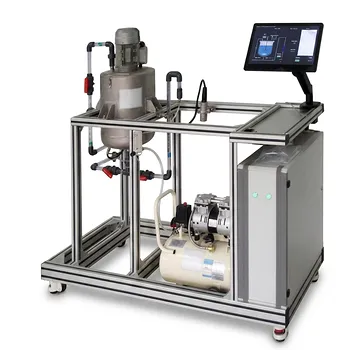
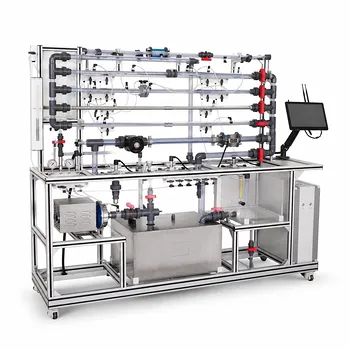
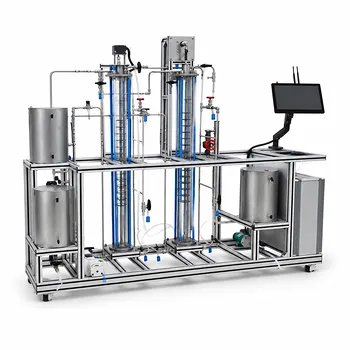
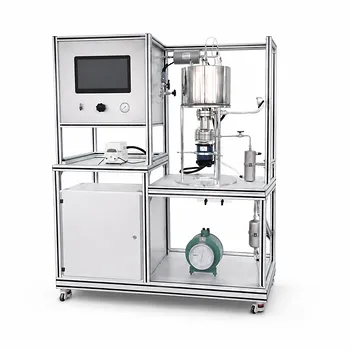
Transitioning from lab to pilot scale requires precision and the right equipment. LABPARK provides advanced Educational and Vocational Unit Operations Pilot Plants in chemical engineering, bioprocess & biotech, and environmental & water treatment.
Designed specifically for universities, research institutes, and enterprises, our pilot plants allow you to hands-on validate mass transfer, optimize agitation dynamics, and master process scaling laws.
Ready to elevate your research or training capabilities? Contact LABPARK today to discuss your custom pilot plant needs.
Related Products
- Agitation and Mixing Educational Unit Operations Pilot Plant
- Bio-fermentation Ethanol Production Practical Training Unit Operations Pilot Plant
- Dual-Mode Rectification Pilot Plant for Practical Training Unit Operations
- Multi-Functional Special Distillation Educational Pilot Plant
- Comprehensive Fluid Mechanics Educational Unit Operations Pilot Plant
People Also Ask
- How do cost-capacity exponents vary across chemical equipment? Scaling insights.
- What are the primary considerations when managing and scaling up shear rates in pilot plant mixing operations? Guide
- What are the differences between set-point, servo, and program control? Master unit operations training.
- Evaluate Tablet Compaction: Force, Density & Porosity in Unit Operations Pilot Plants
- Why Switch Unit Operations Flow Configurations? Impact on Experimental Measurements