The real power of track-etched membranes in the classroom lies not in their exotic manufacturing process, but in their ability to transform abstract filtration theory into a predictable, observable science. These polycarbonate (PC) and poly(ethylene terephthalate) (PET) membranes provide a near-ideal model system. Their precisely defined, straight-through pores allow students to isolate the fundamental relationship between pore size and particle rejection without the confounding variables found in typical industrial membranes.
In membrane unit operations education, track-etched membranes serve as the gold standard for demonstrating precise separation principles. Their uniform, cylindrical pore geometry eliminates the complexities of tortuous paths and wide pore distributions, making it possible to directly correlate theoretical models with experimental results.
The Educational Challenge of Membrane Complexity
Teaching membrane science often starts with a paradox: the most widely used industrial membranes are the least helpful for learning the fundamentals. Their complex internal structure can easily obscure the core sieving mechanism.
Why Real Membranes Obfuscate the Lesson
Most commercial ultrafiltration or microfiltration membranes possess a tortuous, interconnected pore network with a broad and often poorly defined pore size distribution. When a student uses such a membrane, the observed rejection is the result of multiple overlapping mechanisms—size exclusion, adsorption, and internal pore blocking—averaged over thousands of irregular pathways. It is nearly impossible to say whether a change in rejection came from particle size, pore geometry, or membrane fouling.
This lack of structural simplicity makes it exceptionally difficult to validate the theoretical sieving models taught in lecture. Students are left with vague agreement between prediction and reality, which can undermine their confidence in the underlying principles.
The Track-Etched Advantage: A Model System for Sieving
Track-etched membranes flip this problem on its head. Their manufacturing technique—exposing a polymer film to radioactive fission fragments followed by chemical etching—creates individual damage tracks that are dissolved into discrete, uniform pores. This process yields a membrane that is an almost perfect physical realization of a simple sieve.
Predictable Geometry: The Direct Path to Understanding
The pores in a track-etched membrane are essentially straight-through, non-tortuous channels oriented perpendicular to the membrane surface. A particle or molecule entering a pore travels a path that is exactly the membrane thickness. This contrasts sharply with the winding, three-dimensional journey in a phase-inversion membrane. When the flow path is this simple, mass transfer models (such as the Hagen-Poiseuille equation for pore flow) can be applied without corrections for tortuosity, making calculations tractable for students.
A Pore Size Distribution So Narrow, It’s Practically Monodisperse
The etching process can be controlled to produce a pore size distribution that is orders of magnitude narrower than in conventional membranes. For teaching purposes, this is the single most important characteristic. It means that the membrane has a well-defined cut-off—a sharp boundary where particles above a certain size are retained and those below pass through. Students see a direct cause-and-effect relationship, not a statistical smear. They can confidently say, “Rejection increased because the pore size was reduced below the particle diameter,” and the data will support that statement precisely.
Controllable Pore Shapes for Advanced Lessons
Beyond cylinders, pore shape can be manipulated (e.g., into conical or funnel-like geometries) by adjusting the etching conditions. This allows instructors to design advanced experiments demonstrating concepts like asymmetric transport or flow rectification. A conical pore membrane teaches students that separation is not just about a single diameter—it’s also about the direction of flow and the hydrodynamic resistance profile, lessons that are nearly impossible to isolate with spongy, irregular membranes.
Connecting Theory to Measurable Results
The true educational value emerges when students test their predictions against real data. Track-etched membranes create a teaching lab where the equations from the lecture hall work exceptionally well.
Validating the Rejection Curve
With a monodisperse particle suspension and a track-etched membrane, students can generate a sharp, textbook-quality rejection curve. The transition from 0% to 100% rejection occurs over a very small particle size range. This allows for a direct fit to the sieving coefficient model, where rejection is a simple function of the solute-to-pore size ratio. The high degree of agreement builds student confidence in the principles of size-exclusion chromatography and membrane filtration.
Simplifying Flux and Pressure Drop Calculations
Because the pores are regular cylinders, the Hagen-Poiseuille flow equation applies directly. The volumetric flux through each pore is proportional to the fourth power of the pore radius. Students can calculate theoretical flux from the membrane’s stated pore density and compare it to experimental measurements. Any deviations can then be discussed in terms of concentration polarization—an introduction to real-world phenomena, made cleaner by a known baseline.
Understanding the Trade-offs
While track-etched membranes are superb teaching tools, it is important to present them with objective honesty about their limitations. This prevents students from forming an idealized view that doesn’t transfer to industrial practice.
- Cost and fragileness: Track-etched membranes are significantly more expensive than standard asymmetric membranes due to their specialized manufacturing process. They are also thinner and more fragile to handle, which can be a practical consideration in a lab with many students.
- Low porosity, low flux: The straight-through, isolated pore structure results in extremely low overall porosity (often <15%). The membrane’s hydraulic permeability is consequently much lower than a porous asymmetric membrane of the same nominal pore size. This limits throughput and can make experiments needing large volumes time-consuming.
- Absence of tortuosity and fouling complexity: Precisely because they lack tortuous paths and a multilayered structure, these membranes do not replicate the fouling and cake layer dynamics that dominate industrial operations. An educational module based solely on track-etched membranes must be followed by a segment on real-world membranes to provide a complete picture.
Despite these trade-offs, the clarity they bring to separation fundamentals is unmatched. They should be viewed as a diagnostic tool—like a pure sine wave for an electronics lab—not as a direct replacement for industrial filters.
Making the Right Choice for Your Lab
How you incorporate these membranes into your unit operations course depends on your primary pedagogical goal. Use this guide to decide where they will have the most impact.
- If your primary focus is demonstrating the pure size-exclusion principle: Use a set of track-etched membranes with graded pore sizes and a monodisperse particle standard. This will produce a textbook rejection curve and cement the core sieving concept in a single lab session.
- If your primary focus is teaching the modeling of membrane flux and pressure drop: Start with the Hagen-Poiseuille equation on a track-etched membrane. Let students verify the linear relationship between pressure and flux, then introduce an asymmetric membrane to demonstrate the dramatic effect of membrane resistance and tortuosity.
- If your primary focus is advanced transport phenomena: Opt for membranes with tailored pore geometries (e.g., conical). Design an experiment that measures the direction-dependent streaming current or rejection to illustrate how pore asymmetry enables diode-like transport behavior.
A precise tool leads to a precise understanding. By removing the noise from the separation signal, track-etched membranes help your students build an unshakable foundation in the principles that govern all membrane processes.
Summary Table:
| Feature | Track-Etched Membranes | Industrial Membranes |
|---|---|---|
| Pore Geometry | Straight-through, cylindrical | Tortuous, winding network |
| Pore Distribution | Extremely narrow (monodisperse) | Broad and poorly defined |
| Flow Modeling | Simple (Hagen-Poiseuille applies) | Complex (requires corrections) |
| Educational Value | Teaches pure size-exclusion | Demonstrates fouling & cake layers |
Bring Precision to Your Membrane Education Labs
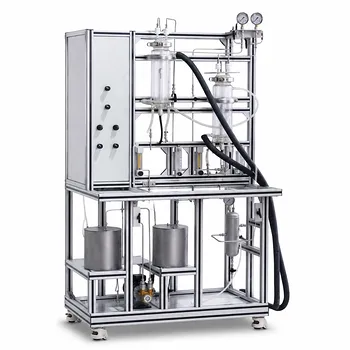
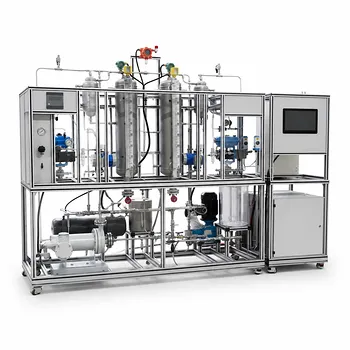
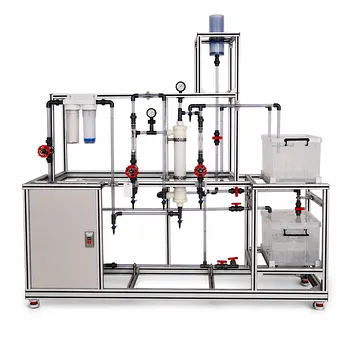
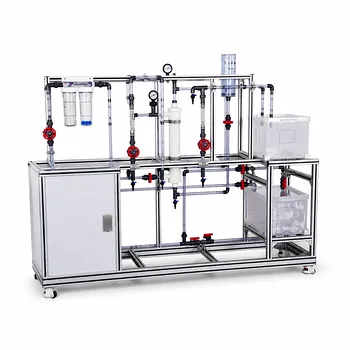
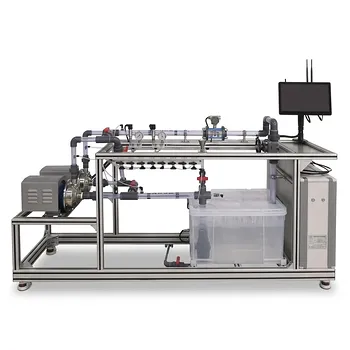
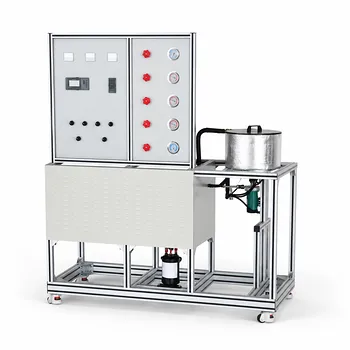
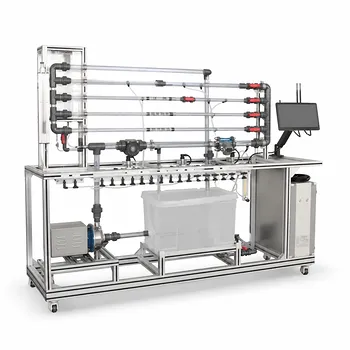
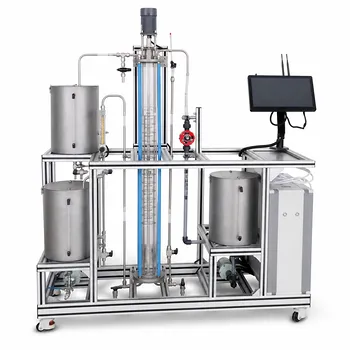
To help students master complex separation principles, LABPARK offers advanced Educational and Vocational Unit Operations Pilot Plants for chemical engineering, bioprocess & biotech, and environmental & water treatment. Designed for universities, research institutes, and enterprises, our pilot plants deliver predictable, repeatable experimental setups that match textbook theory.
Contact our experts today to build the perfect pilot plant for your curriculum!
Related Products
- Multi-Functional Membrane Separation Educational Pilot Plant for Unit Operations Lab
- Multifunctional Membrane Separation Educational Pilot Plant with Ultrafiltration, Nanofiltration, Reverse Osmosis
- Photocatalytic Membrane Separation and Degradation Unit Operations Pilot Plant
- Alkaline Membrane Water Electrolysis Educational Pilot Plant Unit Operations Training System
- Multi Functional Membrane Crystallization Educational Unit Operations Pilot Plant
People Also Ask
- What are the key differences in membrane configurations? Choose the Right Unit Operations Pilot Plant
- How Do Pervaporation, Vapor, and Gas Permeation Differ in Pilot Plants? Key Comparison
- What are the advantages of membrane separation pilot plants? Energy-saving process intensification.
- Pervaporation vs. Vapor Permeation: Handling Suspended Solids in Membrane Pilot Plants
- How do PEI, PVDF, and PSU membranes compare in pilot plants? Find the best fit.