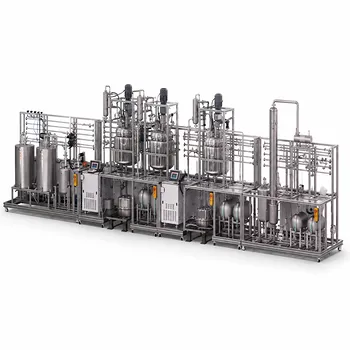
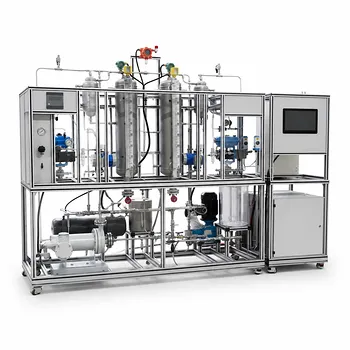
Controlling conversion in an ammonia synthesis pilot plant hinges on mastering a delicate thermodynamic and kinetic balance. The three parameters you must actively control are the reactor temperature and pressure, the hydrogen-to-nitrogen feed ratio, and the inert gas concentration via a purge system. Each of these directly manipulates the reaction's equilibrium position and the real-time partial pressures of the reactants, dictating how much ammonia you can produce per pass.
Ammonia synthesis forces you to accept a compromise: low temperatures favor a higher equilibrium yield, but the kinetics demand elevated temperatures to drive the reaction at a practical rate. Optimizing conversion isn’t about finding a single perfect setpoint—it's about deliberately managing the tension between thermodynamic potential and kinetic reality through pressure, stoichiometry, and inert control.
The Core Thermodynamic Levers
Balancing Pressure and Temperature for Optimal Yield
The ammonia reaction ($N_2 + 3H_2 \rightleftharpoons 2NH_3$) is strongly exothermic and reduces volume. Le Chatelier’s principle dictates that lower temperatures and higher pressures push the equilibrium toward more ammonia. However, the actual operating window reflects a forced compromise.
Pilot plants typically run in one of two regimes: medium-pressure (20–35 MPa at 470–550°C) or low-pressure (8–15 MPa at 350–430°C). Lower temperatures inside the reactor favor the thermodynamics, but the catalyst’s activity plummets if the temperature drops too far.
This is why the equilibrium constant $K_p^\ominus$ can drop from a favorable value at room temperature to an extremely small number at typical reaction temperatures. To compensate, you increase pressure, which increases the partial pressures of the reactants and drives the equilibrium back toward the product side despite the high temperature.
Controlling the Hydrogen-to-Nitrogen Ratio ($\gamma$)
The equilibrium ammonia concentration is acutely sensitive to the $H_2/N_2$ ratio of the make-up gas. Operating at the stoichiometric ratio of 3:1 yields the maximum possible equilibrium concentration.
Any deviation from this ratio immediately penalizes your theoretical ceiling for conversion. If the ratio drifts too high or too low, one reactant becomes limiting in the gas phase, and the partial pressure of the other is wasted. In a pilot plant, precise flow control on both feed streams is not just a calibration detail—it is a primary optimization handle that sets the solubility limit of your product formation.
Managing Inert Gas Fraction ($x_i$)
Inerts such as methane ($CH_4$) and argon enter with the feed or accumulate in the recycle loop. They do not react, yet they occupy volume and lower the partial pressures of both nitrogen and hydrogen.
A rising inert fraction displaces reactants and slashes the equilibrium ammonia concentration, often more dramatically than a small temperature shift would. The only way to counteract this is through a controlled purge stream. You must bleed off a portion of the gas to keep the inert concentration below a threshold where the conversion penalty outweighs the loss of reactants in the purge.
The Kinetic Counterbalance
Why You Cannot Simply Run Cold
Thermodynamics points you toward the lowest feasible temperature. But the diatomic nitrogen molecule has an extraordinarily high bond dissociation energy (945 kJ/mol), making it nearly inert. To break that bond at a meaningful rate, you need temperature.
Catalysts reduce the activation energy, but even the best iron-based or promoted catalysts still require a practical operating temperature (roughly 300–500°C). Below this window, the reaction rate becomes so slow that the equilibrium advantage is worthless.
Making the Loop Work for You
Because single-pass conversion stays incomplete, pilot plants replicate industrial designs with a pressurized recycle loop. Unreacted $N_2$ and $H_2$ are re-compressed and sent back to the reactor after the product ammonia is condensed and separated.
Continuously removing ammonia drops the reaction quotient $Q_p$ below the equilibrium constant $K_p^\ominus$, which drives the net reaction forward even when the thermodynamic limit for a static batch would have been met. The recycle ratio—how many times the unreacted gas is recirculated—becomes a critical operational lever that multiplies overall conversion efficiency.
Understanding the Trade-offs and Operational Hazards
The High-Pressure Material Constraint
Running at 20–30 MPa with hydrogen at high temperature introduces a serious safety risk: hydrogen embrittlement. Small hydrogen molecules can diffuse into the crystal lattice of standard steels, causing sudden brittle failure. Pilot plant reactors and piping must be fabricated from specialized high-strength steel alloys, adding cost and inspection complexity.
The Purge vs. Feed Cost Equation
Aggressively purging to keep inerts low raises your raw material cost because valuable hydrogen and nitrogen are lost in the vent stream. A minimal purge conserves feed but lets inerts build, eroding conversion. Optimization means finding the economic inflection point for your pilot plant’s specific recycle loop volume and feed purity.
Reactor Staging and Temperature Profiling
In more advanced pilot systems, you may have multiple catalyst beds with interstage cooling. This allows you to manipulate the temperature profile along the reactor length, keeping the early beds kinetically fast and the later beds thermodynamically cooler to push equilibrium. Controlling the inlet temperature to each bed stage is then an additional parameter for maximizing overall conversion.
How to Apply This to Your Pilot Plant
The parameter set you prioritize depends on your experimental or teaching objective.
- If your primary focus is maximizing single-pass conversion: Keep the $H_2/N_2$ ratio locked exactly at 3:1, and operate at the highest practical pressure while maintaining the lowest possible temperature that still delivers acceptable catalyst activity.
- If your primary focus is studying dynamic system behavior and loop stability: Focus on step-change experiments with the recycle ratio and purge flow rate, measuring how the inert fraction and transient response affect equilibrium concentration.
- If your primary focus is safe, long-duration operation for teaching: Never compromise on the material specification for hydrogen service, and implement temperature and pressure interlocks that protect both the catalyst and the vessel from thermal runaway or over-pressurization.
- If your primary focus is process integration: Treat the synthesis loop not in isolation but as part of the entire pilot chain, ensuring that residual CO and $CO_2$ from upstream methanation are removed to prevent poisoning, as this directly undercuts the kinetic advantage your temperature and pressure settings aim to provide.
Master these three core parameters—pressure/temperature balance, stoichiometric ratio, and inert gas management—and you will transform the pilot plant from a collection of hardware into a precise tool for understanding one of chemistry’s most important industrial equilibria.
Summary Table:
| Parameter | Typical Target / Range | Operational Impact on Conversion |
|---|---|---|
| Temperature & Pressure | 350–550°C / 8–35 MPa | Balances thermodynamic yield with catalyst kinetic activity. |
| $H_2/N_2$ Feed Ratio | Strict 3:1 ratio | Prevents reactant limitation and maximizes equilibrium concentration. |
| Inert Gas Fraction | Minimized via purge | Keeps reactant partial pressure high; prevents conversion drops. |
| Recycle Loop Ratio | Adjusted dynamically | Recirculates unreacted gases and drops reaction quotient ($Q_p$) below $K_p^\ominus$. |
Bring Industrial-Scale Precision to Your Lab with LABPARK
Optimizing complex thermodynamic processes requires reliable, high-precision equipment. LABPARK provides state-of-the-art Educational and Vocational Unit Operations Pilot Plants across chemical engineering, bioprocess & biotech, and environmental & water treatment.
Engineered specifically for universities, research institutes, and enterprises, our pilot plants help students and researchers safely master critical operating parameters in real-world scenarios.
Ready to elevate your training and research capabilities? Contact LABPARK today to discover our range of customizable pilot plant solutions!
Related Products
- Methanol Synthesis and Catalyst Performance Evaluation Educational Unit Operations Pilot Plant
- Natural Product Extraction Unit Operations Training Pilot Plant
- Multi-Reactor Educational Pilot Plant for Reaction Engineering Unit Operations
- Aspirin API Synthesis Unit Operations Training Pilot Plant
- Dual-Mode Rectification Pilot Plant for Practical Training Unit Operations
People Also Ask
- Why is a purge system necessary when operating a gas recirculation loop in a methanol synthesis pilot plant? (Guide)
- How do temp & pressure affect methanol synthesis pilot plants? Optimize equilibrium and catalyst performance.
- Why do modern methanol pilot plants operate at lower pressures? Catalyst & Feed Requirements Explained
- What are the operational requirements for catalyst activation? Safe Methanol Pilot Plant Operation
- Why Compare Predicted and Experimental Excess Enthalpy? Key to Accurate Pilot Plant Scale-up