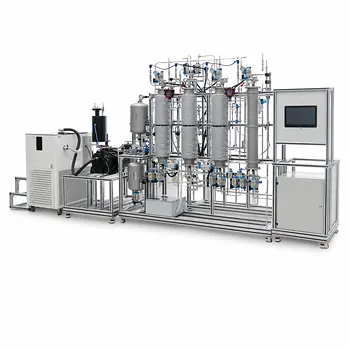
The core thermodynamic and mass transfer principles taught by a pressurized hot water extraction pilot plant center on a two-step model of extraction equilibrium, the distinction between thermodynamic state and kinetic rates, and the direct observation of how temperature and flow control solute partitioning. A PHWE unit is an ideal hands-on tool because it makes abstract concepts like the partitioning coefficient and convective mass transfer tangible—students literally see how adjusting water temperature from 100°C to 200°C changes the color and concentration of a plant extract, while holding the solvent in a liquid state through pressure.
Understanding extraction in a PHWE pilot plant is not just about “heat helps dissolve things.” It’s a perfect experimental system to demonstrate that thermodynamics dictates the maximum possible recovery at equilibrium, while mass transfer controls how fast you get there—and that the two are often confused. The pilot plant makes these two worlds visible in a single, green extraction process.
The Thermodynamic Heart of PHWE: A Two-Step Equilibrium Model
The primary reference frames PHWE as a sequence of two distinct thermodynamic events. Breaking these apart in a lab teaches students that extraction is never a simple “dissolve and go” process.
Step 1: Liberating Analytes from the Matrix
Before any solute dissolves, it must break free from active binding sites in the sample matrix.
This step is fundamentally a surface equilibrium problem. Compounds are held by weak interactions like hydrogen bonds or van der Waals forces. Students learn that high temperature weakens these interactions, effectively lowering the activation energy for desorption.
Elevated pressure plays a supporting but critical role here: it keeps water liquid far above its atmospheric boiling point, enabling temperatures that make desorption thermodynamically favorable. Without this pressure, the water would simply flash to steam and the extraction would fail.
Step 2: Chromatographic Elution into the Bulk Solvent
Once freed, the solute moves into the flowing stream of subcritical water. The primary reference describes this as a chromatographic elution step.
This is where the partitioning coefficient ((K_D)) becomes the star of the lesson. (K_D) is the equilibrium ratio of a solute’s concentration in the stationary phase (the matrix) to its concentration in the mobile phase (the water). By operating the pilot plant at different temperatures and flow rates, students can experimentally determine (K_D) for target compounds like phenolic acids or proteins. They can plot how (K_D) drops dramatically as water’s dielectric constant decreases with temperature, visually proving that subcritical water behaves more and more like an organic solvent.
The Kinetic Reality: Where Mass Transfer Principles Dominate
The supplementary reference wisely underscores the difference between thermodynamic equilibrium and heat/mass transfer rate. PHWE is a perfect vehicle to teach that a large equilibrium driving force is useless if the solute cannot reach the bulk fluid.
Distinguishing the "End Point" from the "Rate"
Thermodynamics defines the final state: at a given temperature, a certain maximum amount of solute will partition into the water at equilibrium. Heat and mass transfer determine the time required to approach that state.
In PHWE, three mass transfer resistances act in series:
- Desorption of the solute from the matrix.
- Internal diffusion through pores inside the particle.
- External convective mass transfer from the particle surface into the flowing water.
Students can manipulate flow rate to isolate the external film resistance. At low flow rates, a stagnant boundary layer slows extraction; increasing the flow shears this layer, improving mass transfer. This teaches the core dimensionless correlations (like the Sherwood number) in a real, messy, biological system—not just a textbook sphere dissolving in water.
The Deceptive Role of Pressure
A critical teaching moment is clarifying what pressure does not do. High pressure has almost no direct thermodynamic effect on the solubility of non-volatile solutes. Its only purpose in PHWE is to maintain the liquid phase of water above its normal boiling point.
This directly counters a common student misconception that “pressurizing the system squeezes out the goodies.” The pilot plant data proves that increasing pressure alone (while holding temperature constant) barely changes extraction yield. The improvement comes from the temperature that the pressure permits. This distinction cements an understanding of phase behavior and Le Chatelier’s principle as it applies to extraction.
Understanding the Trade-offs
No teaching tool is perfect. A PHWE pilot plant has inherent limitations that, when discussed, deepen understanding.
- Co-extraction of Undesirables: High temperature does not just extract your target. Students must analyze how the (K_D) of matrix components (like lignin or unwanted phenolics) also shifts, teaching them that selectivity is often sacrificed for speed.
- Thermal Degradation: At temperatures above 200°C, many valuable compounds degrade. This provides a real-world lesson in balancing thermodynamic driving force (higher temperature increases solubility) against reaction kinetics (degradation rate also increases rapidly). The “optimum” temperature is a trade-off, not a maximum.
- Scaling Discrepancies: What works in a pilot plant is governed by convective-diffusive transport. In a large-scale vessel, channeling and poor wetting can dominate. This warns students against assuming a clean experiment reflects a simple scale-up without considering changes in flow hydrodynamics.
Designing a Teaching Module for Real Insights
A single PHWE pilot plant run can teach a dozen concepts, but focused experiments deliver the deepest learning. Tailor the lab to the principle you want to crystallize.
- If your primary focus is thermodynamic partitioning: Have students run extractions at four distinct temperatures, measure the final concentration of a stable marker (like vanillic acid), and plot the van’t Hoff relationship to calculate the enthalpy of transfer. This directly illustrates how (K_D) shifts with temperature.
- If your primary focus is mass transfer kinetics: Hold temperature constant and run extractions at three different flow rates. Collect fractions over time and plot the extraction curve. Students can fit a mathematical model to determine whether the rate is limited by internal diffusion or external convection.
- If your primary focus is the “green solvent” concept: Have students extract the same analyte with traditional ethanol-water mixtures and with subcritical water, then calculate green metrics like the E-factor. They will immediately see how eliminating organic solvents changes waste profiles, while still leveraging the same polarity-modulation principle.
- If your primary focus is experimental design: Intentionally let one group’s sample dry out or overheat. The “failed” run becomes the best lesson in the critical importance of phase equilibria, the role of pressure, and why the system’s limits must be respected.
By turning the extraction vessel into a controlled thermodynamic and kinetic reactor, students move from memorizing equations to predicting physical behavior. They learn that a great solvent is not just a chemical; it is a set of tunable conditions.
Summary Table:
| Concept | Key Principle | Lab Application |
|---|---|---|
| Thermodynamic Equilibrium | Solute partitioning ($K_D$) shifts as water polarity changes with temperature. | Extract at varying temperatures to plot van ’t Hoff relationships. |
| Mass Transfer Kinetics | Diffusion and convective boundary layers control the rate of extraction. | Vary flow rates at constant temperature to isolate film resistance. |
| Phase Behavior & Pressure | Pressure maintains the liquid state of subcritical water; it does not affect solubility. | Compare yields at constant temperature under varying pressures. |
Bring Hands-On Chemical Engineering to Your Lab
Looking to bridge the gap between abstract theory and real-world industrial application? LABPARK provides state-of-the-art Educational and Vocational Unit Operations Pilot Plants in chemical engineering, bioprocess & biotech, and environmental & water treatment.
Designed specifically for universities, research institutes, and enterprises, our pilot plants (including PHWE units) allow students and researchers to visualize and manipulate complex thermodynamic and mass transfer phenomena safely and efficiently.
Ready to elevate your department's practical training capabilities? Contact LABPARK today to discuss your laboratory requirements and receive a tailored solution!
Related Products
- Hot Filtration Educational Unit Operations Pilot Plant Laboratory System
- Constant Pressure Filtration Educational Unit Operations Pilot Plant
- Comprehensive Liquid-Liquid Extraction Pilot Plant for Engineering Education
- Three-Tube Heat Transfer Educational Pilot Plant for Unit Operations Training
- Multi-Modal Distillation Unit Operations Training Pilot Plant
People Also Ask
- How to Determine Specific Cake (r) & Filter Medium (Rm) Resistance Using Filtration Pilot Plant Data
- How can researchers identify and resolve filter medium blinding? Optimize Your Pilot Plant Runs
- How to select solid-liquid separation equipment for pilot plants? A Step-by-Step Guide
- Why Demo Constant-Rate to Constant-Pressure Filtration on a Pilot Plant? Key Practical Insights
- Why Analyze Filtration Flux & Cake Compressibility in Pilot Plants? Master Solid-Liquid Separation