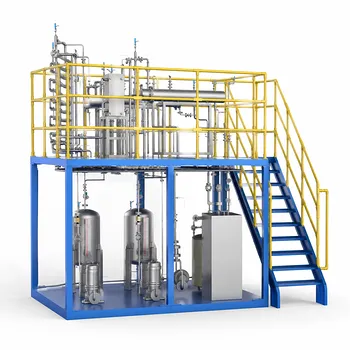
When training students to develop chemometric methods for pilot plants, you must drill three non-negotiable principles into their workflow: relentless model simplicity, ironclad calibration coverage, and the seamless fusion of chemical knowledge with statistics. These aren’t just academic ideals—they are the engineering safeguards that separate a model that looks good on a poster from one that survives the noisy, unpredictable reality of an online bioprocess or chemical reactor. The goal is to build analytical tools that operators can trust instantly, without a statistician standing by.
The foundational triad for any online chemometric method is this: keep the model as simple as possible, design calibration data that covers the entire expected response space (or explicitly define where it doesn’t), and integrate chemical domain knowledge with statistical analysis to avoid “black-box” misinterpretation. This framework ensures the method is not only accurate but also ruggedly reliable and safe in a live pilot plant environment.
Principle 1: Relentlessly Pursue the Simplest Model That Gets the Job Done
Why Complexity Kills Online Reliability
A complex Partial Least Squares (PLS) or neural network model might shave off a tiny bit of prediction error in the lab. In a pilot plant, however, every additional latent variable or hidden node becomes a potential source of drift and noise amplification. Simple models are more robust to the small instrumental shifts, temperature swings, and fouling that define real industrial environments. Teach students that the right model is the one that achieves sufficient accuracy with the fewest parameters—not the one that chases the lowest RMSECV on a single pristine dataset.
Guarding Against Overfitting as a Safety Practice
Overfitting isn’t just a performance problem; it’s a safety risk. A model that learns the noise of a training batch will confidently misclassify a process upset or produce an artificially optimistic concentration prediction. Students must learn to rigorously validate with independent batches, use random subset cross-validation correctly (respecting batch structure!), and always ask “would this model still work if the ambient temperature changes by 2 °C?”. Emphasize that a simpler model with slightly higher validation error is infinitely preferable to a complex one that fails silently.
Principle 2: Design Calibration with a Cartographer’s Precision
Defining the Known Universe: Full Coverage or Explicit Boundaries
The calibration dataset is a map. A useful map must either cover every territory the pilot plant will traverse, or it must clearly label “Here Be Dragons” at the edges. Students should design experiments that span the expected ranges of all critical factors—concentrations, temperatures, pH, biomass density, impurity profiles. If that full factorial coverage is impossible (and it often is), the model’s operational limits must be stated explicitly. No operator should ever be left guessing whether the current spectral reading is an extrapolation.
The Danger of Extrapolation: A Lesson Every Student Must Fear
Empirical chemometric models have zero understanding of physics or chemistry outside their training space. If a calibration only includes reaction temperatures from 30–50 °C, a prediction at 60 °C is not just “a bit less accurate”—it is scientifically meaningless and potentially dangerous. Use clear examples: show students what happens when a PLS model for ethanol concentration, trained only on pure-water backgrounds, encounters a broth with high salt content. The model’s silence is not consent. Instilling a healthy terror of extrapolation ensures graduates never deploy a model without first checking that the current process signature falls within the calibration’s Hotelling’s T² and Q residual limits.
Principle 3: Never Let Statistics Swim Without a Chemical Life Jacket
Chemistry Directs the Math, Not the Other Way Around
A pure “data-mining” approach, where algorithms select wavenumbers without any input from process chemistry, is a recipe for fragile, uninterpretable models. Teach students to use their domain knowledge first: What bonds absorb in this NIR region? Are these two spectral features from the same reaction intermediate? Should we pre-process to remove a known baseline offset caused by particle scattering? By embedding chemical insight into wavelength selection, spectral pre-processing (like multiplicative scatter correction, MSC), and model architecture, the resulting method becomes a dependable sensor rather than a black-box oracle.
Interpreting Patterns with a Chemist’s Eye
Even unsupervised methods like Principal Component Analysis (PCA), used for batch monitoring, demand chemical interpretation. Students must learn to not just look at a score plot but to investigate why a batch is drifting relative to a golden-batch trajectory. Is the drift caused by a failing nutrient feed pump (an engineering deviation) or a slower-than-expected enzymatic reaction (a biochemical shift)? Integrating chemical knowledge turns a statistical alarm into a actionable diagnostic, enabling operators to save a batch rather than just discard it.
Understanding the Trade-offs and Common Pitfalls
The Simplicity-Completeness Tension
A model simple enough to transfer between nearly identical pilot units may fail to capture subtle spectral variations from a new raw material lot. Conversely, a model built with dozens of factors to account for every minor source of variance often crumbles when a different instrument records the spectrum. Teach students to explicitly balance these forces, often by choosing a method like PCA-based classification for qualitative state detection (high simplicity) and reserving PLS for quantitative predictions only after rigorous transferability testing.
Overfitting vs. Underfitting: The Student’s Dilemma
Novice developers overfit because metrics like R² improve in the short term. Train them to use diagnostic tools: plot PLS regression vectors; if they look like noisy first-derivatives with no spectral meaning, the model is overfit. Show them how to use cross-validation error curves to find the minimum number of factors. And make them practice explaining why adding more factors did not meaningfully improve prediction on a test set. This moves their thinking from “I need to lower the training error” to “I need to build a generalizable model that will work tomorrow.”
The Hidden Hurdle of Calibration Transfer
A method that works perfectly on the development instrument may fail on a second, “identical” unit due to subtle optical differences. When training students on method transfer, emphasize the need for standardization samples that are chemically stable, few in number, and matched to the analyzer’s sampling interface. Teach them to flag and correct inter-instrument biases before the model ever reaches the production-like environment. Without this skill, a validated method becomes a single-instrument curiosity.
Making the Right Choice for Your Training Focus
Your emphasis will shift based on whether students will work as process developers, PAT specialists, or scale-up engineers. Tailor the core principles to their future role.
- If their primary focus is real-time process control: Hammer on model simplicity and fast outlier detection. Teach them to use multivariate control charts on PCA scores, setting tight limits from historical golden batches, so they can spot a deviation in seconds, not hours.
- If their primary focus is developing new chemical or bioprocess routes: Prioritize designing comprehensive, space-filling calibration designs. They must learn to operate a pilot plant not just for production but to intentionally probe process boundaries, generating the “danger zone” data that defines safe operating limits.
- If their primary focus is method transfer to manufacturing: Center everything on robustness and instrumentation standardization. Teach them to view the model as a piece of hardware that must be calibrated and verified across multiple units, using transfer standards, and to document the model’s response so clearly that a future operator never misapplies it.
When these three principles—simplicity, map-like calibration, and chemical-statistical fusion—become instinct, students evolve from button-clicking modelers into trusted process engineers who can harness spectral data to illuminate the dark interior of any reactor.
Summary Table:
| Principle | Core Focus | Impact on Pilot Plant Operations |
|---|---|---|
| 1. Relentless Simplicity | Use the fewest parameters to avoid overfitting. | Prevents silent failures, drift, and noise amplification in live environments. |
| 2. Calibration Coverage | Map the entire response space and define limits. | Eliminates the safety risks of extrapolation in unmonitored zones. |
| 3. Chemical-Statistical Fusion | Guide data-mining with physical/chemical knowledge. | Translates abstract statistical alarms into actionable process diagnostics. |
Empower the Next Generation of Process Engineers
To master chemometrics and online monitoring, students need hands-on experience with real-world, industrial-grade equipment.
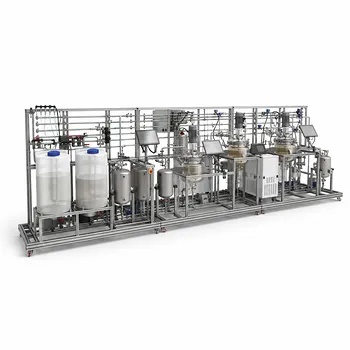
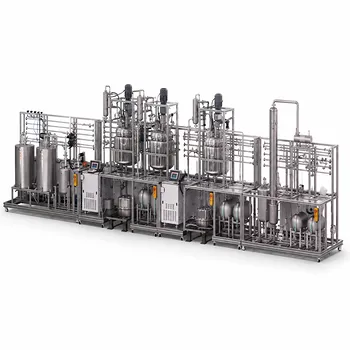
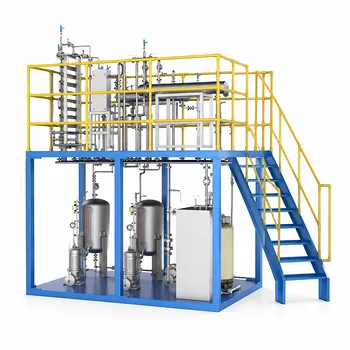
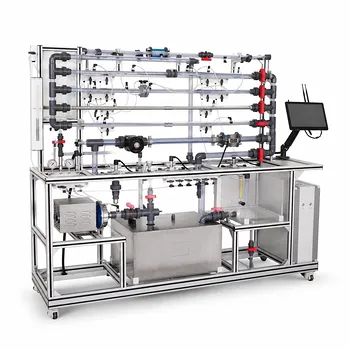
LABPARK designs and manufactures premium Educational and Vocational Unit Operations Pilot Plants specializing in:
- Chemical Engineering
- Bioprocess & Biotech
- Environmental & Water Treatment
Tailored for universities, research institutes, and enterprises, our pilot plants provide a safe, robust environment for teaching process control, sensor integration, and data modeling.
Contact LABPARK today to equip your lab with the tools to bridge the gap between academic theory and industrial reality!
Related Products
- Natural Product Extraction Unit Operations Training Pilot Plant
- Fixed-Bed Chemical Reaction and Gas Dust Tar Removal Unit Operations Pilot Plant
- Ethyl Acetate Synthesis Unit Operations Pilot Plant for Practical Training
- Methanol Synthesis and Catalyst Performance Evaluation Educational Unit Operations Pilot Plant
- Electrolytic Hydrogen Production Educational Unit Operations Pilot Plant
People Also Ask
- How to Demo Solubility Sensitivity in SFE Pilot Plants? Practical Thermodynamics
- How do pilot plants differentiate physical vs chemical extraction? Enhance Chemical Engineering Training
- How are HTU and NTU applied to determine extraction column height? Guide to Pilot Plant Scaling
- How can Hotelling's T² & Q statistics detect pilot plant abnormalities? Optimize Safety
- Why use split-plot designs in pilot plants instead of CRD? Optimize process parameters effectively.