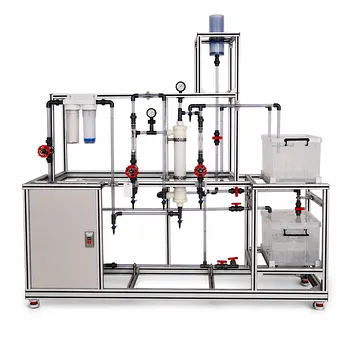
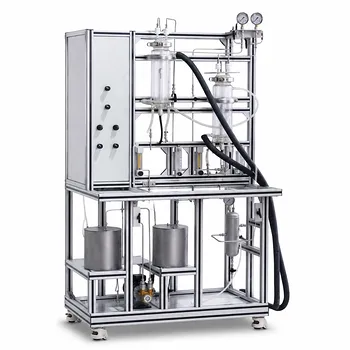
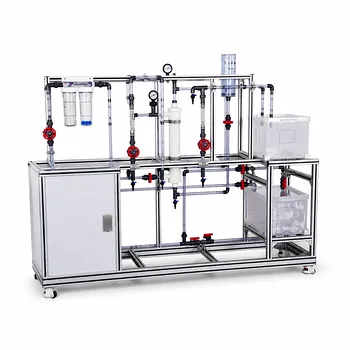
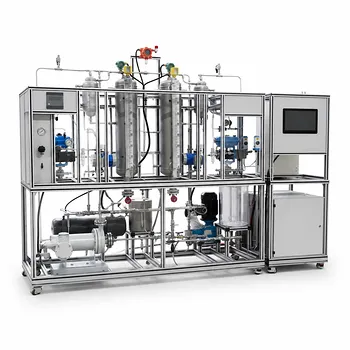
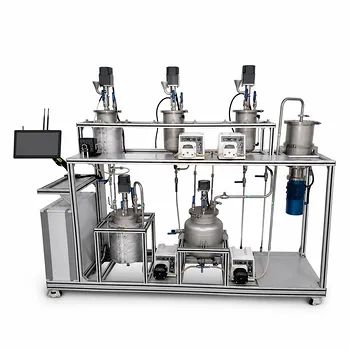
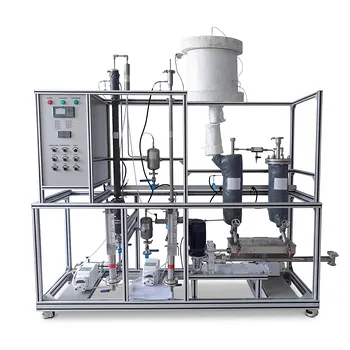
Membrane fouling is the primary operational challenge in MBR systems—and the most valuable lesson a pilot plant can teach. In environmental engineering education, the key factors affecting fouling are operational conditions (aeration rate, permeate flux, sludge retention time) and biomass characteristics of the mixed liquor. These pilot plants make fouling tangible: students can adjust process variables to see immediate changes in transmembrane pressure (TMP) and then apply mitigation strategies like air scouring, backwashing, and chemical cleaning-in-place.
An MBR pilot plant transforms fouling from an abstract problem into a hands-on learning opportunity. By manipulating aeration, flux, and biomass concentration while monitoring TMP, students uncover the cause-and-effect relationships between operating conditions and membrane performance. Mitigation becomes a practical exercise in process optimization, not just a theoretical concept.
The Drivers of Fouling in an Educational MBR
Pilot‑scale submerged hollow‑fiber MBRs are ideal for isolating the forces that clog membranes. Because everything is visible and adjustable, learners can systematically link each driver to a rise in TMP or a drop in permeate flux.
Operational Parameters That Accelerate Fouling
Permeate flux is the most direct lever. Running the plant at elevated fluxes will rapidly increase the rate of foulant deposition, making the fouling curve steep and dramatic—a powerful teaching moment.
Aeration rate controls the shear at the membrane surface. Low aeration allows a cake layer to form quickly; students see TMP spike within hours. The pilot plant’s air sparger beneath the hollow fibers demonstrates exactly how bubbles scrub the surface.
Sludge retention time (SRT) shapes the microbial community. A long SRT typically leads to higher mixed liquor suspended solids (MLSS) and a greater accumulation of soluble microbial products (SMP) and extracellular polymeric substances (EPS)—the gel‑like substances that are the most notorious foulants in MBRs.
Biomass Characteristics and Feedwater Chemistry
MLSS concentration directly influences viscosity. As students increase biomass concentration, they measure a proportional rise in filtration resistance, revealing the role of suspended solids in cake formation.
Feedwater composition matters just as much. Running the pilot with a synthetic wastewater rich in proteins or polysaccharides demonstrates how organic loading accelerates adsorptive fouling and pore blocking. Even pH and temperature shifts can change the solubility and surface charge of foulants, affecting deposition rates.
Real‑Time Monitoring Reveals the Hidden Dynamics
Every educational MBR pilot plant integrates sensors for TMP, permeate flux, and temperature. Transmembrane pressure is the feedback loop: a rising TMP at constant flux signals fouling. By logging these signals, students see the characteristic three‑stage fouling curve (initial conditioning, slow TMP rise, then a sudden jump) and learn to predict when cleaning is needed.
Mitigation Strategies You Can Demonstrate
Once fouling is induced, the pilot plant becomes a testbed for every major control technique. The following methods are routinely demonstrated and evaluated.
Physical Scouring and Hydraulic Cleaning
Air scouring is the baseline defense. By adjusting the airflow rate, students can measure the critical flux below which fouling is minimal. The rising bubbles create turbulence that prevents cake layer consolidation—a concept easily visualized through the transparent membrane module.
Backwashing with permeate or air is the first active recovery step. The pilot plant can be programmed to periodically reverse the flow, dislodging loosely attached foulants and restoring a significant portion of the original permeability. Frequent, low‑volume backwashes often yield better net productivity than infrequent, aggressive ones, a lesson that directly translates to plant operation.
Chemical Cleaning‑in‑Place (CIP)
When physical methods are no longer sufficient (typically after a TMP threshold), chemical cleaning cycles are initiated. The educational pilot allows students to:
- Circulate dilute acids (e.g., citric) to remove inorganic scaling.
- Apply alkaline solutions (e.g., sodium hypochlorite) to oxidize and solubilize organic foulants.
- Observe how cleaning sequence, concentration, and contact time influence flux recovery.
This hands‑on work demystifies the maintenance procedures that full‑scale operators rely on, emphasizing the importance of membrane compatibility with cleaning agents.
Pretreatment and Operational Adjustments
Some fouling can be prevented before the mixed liquor even reaches the membrane. Coagulation or pre‑filtration of the feed removes colloidal solids and reduces the organic load. In a pilot setup, students can compare parallel trains—one with and one without pretreatment—and quantify the difference in cleaning frequency.
Adjusting crossflow velocity (in sidestream configurations) or the relaxation/backpulse ratio also teaches the concept of dynamic fouling control. Optimizing these parameters to balance flux and energy consumption is a core engineering challenge.
Understanding the Trade‑offs
No fouling mitigation strategy is free of side effects. A well‑designed educational program uses these trade‑offs to teach systems thinking.
- Higher aeration reduces fouling but increases energy cost. Students can measure the blower power draw and see that beyond a certain airflow, the marginal benefit in flux flattening vanishes—this is the economic sweet spot.
- Frequent backwashing interrupts production. While cleaning maintains average flux, each backwash cycle consumes permeate or compressed air. Learners can calculate the net water yield and realize that over‑cleaning can be as detrimental as under‑cleaning.
- Chemical cleaning may degrade the membrane over time. Repeated exposure to oxidants can embrittle polymeric hollow fibers. By tracking cleaning cycles across a semester, students witness the gradual loss of mechanical integrity—a real‑world constraint often hidden in textbooks.
- Biomass control through SRT adjustment affects treatment performance. A shorter SRT may reduce fouling but risks compromising nitrification or denitrification. The pilot plant’s effluent analysis provides the complete picture: membrane health versus biological treatment quality.
Making the Right Choice for Your Educational Goal
An MBR pilot plant can be used to teach widely different concepts, from fundamental colloidal science to full‑scale plant management. Tailor your experiments to the desired learning objective.
- If your primary focus is demonstrating fundamental fouling mechanisms: Induce rapid fouling by running at high flux with minimal aeration, then use the LW‑AB approach or flux‑step method to characterize critical flux. This builds a deep understanding of mass transport and gel layer formation.
- If your primary focus is industrial process optimization: Design experiments where students iterate on aeration rate, backwashing frequency, and SRT simultaneously, using TMP trends and energy meters to find the lowest total cost of ownership.
- If your primary focus is operator training for real‑world plants: Simulate a series of chemical cleaning campaigns, emphasizing safety protocols, chemical handling, and the interpretation of cleaning‑efficiency curves. Include stress tests like sudden high‑foulant spikes to mimic industrial upset conditions.
- If your primary focus is membrane material selection: Compare fouling behavior of different membrane types (e.g., PVA vs. PVDF) under identical conditions, measuring surface energy or contact angle to link material properties to fouling propensity.
A well‑structured MBR pilot plant curriculum does more than illustrate fouling—it cultivates the diagnostic skills and pragmatism that future environmental engineers will need to manage the world’s most resilient water reuse systems.
Summary Table:
| Fouling Factor | Impact on Membrane | Mitigation Strategy |
|---|---|---|
| High Permeate Flux | Rapid cake layer deposition & TMP spike | Run below critical flux; optimize backpulse |
| Low Aeration Rate | Reduced shear force on membrane surface | Increase air scouring (bubble turbulence) |
| High MLSS & SRT | High viscosity & EPS/SMP accumulation | Adjust sludge retention time (SRT) & biomass |
| Organic/Inorganic Feed | Adsorptive fouling & pore blocking | Chemical Cleaning-in-Place (CIP) & pretreatment |
Bring Hands-On MBR Learning to Your Lab
Are you looking to bridge the gap between environmental engineering theory and real-world application? LABPARK provides state-of-the-art Educational and Vocational Unit Operations Pilot Plants in chemical engineering, bioprocess & biotech, and environmental & water treatment.
Our MBR pilot plants are specifically designed for universities, research institutes, and enterprises to:
- Provide students and researchers with hands-on experience in fouling dynamics and membrane maintenance.
- Demonstrate advanced mitigation strategies like automated backwashing and chemical CIP.
- Optimize process parameters with precision real-time monitoring of TMP, flux, and temperature.
Equip your institution with the ultimate teaching tool. Contact LABPARK today to customize a pilot plant configuration for your curriculum!
Related Products
- Ultrafiltration Membrane Separation Educational Pilot Plant
- Multi Functional Membrane Crystallization Educational Unit Operations Pilot Plant
- Photocatalytic Membrane Separation and Degradation Unit Operations Pilot Plant
- Multifunctional Membrane Separation Educational Pilot Plant with Ultrafiltration, Nanofiltration, Reverse Osmosis
- Multi-Functional Membrane Separation Educational Pilot Plant for Unit Operations Lab
People Also Ask
- Pervaporation vs. Vapor Permeation: Handling Suspended Solids in Membrane Pilot Plants
- How do PEI, PVDF, and PSU membranes compare in pilot plants? Find the best fit.
- How do membrane pilot plants demonstrate synthetic vs biological membrane advantages?
- Why Use a Membrane Separation Pilot Plant vs. Lab Testing? Avoid Costly Scale-Up Failures
- Isotropic vs. Anisotropic Membranes: How to Choose the Best Pilot Plant Modules