Volumetric efficiency loss is the silent capacity thief that haunts every reciprocating compressor. It’s the unavoidable penalty you pay for the physical clearances required inside a cylinder, where trapped high-pressure gas re-expands and blocks fresh inlet flow. In contrast, centrifugal compressors completely bypass this issue because they operate on a fundamentally different principle—continuous dynamic compression with no captive volume to recycle gas. Understanding this distinction is critical when selecting the right machine for your process.
While reciprocating machines sacrifice 10–15% of their theoretical capacity to clearance volume, centrifugal compressors eliminate this specific loss entirely by using rotating impellers instead of pistons. However, the real story lies in how each design trades volumetric efficiency for other performance characteristics that shape their ideal application envelopes.
The Nature of Volumetric Efficiency Loss in Reciprocating Compressors
Volumetric efficiency (VE) is not a measure of energy waste—it’s a measure of lost displacement. It describes how much less gas the compressor actually draws in compared to the swept volume of its pistons. This loss is a direct, mechanical consequence of the cylinder’s design.
The Role of Clearance Volume
Every reciprocating compressor cylinder head has a deliberate clearance space. This space exists to prevent the piston from striking the cylinder head at top dead center and to accommodate valve pockets.
That clearance volume becomes a trap. At the end of the discharge stroke, a small pocket of gas remains inside the cylinder at discharge pressure. This gas does not exit through the discharge valve.
How the Re-expansion Cycle Steals Capacity
When the piston begins its suction stroke, the trapped high-pressure gas first must expand until its pressure falls below the inlet line pressure. Only then can the suction valve open and fresh gas enter the cylinder.
This re-expansion of already-compressed gas effectively “uses up” part of the piston stroke. The fraction of the stroke that does no useful work is the volumetric efficiency loss. The recycled gas also pre-heats the incoming charge, further reducing the mass of fresh gas that can be drawn in.
Quantifying the Loss
In typical process applications, this loss is not trivial. Volumetric efficiency losses commonly range from 6% to 20%, averaging around 10% to 15%. Higher compression ratios and larger clearance volumes amplify the effect. That means a compressor rated for 1,000 actual cubic feet per minute of swept volume might only move 850–900 cubic feet of fresh gas into the cylinder each stroke.
Why Centrifugal Compressors Eliminate This Loss
The reason centrifugal compressors are immune to volumetric efficiency loss is simple and profound: they do not batch-process gas in a closed chamber. Instead, they accelerate gas continuously, converting velocity into pressure without ever trapping a fixed mass.
A Different Operating Principle
Centrifugal compressors are dynamic machines. They use a high-speed impeller to impart kinetic energy to the gas, followed by a diffuser that converts that velocity into static pressure. There is no piston, no cylinder, and no point where a volume of gas is sealed off at discharge conditions.
Continuous Flow, No Trapped Gas
Because the flow path through the impeller and diffuser is permanently open, there is no clearance volume to re-expand. Gas enters at the eye, is accelerated, discharged into the diffuser, and moves into the volute in a continuous stream. The machine does not cycle between suction, compression, and discharge phases that could leave a residual high-pressure packet behind. Therefore, the concept of volumetric efficiency—based on the ratio of actual intake to swept volume—has no meaning here.
Efficiency Metrics in Dynamic Machines
Centrifugal compressor performance is instead evaluated using isentropic efficiency or polytropic efficiency, which measure how closely the actual compression path follows an ideal, reversible process. Losses in these machines come from aerodynamics (turbulence, flow separation), friction, and internal leakage across seals—not from a re-expanding clearance pocket. While a centrifugal machine does not suffer VE loss, it is still subject to its own unique efficiency limits.
Understanding the Trade-offs
Eliminating volumetric efficiency loss doesn’t make centrifugal compressors universally superior. Each machine’s design introduces a distinct set of trade-offs that directly influence its suitability for a given process.
Reciprocating Compressors: High Pressure, Lower Flow
Reciprocating units pay the VE penalty but excel at generating very high compression ratios in a single stage and at operating efficiently across a wide range of pressures. Their positive-displacement nature makes them the clear choice when your process demands small flow rates at exceptionally high discharge pressures—like in hydrogen makeup or ethylene feed compression.
Centrifugal Compressors: High Flow, New Challenges
Centrifugal machines trade away the VE problem but inherit others. They deliver enormous gas volumes continuously, which is ideal for high-throughput services like air separation or large-scale refrigeration. However, they are sensitive to operating conditions: they can surge if flow drops too low, suffer from stonewalling at excessive rates, and their efficiency drops sharply away from the design point.
When Volumetric Efficiency Matters Most
The VE loss in a reciprocating compressor becomes a dominant factor when you are pushing the machine’s pressure ratio limits or when every percentage of capacity impacts plant throughput. In contrast, for a centrifugal compressor handling steady, large flows with moderate pressure ratios, the absence of VE loss is just one piece of the larger efficiency picture. The real question is whether the clearance-related cap on capacity is a bigger problem for your process than the centrifugal’s flow instability risks.
Making the Right Choice for Your Process Application
Your selection should be driven by the operating conditions and the nature of the loss you can best manage. Consider these common goals in process engineering:
- If your primary focus is extremely high discharge pressure from a small gas stream: Accept the VE loss of a reciprocating compressor. Its ability to achieve high ratios in a single stage far outweighs the capacity penalty.
- If your primary focus is processing very high volumes continuously with stable conditions: Choose a centrifugal compressor. The absence of VE loss, combined with its inherent oil-free design and smooth flow, minimizes your effective capacity losses at scale.
- If your primary focus is maximum energy efficiency at a fixed, large flow rate: Compare the isentropic efficiency of the centrifugal against the sum of VE and mechanical losses of the reciprocating machine. Often the centrifugal will win on overall absorbed power for identical gas rates.
- If your process demands a wide turndown range and variable load: The reciprocating compressor’s predictable capacity control—despite VE loss—may be easier to manage than a centrifugal’s narrow stable operating window and surge risk.
The absence of volumetric efficiency loss in a centrifugal compressor is not just an academic curiosity; it’s a fundamental design difference that shapes the entire economic and operational profile of your compression asset. Match the machine to your process physics, and the efficiency numbers will follow.
Summary Table:
| Feature | Reciprocating Compressors | Centrifugal Compressors |
|---|---|---|
| Compression Type | Positive displacement (batch) | Dynamic (continuous flow) |
| Volumetric Efficiency Loss | 10% – 15% (due to clearance volume) | 0% (no trapped gas or clearance volume) |
| Ideal Flow Rate | Low to moderate flow | High to extremely high flow |
| Discharge Pressure | Exceptionally high pressure | Moderate pressure |
| Efficiency Metrics | Volumetric & Mechanical efficiency | Isentropic & Polytropic efficiency |
| Key Risks | Loss of capacity due to re-expansion | Surge and flow instability at low rates |
Bring Industry-Grade Process Engineering into Your Lab with LABPARK
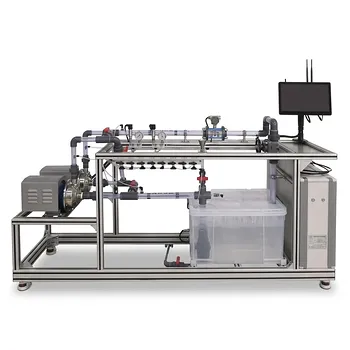
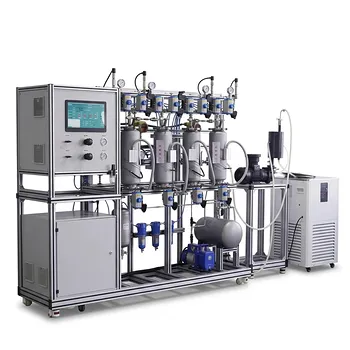
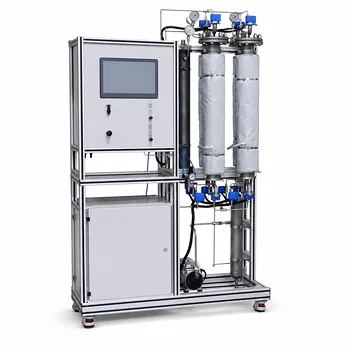
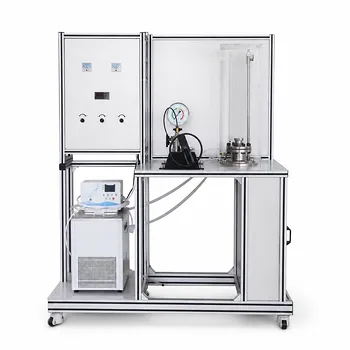
Understanding the real-world performance of reciprocating and centrifugal compressors is vital for the next generation of engineers. LABPARK provides state-of-the-art Educational and Vocational Unit Operations Pilot Plants in chemical engineering, bioprocess & biotech, and environmental & water treatment designed specifically for universities, research institutes, and enterprises.
Equip your students and researchers with hands-on, industrial-scale pilot plants that bring thermodynamic concepts to life. Contact us today to find the perfect educational solution for your institution!
Related Products
- Educational Compression Refrigeration Performance Determination Unit Operations Pilot Plant
- Centrifugal Pump Performance Determination Educational Unit Operations Pilot Plant
- Centrifugal Pump Performance and Orifice Flowmeter Calibration Educational Pilot Plant
- Constant Pressure Filtration Educational Unit Operations Pilot Plant
- Rising and Falling Film Evaporation Educational Unit Operations Pilot Plant
People Also Ask
- In chemical engineering unit operations training plants, how does partial conversion with recycle improve selectivity?
- How should operators and lab engineers resolve material-balance problems? Apply degree-of-freedom analysis
- What process factors must be evaluated when replacing vapor-compression refrigeration? A pilot-plant checklist
- Why Switch Unit Operations Flow Configurations? Impact on Experimental Measurements
- Why is distinguishing between elastic and plastic deformation critical? Prevent tablet capping.