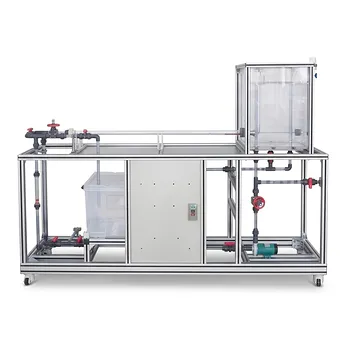
Horizontal baffles are the decisive factor in transforming a fluidized bed from a backmixed vessel into a near-plug-flow reactor. In pilot plant design and operation, horizontal baffles partition the solid catalyst phase into distinct stages, sharply curtailing solid backmixing and enabling the reactor to approximate plug-flow behavior. Vertical baffles, in contrast, cannot stage the catalyst phase or restrict vertical solid mixing, rendering them ineffective for controlling solids residence time distribution. This distinction directly determines whether scale-up data is predictive or misleading.
The fundamental significance of horizontal versus vertical baffles in fluid-bed pilot plants is control over the solids phase. Horizontal baffles physically divide the bed into stages, suppressing the large-scale recirculation that would otherwise destroy plug flow. Vertical baffles, while excellent for breaking swirl in stirred tanks, do not impede the vertical movement of catalyst particles and therefore fail to deliver the staging necessary for scalable, predictable reactor performance.
Why Baffle Geometry is the Decisive Factor
The Problem: Scale-Up Destroys Plug Flow
As fluid-bed reactors are scaled up and vessel diameter increases, solid mixing naturally intensifies. The catalyst phase no longer moves as an orderly plug but engages in vigorous recirculation, carrying already-reacted particles back to the inlet and fresh particles prematurely toward the outlet. This deviation erases the reactor’s intended gradient and can trigger unwanted side reactions or yield losses.
The Role of Baffles in Solids Staging
Pilot plants exist to diagnose and cure exactly these scale-up risks. Baffles are the tool for countering the increased mixing. The geometry of the baffle determines whether it engages with the fluid-like solids phase in a way that resists vertical motion. The primary reference confirms: horizontal baffles succeed in staging the catalyst; vertical baffles do not.
The Physics of Solid Mixing in Fluidized Beds
How Backmixing Undermines Reactor Predictability
In an unbaffled fluidized bed, bubbles and particle clusters rapidly transport solids upward, while a downward dense-phase flow near the walls establishes a large-scale recirculation loop. This results in a broad residence time distribution (RTD), where some catalyst spends far longer in the reactor than others. The RTD curve then shows a tail of early breakthrough and late elution, a hallmark of backmixing.
Why Horizontal Baffles Break the Recirculation Loop
Horizontal baffles act as physical barriers that interrupt the vertical solid fluxes. They segment the bed into multiple compartments, each of which behaves more like a small, well-mixed stage in series. As the number of stages increases, the overall RTD sharpens and converges toward plug flow. This is the core mechanism that makes pilot-plant data relevant for commercial scale-up.
Horizontal Baffles: How They Stage the Catalyst
Creating Discrete Mixing Zones
A horizontal baffle is typically a perforated plate or grid that lets gas pass but imposes a restriction on solids. Solids can still flow through the opening, but the baffle dramatically reduces long-range vertical exchange. The result is that a particle in the bottom stage has a much lower probability of appearing instantly at the top, and vice versa.
Measurable Impact on Residence Time Distribution
Tracer experiments in pilot plants quantify this transition. Without baffles, the cumulative RTD curve shows a gradual, spread-out profile. After installing horizontal baffles, the curve becomes steeper and more symmetrical, signaling that the distribution of catalyst contact times is now tight and controlled. This directly translates into a reduction in side reactions that depend on prolonged exposure.
Bubble Management in the Baffled Bed
Beyond solids staging, horizontal baffles also break up coalescing bubbles. In a fluidized powder, surface tension is nearly zero, so bubbles grow rapidly with height. Large bubbles promote the bypassing of gas and can trigger slugging. A well-spaced horizontal baffle redistributes the gas phase, resets the bubble size, and keeps the bed in a uniform fluidization regime.
Vertical Baffles: Why They Fail to Control Solids Backmixing
The Geometry Mismatch with a Fluidized Solid
In liquid-phase stirred tanks, vertical baffles are essential because they redirect the tangential swirl into axial flow. But a fluidized bed is not a single-phase liquid; it is a gas–solid emulsion with no swirling liquid body to break. The dominant solids motion is vertical, driven by bubbles and gravity. A vertical plate running alongside the wall does nothing to block the upward bouyancy-driven transport of particles through the core of the bed.
Proof from Pilot-Plant Studies
Supplementary references confirm experimental findings: vertical baffles do not successfully stage the catalyst phase or reduce solid mixing. They leave the large-scale recirculation intact. The measured RTD in a vertically baffled fluid bed remains essentially identical to that of an unbaffled bed, and the promise of plug flow remains unfulfilled.
Not a Mixing Tool for Solids
The crucial insight is that the function of a baffle is fluid-system specific. A configuration that is brilliant for liquid mixing can be useless or even detrimental in a gas–solid reactor when solids staging is the goal. Pilot plants that mistakenly apply vertical baffles to a fluid bed will generate RTD data that is misleadingly backmixed, threatening the accuracy of scale-up predictions.
Beyond Staging: Other Performance Factors
Effective Catalyst Volume – Even Baffles Have Limits
Even with properly designed horizontal baffles, the dense catalyst phase may not be fully perfused by the reactant gas. This means not every gram of the physical catalyst holdup actually participates in the reaction. Pilot-plant studies show the effective catalyst volume can be reduced to 50–70% of the physical inventory, even under near-plug-flow conditions. Baffling controls the RTD, but does not automatically guarantee full catalyst utilization.
Preventing the Slugging Regime
A reactor that slugs—where a bubble spans the entire cross-section—loses most of its gas–solid contacting efficiency. Horizontal baffles help by limiting bubble growth, but the body of the vessel itself must also be large enough. Pilot-plant data, interpreted through height-dependent bubble size equations, can predict the minimum vessel diameter required to avoid slugging at the intended throughput. Horizontal baffles then work in concert with this diameter to stabilize the bed.
Understanding the Trade-offs of Horizontal Baffles
Added Pressure Drop and Complexity
Every horizontal baffle introduces a permanent pressure loss. In a pilot plant this may be acceptable for measurement quality, but in a commercial design the cumulative pressure drop across multiple stages can demand larger compressors. The staging benefit must be weighed against the energy and capital cost.
Potential for Solids Maldistribution
Poorly designed baffles—with too large downcomers or insufficient open area—can create dead zones or induce bypassing of solids instead of uniform staging. Pilot plants are the ideal environment to experimentally optimize baffle spacing and geometry so that the staging effect is achieved without inducing flow maldistribution.
Not a Substitute for Proper Diameter
Horizontal baffles cannot rescue a reactor that is fundamentally undersized relative to the volume of gas it must handle. If the bed is already in a bubbling or slugging regime that overwhelms the baffle’s ability to redistribute, the reactor will still perform poorly. The baffle is one element of a coherent hydraulic design.
Making the Right Choice for Your Pilot Plant Objective
Your target determines whether you invest in horizontal baffling and how you interpret the data. Use the following guidelines to align baffle configuration with your scale-up or research goal.
- If your primary focus is generating a predictable, narrow catalyst residence time distribution for scale-up: Install multiple horizontal baffles to stage the bed. This will give you an RTD that can be rigorously modeled as tanks-in-series and will match commercial plug-flow expectations.
- If your primary focus is quantifying the extent of solids backmixing for a given reactor geometry: Start with an unbaffled bed, then run comparative RTD experiments after inserting horizontal baffles. The difference in curve shape directly reveals the mixing you are eliminating.
- If your primary focus is preventing side reactions that depend on prolonged catalyst contact: Staging via horizontal baffles is non-negotiable. Vertical baffles will not reduce the tail of the RTD and will leave your product selectivity vulnerable.
- If your primary focus is studying bubble dynamics and the transition to slugging: Combine horizontal baffles with pressure and voidage measurements. The baffles will allow you to see the bed’s response under larger gas flows without immediately entering slugging, giving you data that is impossible to collect in an unbaffled tube.
- If you are tempted to use vertical baffles because they work in stirred tanks: Resist that temptation for fluidized bed solids staging. The physics differ completely. Vertical baffles will add cost and complexity without delivering the plug-flow behavior your scale-up model requires.
Horizontal baffles are the proven means to stage solids and command the residence time distribution in a pilot-scale fluidized bed. Their decisive advantage over vertical baffles lies in directly interrupting the recirculation that makes scale-up unpredictable — a lesson that, once understood, shapes every successful fluid-bed reactor design.
Summary Table:
| Feature | Horizontal Baffles | Vertical Baffles |
|---|---|---|
| Primary Function | Stages solid catalyst phase | Redirects tangential liquid swirl |
| Solids Backmixing | Suppresses vertical recirculation | Fails to restrict vertical mixing |
| Flow Approximation | Approximates plug-flow | Remains highly backmixed |
| Bubble Control | Breaks up coalescing bubbles | No effect on bubble size |
| Scale-Up Predictability | High; delivers reliable RTD data | Poor; leads to misleading data |
Achieve Reliable Reactor Performance with LABPARK
Designing predictable pilot plant reactors requires precise control over fluidization dynamics. LABPARK provides premium Educational and Vocational Unit Operations Pilot Plants in chemical engineering, bioprocess & biotech, and environmental & water treatment. We help universities, research institutes, and enterprises design and build pilot systems that deliver accurate, scale-up-ready data.
Ready to optimize your chemical engineering lab? Contact LABPARK today to consult with our technical specialists!
Related Products
- Fluidized Bed Gas Solid Catalytic Reaction Educational Pilot Plant
- Multi-Reactor Educational Pilot Plant for Reaction Engineering Unit Operations
- Multi Functional Catalytic Reaction and Reactor Evaluation Educational Unit Operations Pilot Plant
- Fixed Bed Gas Solid Catalytic Reaction Educational Pilot Plant
- Micro-Scale Gas-Solid Catalytic Reaction Educational Pilot Plant
People Also Ask
- Why is the bed height-to-diameter ratio (L/dt) critical? Fluidized bed pilot plant selection guide.
- How do dimensionless numbers guide heat transfer in pilot plants? Optimize Scale-Up
- How is the minimum fluidization velocity (U_mf) determined and utilized? A Unit Operations Guide
- Fixed-Bed vs. Fluidized-Bed Reactor: How to Choose the Right Pilot Plant for Gas-Solid Catalytic Reactions
- How to determine catalyst pore radius & porosity? Optimize your chemical engineering pilot plant.