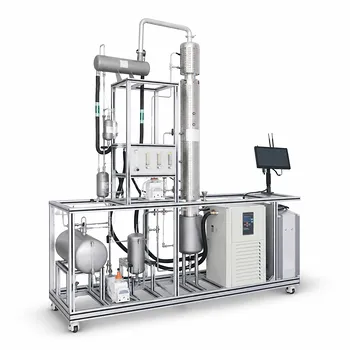
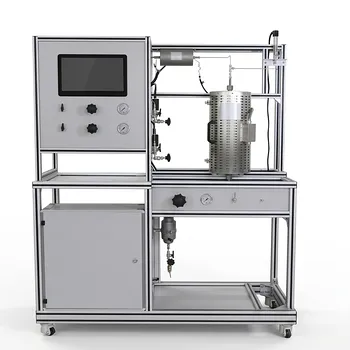
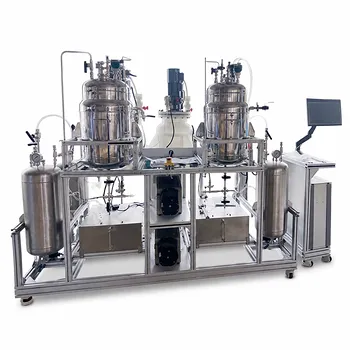
The adjustability of the reflux ratio ($R$) is the single most important experimental variable in an educational distillation pilot plant. It is the primary practical "knob" that turns the abstract mathematical theory of McCabe-Thiele into a tangible, observable reality. By manipulating $R$, students can directly control the slope of the rectifying section operating line, witnessing first-hand how this change dictates the trade-off between a purer product and a higher energy bill.
The core significance of adjustable reflux is that it bridges the gap between thermodynamic equations and physical process outcomes. It allows students to move beyond simply calculating a theoretical reflux ratio to experimentally discovering the economic and operational pinch points of a real separation—demonstrating that in process engineering, no variable is free.
Connecting the Equation to the Experiment
The power of a pilot plant lies in proving theory. The adjustable reflux ratio is the physical manifestation of the McCabe-Thiele operating line equation.
Visualizing the Operating Line
The rectifying operating line’s slope is mathematically defined as $R/(R+1)$. When a student turns a knob to increase $R$, they are literally steepening this line on a live data chart.
This action moves the operating line further away from the equilibrium curve, creating a larger concentration driving force on every tray. The direct, observable result is a measurable increase in distillate purity ($x_D$) without changing the column hardware.
Feeling the Energy Penalty
The relationship $V = L + D$ is no longer just an equation on a whiteboard. By increasing $R$, the liquid reflux flow ($L$) instantly rises.
This forces the reboiler to generate more vapor ($V$) to meet the new internal traffic demand. Students can observe the immediate spike in the reboiler’s heating duty and the condenser’s cooling water flow rate, translating a theoretical operating cost into kilowatts.
The Limits of Purity: Boundary Conditions and Pinch Points
Adjusting $R$ is not a magic wand. A pilot plant’s true educational value emerges when students discover the hard limits of this parameter through direct experimentation.
The Thermodynamic Wall of Minimum Reflux ($R_m$)
The minimum reflux ratio ($R_m$) is a theoretical concept that a pilot plant makes painfully real. As students reduce $R$ towards $R_m$, they observe a pinch zone forming—a section of the column, typically near the feed tray, where the temperature profile flattens.
In this zone, the composition driving force approaches zero. Separation becomes infinitely difficult, and no amount of tray residence time can improve it. This is an unforgettable lesson in a real thermodynamic boundary.
The Physical Ceiling of Flooding
At the other extreme, greedily increasing $R$ to push purity eventually hits a hydraulic limit. The column's internal vapor and liquid loads surge beyond its physical design capacity.
This leads to flooding, a catastrophic state where liquid backs up and massive pressure drops destroy separation efficiency. The pilot plant turns a safe operational guideline into a memorable event with a sharp spike in differential pressure readings.
The Material Balance Handcuff
An adjustable $R$ teaches humility through the overall molar balance. Even at infinite reflux, the maximum possible distillate purity is handcuffed by the ratio of the feed's valuable component flow to the distillate flow ($(F \times x_F)/D$).
You cannot distill more product from the top than you are feeding into the column. The pilot plant proves that separation is a conservation game, not a creation game.
Understanding the Trade-offs
The most profound operational lesson the adjustable reflux ratio offers is the economic balancing act between capital and operating expenditure.
-
The Capital (CAPEX) vs. Operating (OPEX) Conflict: A high $R$ (e.g., $2.0 \times R_m$) requires fewer theoretical stages, meaning a shorter, cheaper column to build. However, this directly increases utility consumption in the reboiler and condenser. A low $R$ (e.g., $1.1 \times R_m$) saves massive amounts on energy but demands a taller, more expensive column with more trays. The pilot plant allows students to map this non-linear cost curve and find the true economic optimum.
-
The Extractive Distillation Trap: A standard pilot plant also prepares students for exceptions. In extractive distillation, where a solvent alters relative volatility, blindly increasing the reflux ratio can be detrimental. A high $R$ dilutes the solvent's concentration on the trays, collapsing the very separation enhancement the solvent was meant to create. This teaches a vital lesson: you must first understand the fundamental mechanism of separation before optimizing a parameter.
Making the Right Choice for Your Goal
Applying the adjustable reflux ratio effectively depends entirely on the objective of the experiment. A clear goal transforms $R$ from a simple control valve position into a strategic process lever.
-
If your primary focus is visualizing theoretical concepts: Start with total reflux to find the true number of theoretical stages in your column. Then, systematically reduce $R$ to watch the pinch zone form and define $R_m$, directly plotting the McCabe-Thiele diagram from live temperature data.
-
If your primary focus is optimizing process economics: Vary $R$ between $1.1$ and $2.0 \times R_m$ and perform a full energy balance at each point. Plot the utility cost against the separation achieved to identify the minimum-cost operating point, proving that the most pure product is rarely the most profitable one.
-
If your primary focus is operator training for hazard recognition: Deliberately push $R$ to an extreme while monitoring the column’s differential pressure. Train operators to correlate the sudden spike in pressure drop with the onset of flooding, teaching them to recognize this dangerous condition before it triggers an automatic shutdown.
The adjustable reflux ratio is fundamentally a tool for teaching disciplined economic and thermodynamic thinking—it is the experimental proof that in chemical engineering, every gain in purity is paid for in thermal energy.
Summary Table:
| Reflux Ratio Setting | Operating / Physical Condition | Key Educational Insight |
|---|---|---|
| High Reflux ($R \to \infty$) | Extreme energy consumption; potential flooding | Illustrates column capacity limits, pressure drop spikes, and high OPEX. |
| Optimal Reflux ($R_{opt}$) | Balanced purity and energy duty | Teaches students how to find the economic sweet spot between CAPEX and OPEX. |
| Minimum Reflux ($R \to R_m$) | Formation of a "pinch zone" | Demonstrates thermodynamic limits where separation driving force approaches zero. |
Bring Chemical Engineering Theory to Life with LABPARK
At LABPARK, we specialize in providing state-of-the-art Educational and Vocational Unit Operations Pilot Plants across chemical engineering, bioprocess & biotech, and environmental & water treatment. Designed specifically for universities, research institutes, and enterprises, our systems feature precise, adjustable parameters like the reflux ratio ($R$) to help students bridge the gap between complex mathematical equations and hands-on operational reality.
Equip your laboratory with reliable, highly illustrative pilot plants that prepare the next generation of engineers. Contact LABPARK today to discuss your custom training needs and receive a tailored proposal!
Related Products
- Continuous Sieve-Plate Distillation Pilot Plant for Unit Operations Laboratory Education
- Multi-Functional Special Distillation Educational Pilot Plant
- Continuous Batch Extractive Distillation Educational Pilot Plant
- Multi-Modal Distillation Unit Operations Training Pilot Plant
- Electrolyte Distillation Purification and Formulation Educational Pilot Plant
People Also Ask
- What are the primary reflux ratio control strategies? Master Distillation Unit Operations
- How to select the right activity coefficient model (Wilson, NRTL, UNIQUAC) for distillation pilot plants?
- How can real-time carbon number prediction improve distillation pilot plants? Optimize control.
- Why is vacuum operation capability an essential feature for a distillation unit operations pilot plant? Unlock Efficiency
- How does catalyst water concentration affect distillation pilot plant design? Key separation train choices.